"Many of us like to ask ourselves, 'What would I do if I was alive during slavery? Or the Jim Crow South? Or apartheid? What would I do if my country was committing genocide?' The answer is, you're doing it. Right now." - #AaronBushnel
"When I was a boy, in post-war Holland, later France, my head was filled with stories of the rise of fascism in the ’30s. I promised myself that I would not be one of those who stands by as neighbors are torn from their homes and imprisoned for somehow being perceived as lesser.
You don’t have to burn the motherfucker down, but are you going to just stand by?" - #WillemVanSpronsen
I remember a point in my life, I don't remember when, that I came to the realization that people in the past weren't really that different from me. I came to the realization that all the evil that we recognize today was once considered acceptable, at least by enough people to not immediately end it.
Once you realize that, you have to realize that for every atrocity in the past there's at least the potential for an analog today. When you look specifically at the evolution of slavery to Jim Crow, you have to acknowledge the possibility that there's *something* similar going on today. Of course, if you know what the 13th Amendment says and you've paid any attention (especially over the last 10 years or so) it's painfully obvious what that analog is.
Every word Aaron said is true, and more. The scale of horror being perpetrated today, where ecocide is a progenitor of genocide globally, has no historical analog because no society has ever had the capacity for this level of atrocity at any point in human history. This is, of course, on top of all the other familiar horrors Aaron referenced.
This can be overwhelming. It is easy to give up, put your head down, and just try to ignore it all. And that's just what most people did during all those other atrocities. But a few people said, "no." Those people did change things for the better.
Let this knowledge be burned into your mind forever. Let this approach shape the way you think about the world. Let this idea guide you until the news fills you with joy and hope instead of rage and despair. Let this idea be your compass.
When one asks the question, "what would I have done," it can be hard to not be overwhelmed by shame when you already know the answer. Willem answered with his actions, "I would do what John Brown did." Aaron answered, "I would do what Thích Quảng Đức did."
If you're not happy with your answer to this question today, you can turn to shame and hide or you can take action and be proud. Shame, in this situation, is selfish and only reinforces itself. But before you turn to action, you need knowledge. While the scale of this time is unique, those who have resisted, those who you join with your action, have been resisting for a *long* time.
Those people attacked plantations from maroon colonies. They built the underground railroad. They hid Jews in their homes, and helped them escape persecution. They bombed Nazi infrastructure. They handed out flyers and were executed for it. They talked to other people. They were beaten by police. They canned food and stored it to remove one bit of leverage from their oppressors. They learned history, learned from their ancestors, and shared their knowledge with anyone who could use it.
This is a long fight and most of the critical things are invisible. It is the invisible labor of organizing and caretaking without which revolutions are impossible.
That work, the hard and invisible work performed mostly by femme socialized and presenting folks, is the work that needs to be done right now. As someone socialized male, it's hard to remember that. I have to keep reminding myself.
Aaron was doing some of that work before he died. With his death he sent a clear message. He reminded us to pay attention to our place in history. This was an important act. But I wonder if the houseless folks he supported were better served by his life or by his sacrifice. No one can answer that question now. We may never be able to answer it.
It can be hard to feel like that's enough because the history we're told excludes those people and the work they do. Maybe we need to learn to tell our own histories.
Keep this in mind when you answer that question for yourself. Most of the people who ever changed things for the better will never have their names in a history book. In building a future worth living in, we need those people more than ever right now. It may never feel like you're doing enough, and that's OK. If we all do what we can, that is enough. It's always been enough, because that's what everyone who's resisted has done... everything they can.
 Abdullah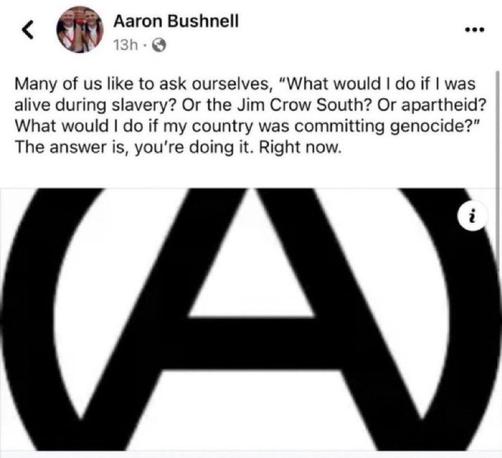
 MMR Nmd

 Steve Leach
 Savannah Worley
 Diligence Jones
 Les capsules du prof Lutz
 hex
hex Nizar Kerkeni 🇹🇳 نزار القرقني