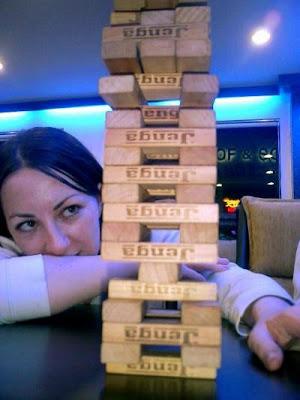
#PSA: #Flirting is like playing #Jenga, and a lot of people don't know how to play Jenga either.
If you're not familiar with Jenga, here's my description: Jenga is a *cooperative*, turn-based game, in which you and one or more willing partners attempt to build anticipation until someone gets too flustered and spills the pieces.
The win condition is:"How long can we maintain that state *just* before the tower falls—when everyone is on the edge of their seats, leaning in, wide-eyed and holding their breath?"
The game is played by taking turns poking around for a good piece and then making a move. Each move raises the stakes *just a little bit*. As tension builds, everyone gets more involved in the game, and when the tower finally topples—regardless of who knocked it over—it should be exciting, fun for everyone, and involve positive aftercare; that's what makes people happy they played with you (and want to play another round).
Some mistakes I see people making when they play:
- forcing the game; not everyone wants to play with you—respect that.
- making "big dick" moves to speed the game up; sure, you *can* make an early goblin move that'll destabilize the tower in the hopes of a quick topple, but if your only goal is to spill blocks, it's better if you just play with yourself at home.
- trying to get the other person to lose; there are plenty of sneaky ways to make the other person more likely to knock the tower over—don't use them—folx won't want to play with you.
- dragging out your turn because you're too afraid to "lose"; it's not as bad as you fear, and if you knock the tower down, as long as y'all're having fun playing, there's nothing stopping you from picking right back up and starting another round.
---
Some mistakes I see people making when they flirt (or engage in any social interaction):
- forcing the interaction; not everyone is open to that kind of attention—respect that.
- making "big dick" moves to speed the game up; sure, you can open with a dick pic or a wolf-whistle, but if your goal is to flirt *at* someone, it's better if you just play with yourself at home.
- trying to get the other person to lose; there are plenty of sneaky ways to make the other person more likely to sleep with you—don't use them—that's coercion at best, and quite possibly sexual assault.
- dragging out your turn because you're too afraid to "lose"; it's not as bad as you fear. If you're genuine, and playing because you want the *other* person to have fun, then most folx will be flattered you made that effort, even if they're not interested in playing a full round.
---
"How do I let someone know I want to play with them?"
> Try complimenting them on something they *put effort into*—"Those are amazing earrings!"
"How do I do that without feeling creepy?"
> Smile, say it, and disengage. If they're receptive, they'll engage you.
"How do I know what to say?"
> Most people are pretty interesting, and most people who want to be interacted with will put out bids for interaction, so look for cues. Are they wearing a cool t-shirt? Is their hair dyed? Have they smiled at you more than once (and you're not a customer)?
"Yeah, but really, how do I know what to say?"
> The game is played by taking turns poking around for a good piece and then making a move. Each move raises the stakes *just a little bit*. When they take a turn, they'll often leave an opening just for you. If they don't, they might also be bad a Jenga, or they're not really into playing with you right now.
"Can you give me examples?"
> Sure.
You're in line at a grocery store, and there's a cute person in line next to you, so you wait until *one* of you is leaving the line. "Your hair is amazing; I love that color blue 😊", then you go back to what you were doing. If they want to play, they'll say something like "thanks, I just dyed it! 🩵" and then wait for you to take your turn again; if they don't want to play, they might just say "thanks" and disengage. If it's your turn again, you might respond "did you have it professionally done? I've been meaning to redye mine 😅" Now it's their turn to respond.
Of course your turns will look different, but each one should take a cue from your partner, and also volunteer a possible move for them to make on their turn.
"My games keep fizzling out, how do I keep them lively?"
> Look for their cues, and leave your own cues for them. Co-op games are about helping your teammates so you can all have the most fun, and *anyone* feels awkward when they don't know what they should do on their turn, so don't leave them hanging.
"How do I let someone know I'd like to play again sometime?"
> Tell them. "I really enjoyed talking to you 😊 and I'd like to do it again if you're interested. Can I give you my Mastodon handle?". If they look confused, just say you're a friend of @alice; that'll probably work.
#Dating #Socializing #Anxiety

 Natasha
  🇪🇺
🇪🇺 🅰🅻🅸🅲🅴 (🌈🦄)
 Dgar
Dgar moanos
 Radio Free Society 🗼
 CrimethInc. Ex-Workers
 David
David