
Christian Diener

71 Followers
104 Following
100 Posts

Lifelong relationship with microbes. Now studying them for a living. 🦠+💻=❤️

#microbiome #metagenomics #ecology #stats

websitehttps://cdiener.com
orcid0000-0002-7476-0868
pronounshe/him
GitHubhttps://github.com/cdiener

📢 New release of AncientMetagenomeDir (v23.09: Historic Centre of Cienfuegos) by the @spaam_community !

https://github.com/SPAAM-community/AncientMetagenomeDir/releases/tag/v23.09.0

💀 #AncientMetagenomeDir is a community curated resource of standardised lists of #metadata of >2000 shotgun-sequenced and publicly available #AncientMetagenome or ancient microbial genome-level enriched samples and >5000 libraries.

Release stats in the thread below 👇

#AncientDNA #palaeogenomics #aDNA #SPAAM #metagenomics

Release v23.09: Historic Centre of Cienfuegos · SPAAM-community/AncientMetagenomeDir

Release v23.09.0 includes 7 new publications, representing 2 new ancient host-associated metagenome samples, 35 new ancient microbial genomes, and 0 new ancient environmental samples. This brings t...

GitHub

There are obviously limitations such as an inability to quantify supplements or very processed foods with little or no DNA, but overall it seems to work quite well and will combine well with marker gene and metabolomics approaches since they are very complementary.
https://www.pnas.org/doi/full/10.1073/pnas.2304441120
https://www.nature.com/articles/s41587-022-01368-1

Many thanks to @gibbological and the ISB for the patience with this long-running project.

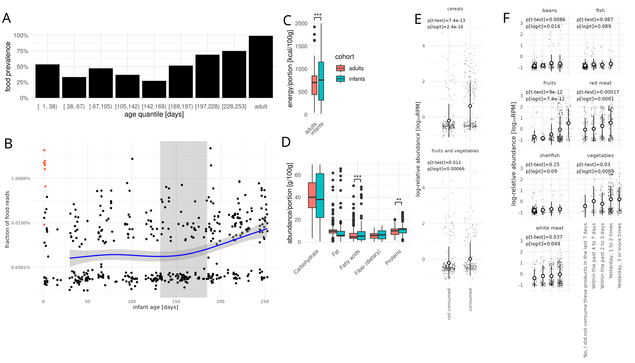
Food genomic material was detected only in about half of infant stool samples but increased at the onset of solid food consumption and was ubiquitous in adult stool samples.

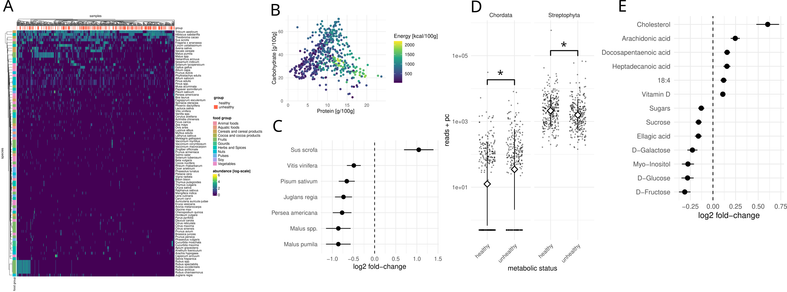
We also ran a proof-of-concept identifying foods and nutrients that were associated with the onset of metabolic disease in an adult cohort.

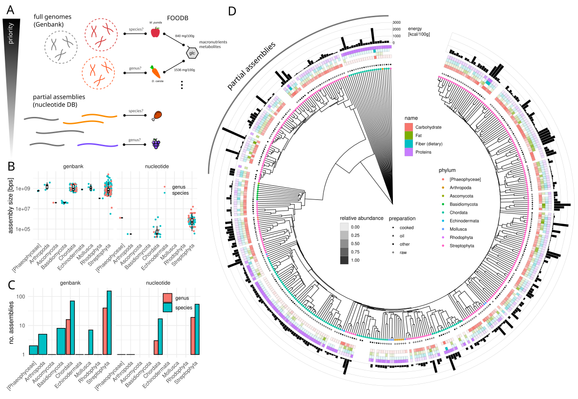
Building a comprehensive genomic database for as many foods in FOODB as possible we could connect individual genomes to nutrient content. For now we can match 77% of all foods in FOODB with taxonomic information and the next version of the database will push this to 90%.

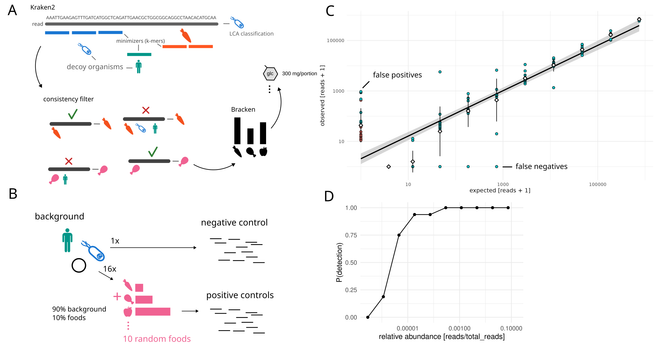
Using a decoy-aware mapping approach with additional consistency filtering we could show good sensitivity and specificity in simulated sequencing samples with a false positive rate around 1-10 reads per million.

Happy to announce that my last preprint from the Gibbons Lab at ISB is now out at https://www.biorxiv.org/content/10.1101/2024.02.02.578701v1 . In the end it took us almost 5 years to make this work well.

Dietary intake is major factor in many studies but is not easy to measure on a fine-grained level. Our idea was to use metagenomic shotgun sequencing of fecal samples to detect and quantify food-derived DNA.

Thrilled to congratulate #MathiasGotsmy on a stellar defense! 🥳

Grateful for the opportunity to have guided you through the start of your academic journey, proud to witness your achievements & excited for a bright future ahead

Huge congrats! 🙌

#phdlife #proudPI #univienna

🐈 ← 💼 Some personal news: Early 2024 I will be joining the faculty of the @medunigraz. It's definitely a bitter-sweet moment leaving the amazing @gibbological lab at ISB, but I am very excited for what comes next and can't wait to work with the great research community in Graz (and Europe). https://www.cdiener.com/posts/meduni-graz/
Some personal news...

It still feels a bit unreal to write this but here it comes. After almost 6 incredible years at the Institute for Systems Biology in Seattle I will join the faculty of the Medical University of Graz early 2024 as an Assistant Professor in Computational Microbiome Science. My lab will be part of The Diagnostic and Research Institute of Hygiene, Microbiology and Environmental Medicine and will operate within the Austrian Cluster of Excellence “Microbiomes Drive Planetary Health”....

Disease-specific loss of microbial cross-feeding interactions in the human gut https://www.nature.com/articles/s41467-023-42112-w
Disease-specific loss of microbial cross-feeding interactions in the human gut - Nature Communications

Gut microbes rely on nutrient exchange for survival, but these cross-feeding interactions remain poorly characterized. Here, Marcelino et al. present a metabolite-exchange scoring system derived from metagenome-scale metabolic models, designed to identify the potential microbial cross-feeding interactions most affected in human diseases.

Nature
The final day of the 2023 ISB Microbiome series will start in 30m. Today we have a symposium packed with amazing speakers, so be there or be ▣. 🦠+💻=💕 Session 1 will feature @cecilia and Lisa Maier. #ISBMicro23 #microbiome @isbsci