Robert Nuske

@rnuske
20 Followers
82 Following
20 Posts
Program Director @ VolkswagenStiftung (opinions are my own) - Open Science, Forestry, Free and Open Source for GIS, Orienteering Sport.

Wir spielen mit offenen Karten - Der FOSSGIS e.V.

Neu auf der #FOSSGIS2026 und ihr kennt den FOSSGIS-Verein noch nicht?
Um 16:30 stellt Jochen Topf von der Koordinierungsstelle den Verein vor und gibt einen Einblick hinter die Kulissen - nicht verpassen! https://pretalx.com/fossgis2026/talk/ULQLYP/

Wir freuen uns außerdem über neue Mitglieder & auf einen Besuch am Stand des FOSSGIS e.V. im Foyer!
Informationen zum Verein https://www.fossgis.de/verein/

#FOSSGIS #OSGeo #FOSS4G #OSM #Geospatial #GIS 

Wir spielen mit offenen Karten - Der FOSSGIS e.V. FOSSGIS-Konferenz 2026

Der Vortrag gibt einen Blick "hinter die Kulissen" für alle, die schon immer mal wissen wollten, wie die Vereinsarbeit gemacht wird. Und für diejenigen, die mitmachen wollen, aber noch nicht so richtig wissen wie und wo.

#FOSSGIS-Konferenz im Livestream

Die #FOSSGIS2026 Konferenz wird auch im Livestream übertragen. Ein tolles Programm erwartet uns in den nächsten 3 Tagen rund um #OpenSource #Geospatial #OpenData #OSM & mehr.

Schauen Sie gerne vorbei.
https://www.fossgis-konferenz.de/2026/programm/

#FOSSGIS2026 #FOSSGIS #OSM #OpenStreetMap

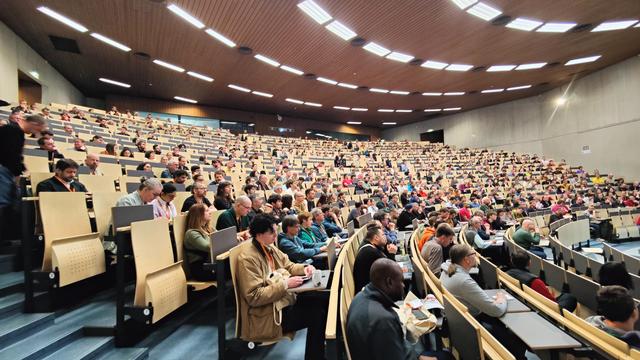
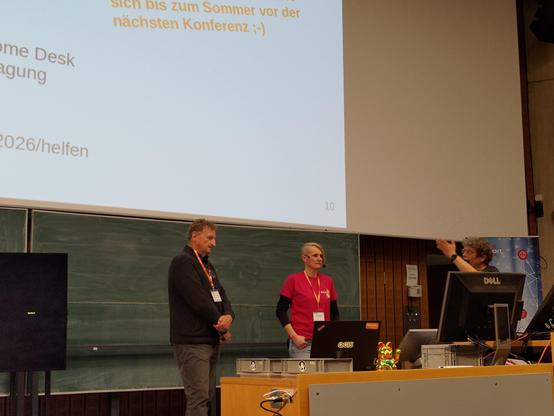
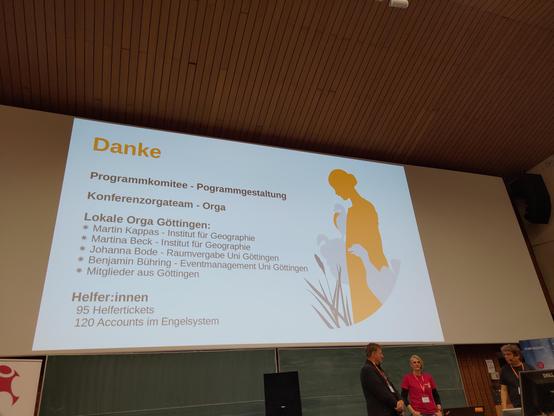
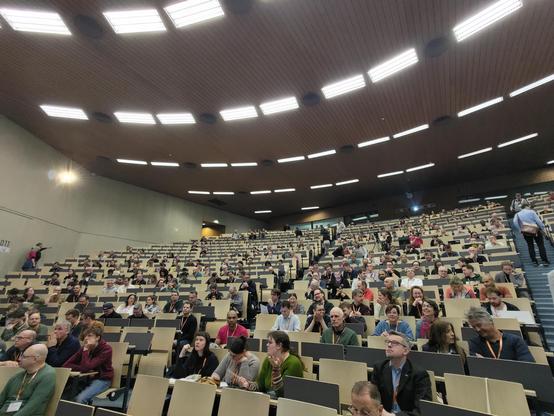
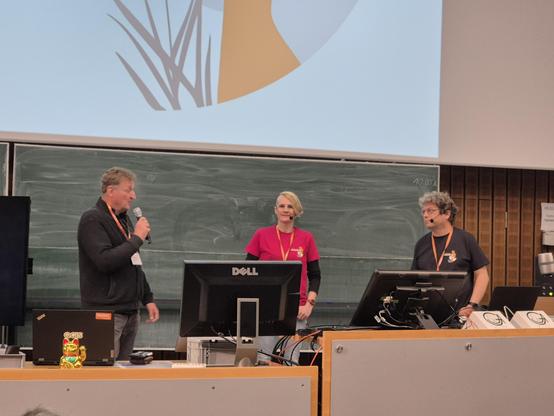
Es geht los - das Programm der #FOSSGIS2026 ist gestartet und der FOSSGIS Verein und unser diesjähriger Gastgeber @unigoettingen begrüßen herzlich alle Teilnehmenden vor Ort und digital!

#FOSSGIS #OSM #OpenStreetMap

🎉 New R package {quaxnat} published on CRAN by Axer, Schlicht & Nuske. Estimation of the natural regeneration potential of tree species.

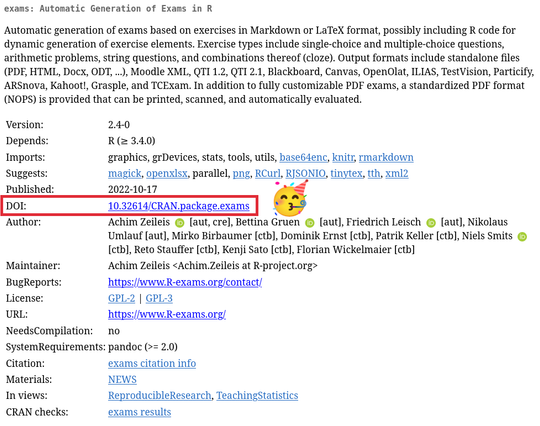
Already benefitting from the brand new CRAN DOI Service: https://doi.org/10.32614/CRAN.package.quaxnat

#rstats #forests #forestry

quaxnat: Estimation of Natural Regeneration Potential

Functions for estimating the potential dispersal of tree species using regeneration densities and dispersal distances to nearest seed trees. A quantile regression is implemented to determine the dispersal potential. Spatial prediction can be used to identify natural regeneration potential for forest restoration as described in Axer et al. (2021) <<a href="https://doi.org/10.1016%2Fj.foreco.2020.118802" target="_top">doi:10.1016/j.foreco.2020.118802</a>>.

A new anothology about the extreme dangers of staying on our current trajectory — global warming of 3 degrees or more. The book includes an important chapter from Mastodon's Stefan Rahmstorf (@rahmstorf).

Best of all it's free to read!
➡️ https://link.springer.com/book/10.1007/978-3-031-58144-1

#Science #Environment #Climate #ClimateChange #ClimateCrisis

3 Degrees More

This open access book shows the consequences of a global warming of +3°C, and details what politically feasible, cost-effective measures should be taken.

SpringerLink

PSA: All #rstats package on #cran will get an official DOI!

This will facilitate bibliometrics and giving credit to  package authors.

Registering all 20,000+ packages will still take a few more days. But the first couple of thousand are already live. Example:

Aktuelle Job-Angebote

Als größter Arbeitgeber in Niedersachsen stehen wir für zukunftssichere Arbeitsplätze in den unterschiedlichsten Fachbereichen und Qualifikationen. Sei dabei!

Karriereportal.de

New paper: "Data science competition for cross-site individual tree species identification from airborne remote sensing data"

TLDR; Predicting common species w/local training data works; rarer species are difficult; same species w/o local training data are harder.

https://doi.org/10.7717/peerj.16578

Data science competition for cross-site individual tree species identification from airborne remote sensing data

Data on individual tree crowns from remote sensing have the potential to advance forest ecology by providing information about forest composition and structure with a continuous spatial coverage over large spatial extents. Classifying individual trees to their taxonomic species over large regions from remote sensing data is challenging. Methods to classify individual species are often accurate for common species, but perform poorly for less common species and when applied to new sites. We ran a data science competition to help identify effective methods for the task of classification of individual crowns to species identity. The competition included data from three sites to assess each methods’ ability to generalize patterns across two sites simultaneously and apply methods to an untrained site. Three different metrics were used to assess and compare model performance. Six teams participated, representing four countries and nine individuals. The highest performing method from a previous competition in 2017 was applied and used as a baseline to understand advancements and changes in successful methods. The best species classification method was based on a two-stage fully connected neural network that significantly outperformed the baseline random forest and gradient boosting ensemble methods. All methods generalized well by showing relatively strong performance on the trained sites (accuracy = 0.46–0.55, macro F1 = 0.09–0.32, cross entropy loss = 2.4–9.2), but generally failed to transfer effectively to the untrained site (accuracy = 0.07–0.32, macro F1 = 0.02–0.18, cross entropy loss = 2.8–16.3). Classification performance was influenced by the number of samples with species labels available for training, with most methods predicting common species at the training sites well (maximum F1 score of 0.86) relative to the uncommon species where none were predicted. Classification errors were most common between species in the same genus and different species that occur in the same habitat. Most methods performed better than the baseline in detecting if a species was not in the training data by predicting an untrained mixed-species class, especially in the untrained site. This work has highlighted that data science competitions can encourage advancement of methods, particularly by bringing in new people from outside the focal discipline, and by providing an open dataset and evaluation criteria from which participants can learn.

PeerJ
Pensoft’s statement on the European Union’s Conclusions on OA scholarly publishing

We are firm supporters of healthy competition that drives innovation and revolutionary technologies, while supporting freedom of choice.

Blog |
Taktile Karten zum Anfassen und große Karten zum Mitnehmen gibt es am #OpenStreetMap #fossgis Stand auf der #makerfaire2023 in Hannover