
Darren Irwin

320 Followers
331 Following
609 Posts
student of warblers, wrens, sparrows, thrushes, goshawks, etc.; Professor at #UBC; opinions my own; celebrating diversity; #BlackLivesMatter; 🏳️‍🌈; he/him; fan of #JuliaLang ; above is a Winter (not Pacific) Wren 🤪
websitehttps://www.zoology.ubc.ca/~irwin/irwinlab/
The Driving W Hypothesis for Low Within-Population Mitochondrial DNA Diversity and Between-Population Mitochondrial Capture https://www.biorxiv.org/content/10.1101/2025.05.31.656024v1?med=mas
The Driving W Hypothesis for Low Within-Population Mitochondrial DNA Diversity and Between-Population Mitochondrial Capture

The fields of evolutionary biology, molecular ecology, genetics, and taxonomy have been profoundly influenced by studies of variation in mitochondrial DNA. Here I propose a hypothesis that will likely contribute to a full understanding of commonly observed differences in patterns of variation in mitochondrial DNA versus phenotypic traits and nuclear autosomal DNA. The Driving W Hypothesis applies to the many taxonomic groups (e.g., birds, butterflies and moths; most snakes; some amphibians, fish, and plants) in which females are heterogametic (i.e., have ZW sex chromosomes). If a W chromosome undergoes a mutation that gives it a transmission advantage in getting into the one egg produced by female meiosis, the driving W chromosome can spread rapidly through a population, carrying along the particular mitochondrial genome that happens to be associated with the driving W. Simulations show that W drivers spread much more rapidly than equivalent-strength Z or autosomal drivers, and that autosomal suppressors of W drive spread at a vastly lower rate. I summarize the logic and evidence in support of the seven components of this hypothesis and conclude that the driving W hypothesis has tremendous potential to explain observations of low within-population mitochondrial diversity as well as cases of "mitochondrial capture" between species. ### Competing Interest Statement The authors have declared no competing interest. Natural Sciences and Engineering Research Council of Canada, RGPIN-2023-04300
bioRxiv

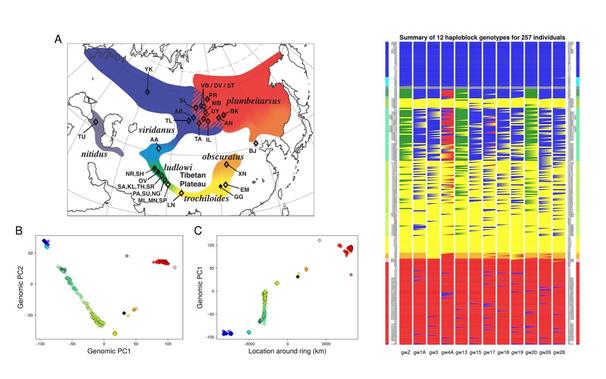
What better way to celebrate St. Patrick's Day than publishing about GREENish Warblers! (and/or reading about them)

https://mastodon.online/@pacific_wren/114179184666806972

Darren Irwin (@[email protected])

Attached: 1 image OK who's ready for some science? Do you like speciation? Genomics? Hybridization? Bioinformatics? Then this is for you: Published today: "The Distribution & Dispersal of Large Haploblocks in a Superspecies" Bonus interest if you like ring species and cute greenish birds: https://doi.org/10.1111/mec.17731

Mastodon

OK who's ready for some science?

Do you like speciation? Genomics? Hybridization? Bioinformatics? Then this is for you:

Published today: "The Distribution & Dispersal of Large Haploblocks in a Superspecies"

Bonus interest if you like ring species and cute greenish birds:

https://doi.org/10.1111/mec.17731

Julia v1.11.4 and v1.10.9 have been released #julialang https://julialang.org/downloads/
Download Julia

Ecology and sexual conflict drive the macroevolutionary dynamics of female-limited colour polymorphisms

Sexual conflict over mating has been documented in many species, both in the field and in experimental studies. In pond damselflies (family Coenagrionidae), sexual conflict maintains heritable female colour polymorphisms, with one female morph typically being a male mimic. However, it is not known whether sexual conflict can also explain the evolutionary origin of female-limited colour morphs, and if so, what ecological factors play a role in this macroevolutionary transition, by modulating the strength of the conflict. Furthermore, the effects of sexual conflict on phylogenetic diversification remain controversial, in particular, whether sexual conflict elevates speciation rates, extinction rates, or both. Here, we use phylogenetic comparative methods to show that female colour polymorphisms are more likely to evolve when population densities at breeding sites are high, and that these demographic conditions are more common at high latitudes and in open landscapes. We show that female-limited polymorphisms typically evolve from sexually dimorphic ancestors through the addition of a male-like female morph, consistent with the hypothesis of selection for male mimicry. Female colour polymorphisms increase both speciation and extinction rates, leading to higher evolutionary turnover of polymorphic lineages. We conclude that female colour polymorphisms evolve in a predictable fashion, and are likely driven by ecological conditions that increase the rate of pre-mating interactions and thus the intensity of sexual conflict. The effects of female colour polymorphisms on extinction differ from previous intraspecific studies and indicate contrasting long-term effects of sexual conflict at micro- and macroevolutionary scales. ### Competing Interest Statement The authors have declared no competing interest.

bioRxiv

I recently developed & taught a 1-credit graduate course titled Computer Programming for Biologists. The students produced some fantastic projects!

For the course & for you, I developed tutorials in the Julia programming language. I share these here:

https://darreni.github.io/JuliaProgrammingForBiologists/

#julialang

Julia Programming For Biologists – JuliaProgrammingForBiologists

I recently developed & taught a 1-credit graduate course titled Computer Programming for Biologists. The students produced some fantastic projects!

For the course & for you, I developed tutorials in the Julia programming language. I share these here:

https://darreni.github.io/JuliaProgrammingForBiologists/

#julialang

Julia Programming For Biologists – JuliaProgrammingForBiologists

Evil's gonna evil.

But what will Good do?

A propos of which, as I mention from time to time: if you're teaching Scientific Writing or will be soon, and would like all my course materials, they're here: https://scientistseessquirrel.wordpress.com/2020/05/26/steal-this-updated-syllabus-for-scientific-writing/
2/2
Steal this (updated) syllabus for Scientific Writing

I wrote this post just after finishing the 3rd go-around of my Scientific Writing course, back in 2020(!), and then updated it in 2021 and 2023. Since then, I’ve developed a one-week intensiv…

Scientist Sees Squirrel

Congrats to PhD Candidate Rashika Ranasinghe on today's publication of her paper "Cryptic Hybridization Dynamics in a Three-Way Hybrid Zone of Dinopium Flamebacks on a Tropical Island."

Happy holidays!

https://doi.org/10.1002/ece3.70716