Mapologies

@mapologies
1.4K Followers
19 Following
391 Posts

Maps and mops are my obsession.

Share & comment to improve our blog:
www.mapologies.com

Support us:
http://ko-fi.com/mapologies

#language 📞 #tvseries 📺 #etymology 🐣 #geography 🌐 #maps 🗺 #history ⏰️ #cartoons 🪅 #art 🎨 #movies 🎥 #linguistics 💬 #philosophy🦉

Our webhttps://mapologies.com/about-us/
Support ushttp://ko-fi.com/mapologies
Instangramhttps://www.instagram.com/mapologiess/
Blueskyhttps://bsky.app/profile/mapologies.bsky.social
@dendroniker Hello! It is the language borrowings: from Latin to Greek, later from Arab to French. Apricots are believed to have originated in Central Asia and China.

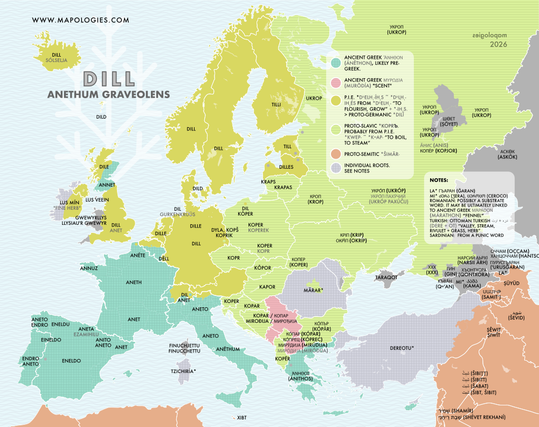
#Dill is an herb originated in North Africa, Iran, and the Arabian Peninsula. The name in these regions is Semitic, such as Arabic شبت (šibitt) and Azerbaijani şüyüd. In Europe the plant’s name falls into three main groups. The first group is Germanic-derived, giving English, German and Swedish "dill". This root also appears in some non‑Germanic languages, for example Latvian dilles.

https://mapologies.com/herbs/

https://mapologies.com/time/#Spring

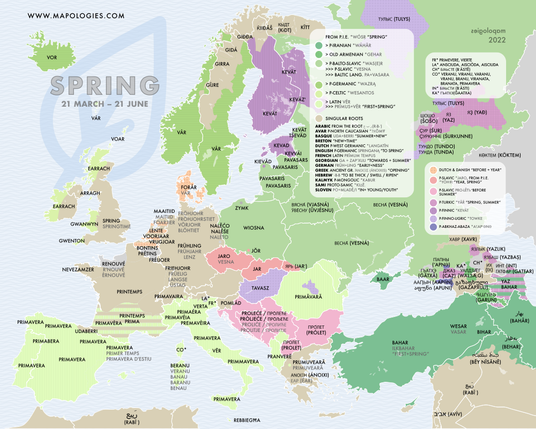
Spring is found in more than fifteen languages. English, among them, employs “spring” to denote the season when vegetation begins to “spring” forth, or emerge. Before its adoption in English, the word was “Lent”, like in Dutch Lente, from Proto-West Germanic *langatīn, literally “longer day” in reference to the lengthening of daylight.

@sjcooke66 right! I should add it to the map. Thanks!
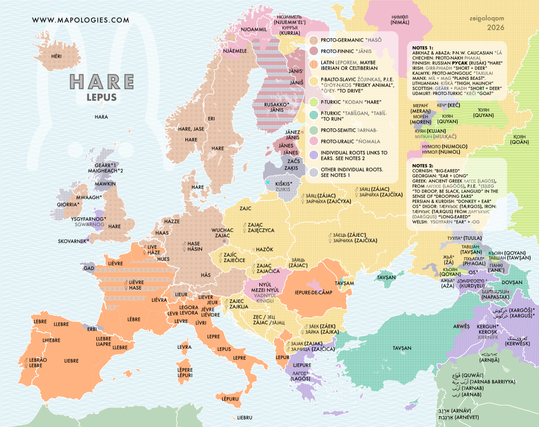
Hares and rabbits are not that easy to distinguish: Do you know the difference?
https://mapologies.com/animals/

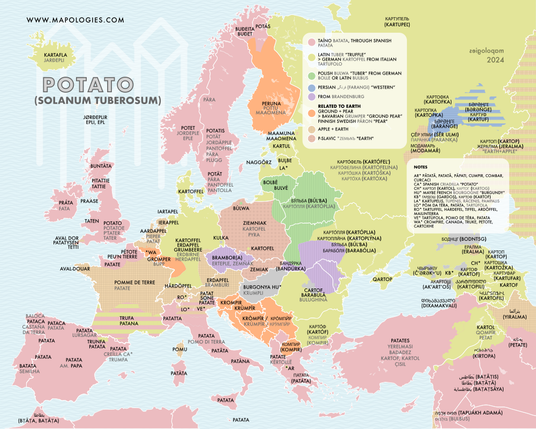
Although now a staple of several European cultures, the potato is not a native plant; it was introduced as patata by the Spanish in the second half of the 16th century following their arrival in the Americas. It was borrowed from the Taíno word batata "sweet potato". As the crop was slowly introduced to the public, this name evolved into the English potato, the Swedish potatis, and the Turkish patates.

https://mapologies.com/roots/

In English, it's commonly referred to as a bathtub, often shortened to bath or tub. In Spanish, the term is quite similar. Just as bathtub is derived from the word bath, in Spanish, we have baño, which has given rise to two terms: bañera and bañadera (the latter being more commonly used in Argentina). Additionally, tina can be translated as vat, jar, or bucket, but it can also mean bathtub.
https://mapologies.com/el-atlas/

It can have many names: Menta, Minze, Menthe, Mjata, but all of them refer to Mint. The origin of this word is Greek: μίνθη (mínthē) or μίνθα (míntha). This name is pretty widely spread but we can find other names on the map: Turkish nane, Macedonian нана (nana) or Arabian نَعْنَاع (naʕnāʕ) looks similar because they shared the same root: Hurrian *an-an-uḫḫə or *an-an-uγə.

https://mapologies.com/herbs/

@fiee yes! My mistake. I delete that one by mistake. But I will add it again
@fiee Is it more like "white root" or "white vegetable root"?