Gregor Reisch

@gregorreisch
11 Followers
78 Following
11 Posts
#EUISS please forgive me for brazenly/shamelessly using your original post on X as a template. And thank you for comissioning this insightful publication on #EU #earlywarning #conflictprevention #forecasting #foresight #prediction #data4peace #data4good !

⚠️ "The EU’s warning system is a good example of successful science-policy cooperation," says @bressansar in the first #EUISS Brief of the year.

Sarah Bressan assesses the effectiveness of the #EU’s #conflictprevention mechanisms and how they can be strengthened.

Find the #EUISS brief here:
https://www.iss.europa.eu/content/power-and-limits-data-peace

The power and limits of data for peace

Preventing violent conflict and fostering peace are the European Union’s main foreign policy goals – particularly regarding its immediate neighbourhood (1). The recent escalation of violence in places like Ukraine, Mali and Sudan begs the question of whether the EU’s conflict prevention mechanisms are effective and how they can be strengthened. To help avoid deadly violence and its consequences in the future, the EU needs to assess where risks for violence loom and how they can be reduced before violence escalates. Since 2012 it has done so with the help of its conflict early warning system (EWS), which has recently been updated as the toolset on EU conflict analysis and early warning. The toolset is one of the rare examples of a system that integrates data-driven conflict forecasting with traditional qualitative and intelligence assessments. The process combines in-depth analysis, political prioritisation, and planning of preventive engagement in countries at risk. In combination with other tools, the system is designed to improve the EU’s efforts towards conflict prevention and peacebuilding outside the Union (2). This Brief analyses the EU warning system’s contribution to conflict prevention and discusses ways to strengthen it. The first section examines the factors that contribute to the success of the system. The second section suggests how the system and the EU’s overall prevention approach can be further improved. Both sections hold lessons for developers of risk assessment and warning systems within and outside EU institutions. The Brief concludes by arguing that the European External Action Service (EEAS) should focus on expanding the methodological toolbox to include innovative foresight approaches. Together with the EU Commission, Member States and other partners, it should strengthen the link between warning and action to make sure analyses translate into meaningful, coordinated prevention.


European Union Institute for Security Studies

Job alert! 👇

Spannende Stelle in #NewYorkCity im Risk Anticipation Hub (RAH) bei @UNDP sekundiert/endsendet für @AuswaertigesAmt durch @ZIF

Data and Risk Analysis Specialist (m/w/d) im UNDP Crisis Bureau

Mehr Infos/Stellenausschreibung:
https://ventus-zif.org/r/z1085okomh7io7l/Data+and+Risk+Analysis+Specialist+mwd+im+UNDP+Crisis+Bureau/USA++Vereinigte+Staaten

UN -- Data and Risk Analysis Specialist (m/w/d) im UNDP Crisis Bureau

Data and Risk Analysis Specialist (m/w/d) im UNDP Crisis Bureau

Interesting paper: "Direction Augmentation in the Evaluation of Armed Conflict Predictions" by @johannes (Johannes Bracher), Lotta Rüter, Fabian Krüger, @sebastianlerch and Melanie Schienle
#Prediction #Forecasting #modelevaluation #conflictprediction
https://arxiv.org/abs/2304.12108
Direction Augmentation in the Evaluation of Armed Conflict Predictions

In many forecasting settings, there is a specific interest in predicting the sign of an outcome variable correctly in addition to its magnitude. For instance, when forecasting armed conflicts, positive and negative log-changes in monthly fatalities represent escalation and de-escalation, respectively, and have very different implications. In the ViEWS forecasting challenge, a prediction competition on state-based violence, a novel evaluation score called targeted absolute deviation with direction augmentation (TADDA) has therefore been suggested, which accounts for both for the sign and magnitude of log-changes. While it has a straightforward intuitive motivation, the empirical results of the challenge show that a no-change model always predicting a log-change of zero outperforms all submitted forecasting models under the TADDA score. We provide a statistical explanation for this phenomenon. Analyzing the properties of TADDA, we find that in order to achieve good scores, forecasters often have an incentive to predict no or only modest log-changes. In particular, there is often an incentive to report conservative point predictions considerably closer to zero than the forecaster's actual predictive median or mean. In an empirical application, we demonstrate that a no-change model can be improved upon by tailoring predictions to the particularities of the TADDA score. We conclude by outlining some alternative scoring concepts.

arXiv.org
We're looking for a part-time #research assistant on crisis early warning, foresight, conflict prediction and evidence-based decision making in #foreignpolicy, based in #Berlin!
Please help spread the word to current and former students
#polsci #polecon #data #Berlinjobs #thinktankjobs:
https://gppi.net/about/jobs-internships/gppi-seeks-a-research-assistant-in-peace-security
GPPi Seeks a Research Assistant in Peace & Security

GPPi is an independent non-profit think tank based in Berlin. Our mission is to improve global governance through research, policy advice and debate.

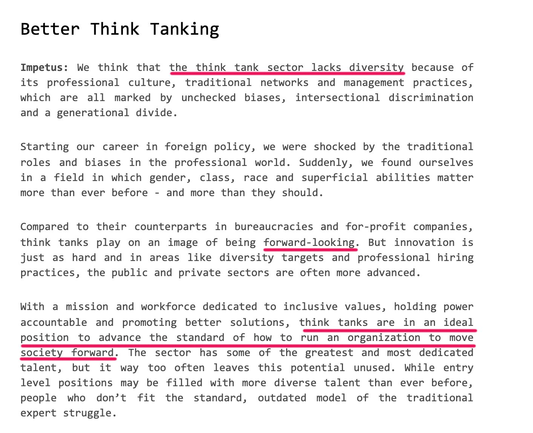
We founded the #BetterThinkTanking movement
because we think the non-profit sector can and should be better
- more inclusive, more effective, more forward-looking.
To get regular inspiration in your inbox, check out our latest newsletter, subscribe, and get in touch 😊 :
https://t.co/aNHXv68Oap
Better Think Tanking #14

Check your privilege

Better Think Tanking
I am really proud that today is my first day as the Associate Vice Provost for Data Science here at Pitt. Bruce Childers (now SCI Dean) and the previous task force members did a great job of identifying the potential for Pitt to innovate a leading, responsible data science programs that engages the entire campus community. The next few years are going to be very exciting! If you have experience building broad data science institutions and programs, please get in touch https://www.datascience.pitt.edu
Home | Data Science

#openaccess article "From academia to policy makers: a methodology for real-time #forecasting of infrequent events" by Alfred Krzywicki, David Muchlinski (Twitter: @DMuchlinski), Benjamin E. Goldsmith (Twitter: @goldsmithbe), Arcot Sowmya in the Journal of Computational Social Science (JCSS)
#conflictprediction #conflictforecasting #machinelearning #masskillings @genocides
👇
https://link.springer.com/article/10.1007/s42001-022-00176-6
From academia to policy makers: a methodology for real-time forecasting of infrequent events - Journal of Computational Social Science

The field of conflict forecasting has matured greatly over the last decade. Advances in machine learning have allowed researchers to forecast rare political and social events in near real time. Yet the maturity of the field has led to a proliferation of diverse platforms for forecasting, divergent results across forecasts, and an explosion of forecasting methodologies. While the field has done much to establish some baseline results, true, consensual benchmarks against which future forecasts may be evaluated remain elusive, and thus, agreed upon empirical results are still rare. The aim of this work is to address these concerns and provide the field of conflict forecasting with a standardized analysis pipeline to evaluate future forecasts of political violence. We aim to open the black box of the conflict forecasting pipeline and provide empirical evidence on how modeling decisions along all steps of the pipeline affect end results. In this way, we empirically demonstrate best practices that conflict forecasting researchers may utilize in future endeavors. We employ forecasts of targeted mass killings and genocides to support our methodological claims.

SpringerLink

Sharing first on Mastodon and on the Slack channel of the Data Visualization Society: “The training wheel approach to teaching visualization” http://www.thefunctionalart.com/2022/11/the-training-wheel-approach-to-teaching.html

#dataviz #infographics #datavisualization #visualization

The training wheel approach to teaching visualization

Every semester I teach my regular introduction to information design and data visualization class ( syllabus here .) Most students are data ...

Great special issue of International Interactions (48:4) is out. It’s the result of a competition to see who could best forecast escalation in ongoing civil conflict. The link leads to a summary article by Hegre, Vesco, and @colaresi, but the whole issue is worth a read. It was fascinating to see how many different approaches people took and what motivated each. @socsciresearch https://doi.org/10.1080/03050629.2022.2070745
Lessons from an escalation prediction competition

Recent research on the forecasting of violence has mostly focused on predicting the presence or absence of conflict in a given location, while much less attention has been paid to predicting change...

Taylor & Francis