Frédérick Madore

218 Followers
177 Following
18 Posts

The panel proposal "Digital Humanities ( #DH ) and
#AI in African Studies: Opportunities, Challenges, and Decolonial Perspectives" that I submitted with Vincent Hiribarren has been accepted for the #ECAS2025. The conference will take place in Prague next year.

https://frederickmadore.com/conference/digital-humanities-dh-and-ai-in-african-studies-opportunities-challenges-and-decolonial-perspectives/

Digital Humanities (DH) and AI in African Studies: Opportunities, Challenges, and Decolonial Perspectives - Frédérick Madore

I am pleased to announce that the panel proposal “Digital Humanities (DH) and AI in African Studies: Opportunities, Challenges, and Decolonial Perspectives” submitted by Vincent Hiribarren and myself has been accepted for the 10th European Conference on African Studies (ECAS). The conference will be held in Prague in June 2025. Further details on the call for papers […]

Frédérick Madore

I'm delighted to announce that my forthcoming book, "Religious Activism on Campuses in Togo and Benin: Christian and Muslim Students Navigating Authoritarianism and Laïcité, 1970-2023" is now listed on the De Gruyter website. It is currently scheduled for publication in March 2025, but we aim to have it published and made available in open access by the end of the year.

This book, based on my research with the Remoboko project at ZMO since 2021, examines Christian and Muslim student associations at the Universities of Lomé and Abomey-Calavi. It explores their resilience over five decades, navigating authoritarianism, political change and laïcité while shaping campus life and offering a "social curriculum". The study offers new insights into the role of faith in public universities and social change in West Africa.

I'm grateful to many people, especially Abdoulaye Sounaye, the project's PI, my colleagues at ZMO, and all the interviewees in Benin and Togo.
https://www.degruyter.com/document/isbn/9783111429182/html

Religious Activism on Campuses in Togo and Benin

The interplay between religion and student activism at the universities of Abomey-Calavi (Benin) and Lomé (Togo) has often been overlooked, although faith-based organisations and student unions have coexisted since the 1970s. Based on interviews with different generations of activists, this book uncovers the neglected history of Christian and Muslim student associations on these campuses, originally strongholds of leftist and secular ideologies. It analyses the emergence of these groups under a Marxist-Leninist regime in Benin and a one-party dictatorship in Togo, and explores the implications of growing religiosity for these public universities as secular institutions. The history of these associations reveals the campus as a microcosm reflecting wider national socio-political life, while also highlighting the importance of translocal factors in shaping the internal dynamics of these groups. Amidst the massification of university enrolments and rising graduate unemployment, faith-based associations have come to provide more than religious guidance. Increasingly, they offer a "social curriculum", providing a space for socialisation and a set of skills, norms and moral values that complement the secular academic curriculum.

De Gruyter

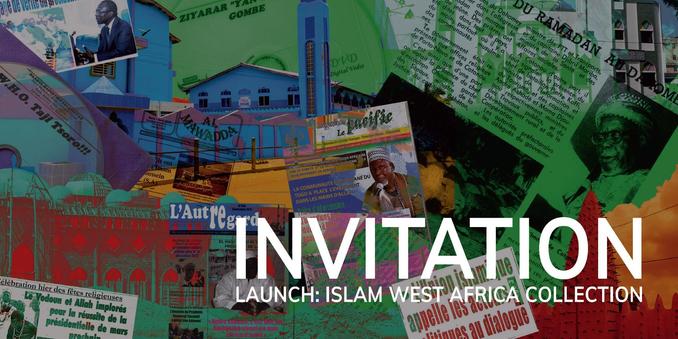
On 9 November 2023, the Leibniz-Zentrum Moderner Orient (#ZMO) will officially launch the "Islam #WestAfrica Collection" (https://islam.zmo.de/s/westafrica/) in Berlin. This project, which I’m directing, is a collaborative, #openaccess digital #database that currently contains over 5,000 archival documents, newspaper articles, Islamic publications of various kinds, audio and video recordings, photographs, and references on #Islam and #Muslims in #BurkinaFaso, #Benin, #Niger, #Nigeria, #Togo and #Cotedivoire.

Far from being the end of a project, this is just the beginning, as the database will continue to grow and will lay the groundwork for future collaborations with other scholars and institutes as more countries may be added.

Mauro Nobili (University of Illinois at Urbana-Champaign, USA), Issouf Binaté (Université Alassane Ouattara, Côte d'Ivoire) and Kai Kresse (ZMO) will comment on the project.

https://www.zmo.de/en/events/launch-islam-west-africa-collection

#omeka #DH

Home · Islam West Africa Collection · IWAC

On 9 November 2023, the Leibniz-Zentrum Moderner Orient (#ZMO) will officially launch the "Islam #WestAfrica Collection" (https://islam.zmo.de/s/westafrica/) in Berlin. This project, which I’m directing, is a collaborative, #openaccess digital #database that currently contains over 5,000 archival documents, newspaper articles, Islamic publications of various kinds, audio and video recordings, photographs, and references on #Islam and #Muslims in #BurkinaFaso, #Benin, #Niger, #Nigeria, #Togo and #Cotedivoire.

Far from being the end of a project, this is just the beginning, as the database will continue to grow and will lay the groundwork for future collaborations with other scholars and institutes as more countries may be added.

Mauro Nobili (University of Illinois at Urbana-Champaign, USA), Issouf Binaté (Université Alassane Ouattara, Côte d'Ivoire) and Kai Kresse (ZMO) will comment on the project.

https://www.zmo.de/en/events/launch-islam-west-africa-collection

#omeka #DH

Home · Islam West Africa Collection · IWAC

Thanks to a generous funding from the Fritz Thyssen Stiftung, our #Remoboko research group is organising its final #conference entitled "#University Campuses in #Africa and Beyond: Training Grounds, Moral Spaces and Political Arenas" at Leibniz-Zentrum Moderner Orient (#ZMO) in #Berlin next week.

This conference seeks to examine how university campuses in Africa and beyond:
1) offer training for various skills and know-how which translate into key assets for the social becoming of students beyond the #campus;
2) become a site of moral activism where competing claims of social good and citizenry lead to projects of self-transformation (individual, collective) and/or even conflicts of norms;
3) feed on various forms of engagements (intellectual, religious, political) while developing their own politics (regional, religious, ethnic, ideological, etc.).

The event will feature 22 papers across 8 panels, a book launch, a photo exhibition and the screening of an ethnographic film.

I'm honored to have received one of the two "2023 Emerging Open Scholarship Award" by the Canadian Social Knowledge Institute (C-SKI) and its partners for my work on the "Islam #BurkinaFaso Collection"! I would especially like to thank Perry Collins, the LibraryPress@UF, the Sahel Research Group and my current institution, Leibniz-Zentrum Moderner Orient (ZMO), for their invaluable support.

I'm already working on the next phase of the project with the creation of a larger collaborative digital database on #Islam in #WestAfrica, which will include material on #CotedIvoire, #Benin and #Togo.

https://etcl.uvic.ca/2023/01/17/2023-open-scholarship-awards/

#openscience #dh #digitalhistory #omeka

2023 Open Scholarship Awards

Sponsored by the Canadian Social Knowledge Institute and its partners For 2023, we are pleased to be able to award 2 Open Scholarship Awards and 2 Emerging Open Scholarship Awards, as well as a num…

Electronic Textual Cultures Lab
#Introduction: Omeka is a set of FOSS web publishing platforms for cultural heritage materials and digital scholarship. Omeka Classic is perfect for smaller projects. Omeka.net is the place to go if you don't want to host your own. And, Omeka S is all linked open data and made for larger ventures.

I don't know how useful this will be, but I've compiled a quick start guide, with lots of screenshots, aimed at #humanities #academics who are #NewToMastodon, trying to cover some of the things I see people most frequently getting stuck on in some less technical language than existing documentation.

I've put it on #HumanitiesCommons open for edits and comments so that other folks can help fill out things like useful hashtags.

https://hcommons.org/docs/mastodon-quick-start-guide-for-humanities-scholars/

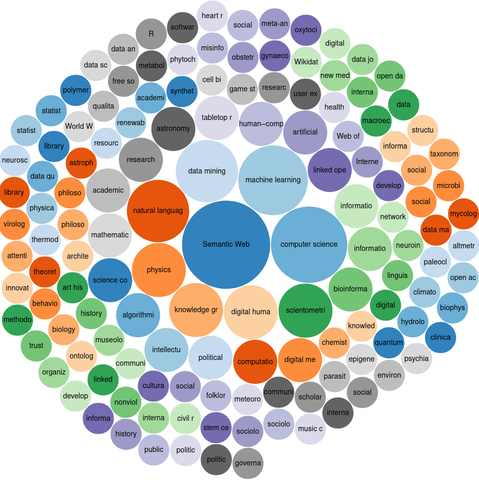
#researchers with a #mastodon account and a known field of work (as known by #wikidata) https://w.wiki/649f

Most represented fields of work:
1 #SemanticWeb
2 #ComputerScience
3 #MachineLearning
Good illustration of the bias in the data ^^

Edit: See also https://mastodon.social/@nemobis@mamot.fr/109333232434584227

RT @Adam_Crymble
Great to see @RoyalHistSoc asking what the digital era has done to our profession, with @ianmilligan1 providing the first perspective: https://blog.royalhistsoc.org/2022/11/30/we-are-all-digital-now-1/
Historical Research in the Digital Age – Part 1: ‘We Are All Digital Now’ | Historical Transactions