cR0w
cR0w 
 🏴☠️
🏴☠️Are you interested in adding 829,667,502 IPv4 curated addresses to your block lists?
You're in luck.
Are you interested in adding 829,667,502 IPv4 curated addresses to your block lists?
You're in luck.
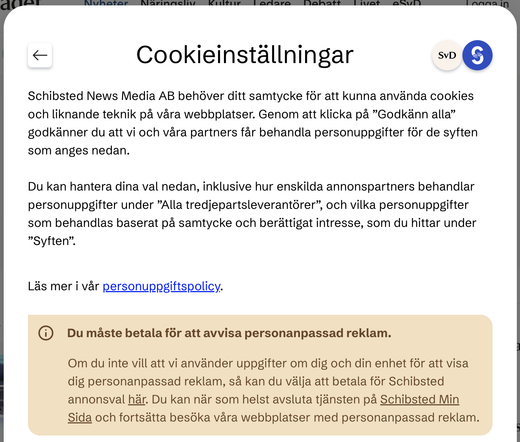
Nu har Aftonbladet och SvD börjat ta betalt av besökare som inte vill bli spårade eller få personuppgifter delade med Schibsteds 40 partners.
Blockera följande domäner i Ublock Origin eller Brave för att slippa rutan.
cmp.aftonbladet.se
cmp.svd.se
“Saudi Leader Is Said to Push Trump to Continue Iran War in Recent Calls
Crown Prince Mohammed bin Salman sees a “historic opportunity” to remake the region, according to people briefed by U.S. officials on the conversations.”
Send your own troops, you murdering bastard…
https://www.nytimes.com/2026/03/24/us/politics/saudi-prince-iran-trump.html?smid=nytcore-ios-share
RE: https://mastodon.social/@MozillaAI/116279201448628866
All we wanted was a browser. All you had to do was build a browser. You had one job.
"The Maven Smart System is the platform that came out of those exercises, and it, not Claude, is what is being used to produce “target packages” in Iran. There are real limits to what a civilian like myself can know about this system, and what follows is based on publicly-available information, assembled from Palantir product demos, conferences, as well as instructional material produced for military users. But we can know quite a bit. The interface looks like a tacticool, dark mode send-up of enterprise software paired with the features of geospatial application like ArcGIS. What the operator sees are either maps with GIS-like overlays or a screen organized like a project management board. There are columns representing stages of the targeting process, with individual targets moving across them from left to right, as in a Kanban board.
Before Maven, operators worked across eight or nine separate systems simultaneously, pulling data from one, cross-referencing in another, manually moving detections between platforms to build a targeting case. Maven consolidated and orchestrated all of these behind a single interface. Cameron Stanley, the Pentagon’s chief digital and AI officer, called it an “abstraction layer,” a common term in software engineering, meaning a system which hides the complexity underneath it.16 Humans run the targeting and the ML systems underneath produce confidence intervals. Three clicks convert a data point on the map into a formal detection and move it into a targeting pipeline. These targets then move through columns representing different decision-making processes and rules of engagement. The system evaluates factors and presents ranked options for which platform and munition to assign, what the military calls a Course of Action. The officer selects from the ranked options, and the system, depending on who is using it, either sends the target package to an officer for approval or moves it to execution.
The AI underneath the interface is not a language model, or at least the AI that counts is not. The systems that detect targets in satellite imagery, fuse data from radar and drone footage, and track objects across multiple intelligence sources are computer vision and sensor fusion.17 They predate large language models by years. Neither Claude nor any other LLMs detects targets, processes radar, fuses sensor data, or pairs weapons to targets. LLMs are late additions to Palantir’s ecosystem;they were added in late 2024, years after the core system was operational, “AIP” was added as a natural language layer that summarizes documents or constructs and answers queries.18 When Anthropic was blacklisted, the Pentagon signed a replacement contract with OpenAI within hours. Replacing one language model with another is often just a simple configuration change, all you really have to do is change the API endpoint.
The language model was never what mattered about this system. What mattered was what Maven did to the process: it consolidated the systems, compressed the time, and reduced the people. That is not a new idea. The United States military has been trying to close the gap between seeing something and destroying it for as long as that gap has existed, and every attempt has produced the same failure. Maven may not even be the most extreme case."
Den här debattartikeln var riktigt bra!
”Skillnaden mellan olika samhällsgrupper i Sverige är den största vi har observerat – i hela världen. Sveriges miljardärer har orimliga privilegier. De betalar bara en tredjedel så mycket i skatter och avgifter som den övre medelklassen.”
Det här borde alla inse att det är åt helvete.
https://www.dn.se/varlden/stjarnekonomen-miljardarer-i-sverige-har-orimliga-privilegier-behovs-ny-skatt/
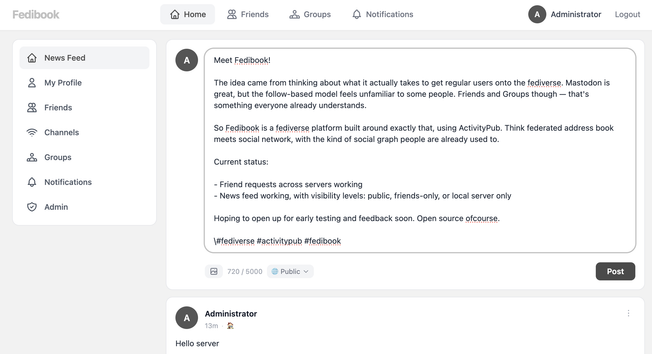
Meet Fedibook!
The idea came from thinking about what it actually takes to get regular users onto the fediverse. Mastodon is great (i love it), but the follow-based model feels unfamiliar to some. Friends and Groups though — that's something everyone already understands.
So Fedibook is a fediverse platform built around exactly that, using ActivityPub. Think federated address book meets social network, with the kind of social graph people are already used to.
Current status:
- Friend requests across servers working
- News feed working, with visibility levels: public, friends-only, or local server only
Hoping to open up for early testing and feedback soon. Open source of course.

 Karl Emil Nikka
 Sam Litzinger
 4am ❧
4am ❧ Adfichter
 Dagens ETC
 Nuke
Nuke
 Karolina
 Rasmus Sindum
 Lyn
Lyn