 Cat 🐈🥗 (D.Burch)
Testing please ignore
Love it when the centrifuge gets to the angry part... LET IT OUT GIRL!
| Main (InfoSec)🐈 | https://infosec.exchange/@catsalad |
| 🔺🥗 | https://sakurajima.moe/@catsalad |
| 🔻🥗 | https://sechtor.social/@catsalad |

Love it when the centrifuge gets to the angry part... LET IT OUT GIRL!
| Main (InfoSec)🐈 | https://infosec.exchange/@catsalad |
| 🔺🥗 | https://sakurajima.moe/@catsalad |
| 🔻🥗 | https://sechtor.social/@catsalad |
RE: https://infosec.exchange/@mttaggart/113694884783855934
It's 2026 now. Boost if you're ready to destroy genAI entirely.
The Nobel Prize in Physics goes to John Hopfield & Geoffrey Hinton for work in machine learning and neural networks.
Here's why that research qualifies as physics (it's also a fascinating read):
https://www.nobelprize.org/prizes/physics/2024/popular-information/ #science #physics #nobel #tech

New guide: What's in your Covid Emergency Kit?

When deciding what material to use for infrastructure projects, metals are often selected for their durability. However, if placed in a hydrogen-rich environment, like water, metals can become brittle and fail. Since the mid-19th century, this phenomenon, known as hydrogen embrittlement, has puzzled researchers with its unpredictable nature. Now, a study published in Science Advances brings us a step closer to predicting it with confidence.
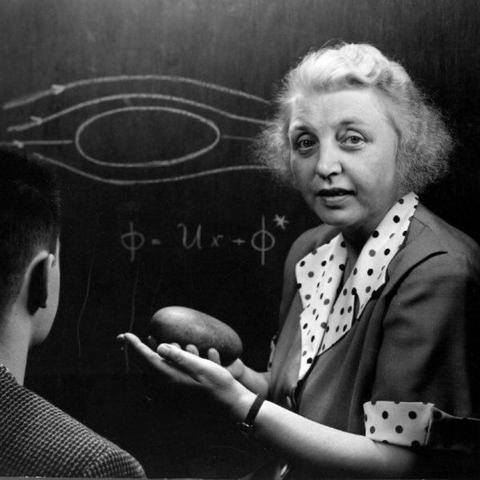
Aerodynamics engineer and mathematician Irmgard Flügge-Lotz was born #OTD in 1903.
She advanced the understanding of aerodynamic pressure on wings and turbine blades, pioneered the theory of discontinuous control systems, and was the first woman named full professor of engineering at Stanford.
 Taggart
 cR0w
cR0w 
 🏴☠️
🏴☠️
 Corey S Powell
 Violet Blue
 Ed
Ed Science Scholar
 Robert McNees