
Alex Hernandez-Garcia

157 Followers
92 Following
10 Posts
Postdoc at Mila, the Québec AI Institute
· ML for scientific discovery against climate change, ML and comp. neuroscience · Open Science · he/él/il #BlackLivesMatter #нівійні
Websitehttps://alexhernandezgarcia.github.io
Climate changehttps://thisclimatedoesnotexist.com
AI Helps Ukrainehttps://aihelpsukraine.cc/
Based inTiohtià:ke / Montréal

The strain on scientific publishing 📄:

The publishing sector has a problem. Scientists are overwhelmed, editors are overworked, special issue invitations are constant, research paper mills, article retractions, journal delistings… JUST WHAT IS GOING ON!?

Myself, pablo, @paolocrosetto and Dan have spent the last few months investigating just that.
https://arxiv.org/abs/2309.15884

A thread🧵1/n

#AcademicChatter #PublishOrPerish #Elsevier #Springer #MDPI #Wiley #Frontiers #PhDAdvice #PhDChat #SciComm

The strain on scientific publishing

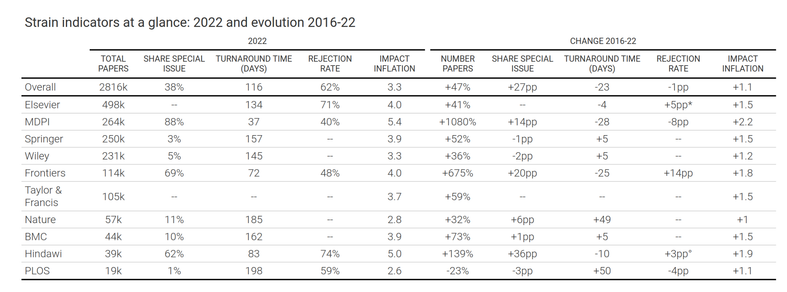
Scientists are increasingly overwhelmed by the volume of articles being published. Total articles indexed in Scopus and Web of Science have grown exponentially in recent years; in 2022 the article total was approximately ~47% higher than in 2016, which has outpaced the limited growth - if any - in the number of practising scientists. Thus, publication workload per scientist (writing, reviewing, editing) has increased dramatically. We define this problem as the strain on scientific publishing. To analyse this strain, we present five data-driven metrics showing publisher growth, processing times, and citation behaviours. We draw these data from web scrapes, requests for data from publishers, and material that is freely available through publisher websites. Our findings are based on millions of papers produced by leading academic publishers. We find specific groups have disproportionately grown in their articles published per year, contributing to this strain. Some publishers enabled this growth by adopting a strategy of hosting special issues, which publish articles with reduced turnaround times. Given pressures on researchers to publish or perish to be competitive for funding applications, this strain was likely amplified by these offers to publish more articles. We also observed widespread year-over-year inflation of journal impact factors coinciding with this strain, which risks confusing quality signals. Such exponential growth cannot be sustained. The metrics we define here should enable this evolving conversation to reach actionable solutions to address the strain on scientific publishing.

arXiv.org

🔥 🌍 The climate crisis is not a technical problem to be fixed by engineers, but a predicament we all have to face. This interactive flowchart by Andrew Boyd and Jona Pomerance is an invitation to hear the impossible news and navigate the implications:

👉 https://flowchart.bettercatastrophe.com

Please, give it a go, share your feedback and pass it on! It is an experimental prototype: We are curious to hear what you think.

#BetterCatastrophe #ClimateCrisis #ClimateAction #DataVis #Storytelling #InterfaceDesign

I Want a Better Catastrophe · Flowchart

A flowchart for navigating our climate predicament

If you are at #ICML23 and want to learn about GFlowNets or generative models for scientific discovery, go talk to my co-authors at the poster sessions today!

- A theory of continuous generative flow networks (11 am now!) https://arxiv.org/abs/2301.12594
- Multi-Objective GFlowNets (2 pm) https://arxiv.org/abs/2210.12765

A theory of continuous generative flow networks

Generative flow networks (GFlowNets) are amortized variational inference algorithms that are trained to sample from unnormalized target distributions over compositional objects. A key limitation of GFlowNets until this time has been that they are restricted to discrete spaces. We present a theory for generalized GFlowNets, which encompasses both existing discrete GFlowNets and ones with continuous or hybrid state spaces, and perform experiments with two goals in mind. First, we illustrate critical points of the theory and the importance of various assumptions. Second, we empirically demonstrate how observations about discrete GFlowNets transfer to the continuous case and show strong results compared to non-GFlowNet baselines on several previously studied tasks. This work greatly widens the perspectives for the application of GFlowNets in probabilistic inference and various modeling settings.

arXiv.org
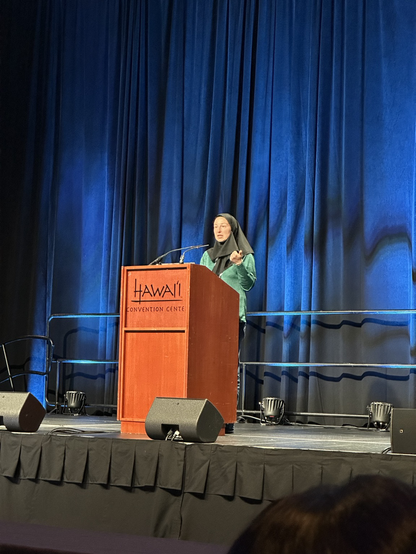
@MarzyehGhassemi speaking about ‘Taking the Pulse of Ethical ML in Health’ as the first keynote of #ICML2023 🤩 Have diverse data, audit models, deploy fair advice. So many insights in the progress on ML and Health. 👏👏

Are you attending #ICLR2022? Would you like to learn about ClimateGAN, the deep learning algorithm behind https://thisclimatedoesnotexist.com which simulates flood images on street photos to raise climate change awareness?

We'd love to see you at our poster!

Spot G3: Th 28.04 at 5:30 pm UTC

10:30 am PST · 1:30 pm EST · 7:30 pm CEST/CAT

ThisClimateDoesNotExist.com

Our AI-driven tool allows you to visualize the impacts of climate change on your home. For the planet to survive the climate crisis, we need to act as though our homes were directly affected.

This Climate Does Not Exist

#introductions

My name is Alex Hernandez-Garcia and I am currently a postdoc at Mila, the Québec AI Institute, and the Université de Montréal. I work with professors Yoshua Bengio and David Rolnick on applications of machine learning for scientific discoveries to fight climate change.

I grew up in Madrid (Spain) and did my PhD in Berlin and Osnabrück (Germany) working at the intersection of deep learning and computational neuroscience.

It's wonderful to be here and see some action!