We have now put the ESP32 Microscope design on printables as well:


Assistant professor in BioNanoTechnology
WUR (Wageningen, the Netherlands)
(ex kieluni, univgroningen, UninaIT).
Tech + Chem = microfabrication, 3D printing, Sensors and Devices.
Nerd, gamer, and bad artist
| Lab Website | https://www.wur.nl/bnt/ |
| ORCiD | https://orcid.org/0000-0001-7196-602X |
| Google Scholar | https://scholar.google.com/citations?user=AlppnJ4AAAAJ&hl=en |
| Youtube | https://www.youtube.com/c/vsaggiomo/about |
We have now put the ESP32 Microscope design on printables as well:
Back on the microfluidic. Detection of #microplastics from water? No problem! Our microfluidic can filter and size-sort them in a single flush. Add nile red and check if they are plastic or something else. Red=plastic, black=not plastic.
Identification of #Zooplankton? Once more, not a problem. Fill a syringe from a pond, flush the liquid on the microfluidics, and boom, zooplankton is size sorted in the device, ready for identification (thanks @ReynaudEmmanuel :))


#Schistosomiasis is a neglected tropical disease (#NTD); one diagnosis is finding the parasite egg in urine. It can be as low as one egg in one liter. We can use our microfluidic to find and identify the egg using cheap microscopes.
How cheap, you ask? Same question I asked @beniroquai: “what’s the cheapest microscope we can do for this detection?” And so the #ESP32 #microscope was born. Less than 10€, mostly 3D printed, wifi, and fully open: https://github.com/Matchboxscope/Matchboxscope/blob/master/Matchboxscope.md


Do you know those annoying layer lines on #3Dprinted parts? In resin #3Dprinters, they are as small as 25 microns… And we can make #microfluidics molds with these printers. Does this mean we can reach 25 microns features in Z?
YES! We can make a mold for a “staircase” microfluidic device. Now we have steps of 25um on the height of the channel. This #microfluidic does not only filter #microparticles, but also size-sort them. Particles of different sizes will be blocked on different steps.


Can you use standard #3Dprinters to make #microfluidics for separating #microparticles down to 25 micrometers? Spoiler alert: YES we can on a “staircase microfluidic device”
But why and how? Paper here: https://chemrxiv.org/engage/chemrxiv/article-details/63fb0342937392db3d1126e6 1/12
#Microparticles, from tens to hundreds of micrometers, are everywhere: parasite eggs in urine, #microplastics in water, #plankton, etc. You need to filter or centrifuge quite some litres of liquids to detect them. Not nice if you are in the field. 2/12
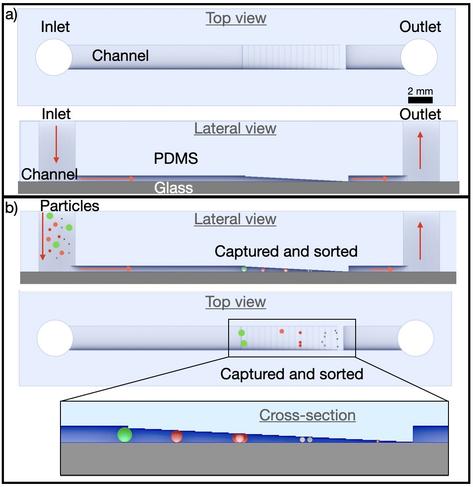


Microparticles are ubiquitous and span from living matter to microplastics to inorganic materials. Their detection and identification must be more accessible and time efficient. Microfluidic devices can filter microparticles from liquids, but fabricating microfluidics with lateral resolutions of a few tens of microns is complex, lengthy, and outside the reach of most scientists researching microparticles. In this article, we show how to use height features in a channel instead of relying on lateral elements for separating particles. The height features can be as small as 25 µm, along the Z axis, using consumer-grade 3D printers. We show the potential of such microfluidic devices for size-sorting parasite eggs such as Schistosoma haematobium, microplastics, and zooplankton.
And let’s start the #PizzaOfMastodon #ChemistsWhoCook
That’s my pizza salsiccia e friarielli :)