 KiCad
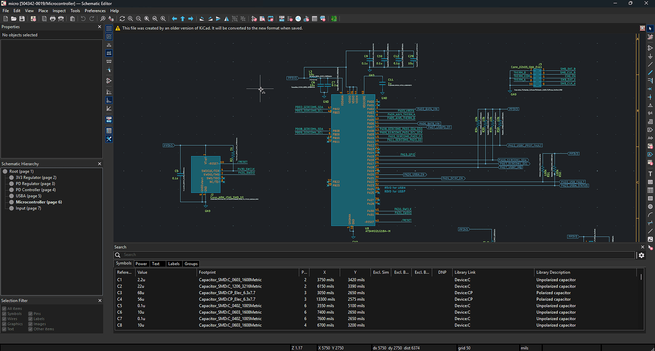
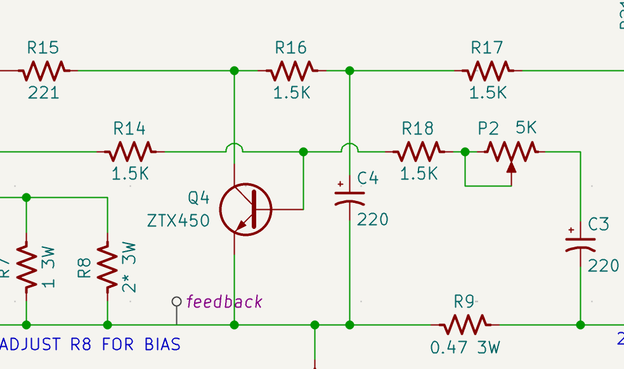
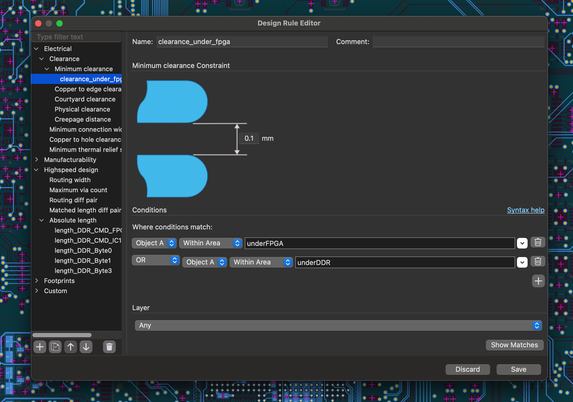
KiCadKiCad version 10 is out today! Lots of features, lots of speed. We hope you like it. https://www.kicad.org/blog/2026/03/Version-10.0.0-Released/

Apartment dwelling ham radio nerd from Sweden. Licensed since 2019 and a youth member of SSA.
I like electronics and reading fiction.
Mostly lurking around here
I'm here for #hamradio and #electronics content
| Pronoun | He/Him |
| QTH? | Sweden |
| Website | No |
Hi Folks! I'm Erica and although I'm not new to mastodon in general, I am new to mastodon.radio. I wanted to establish a home to post stuff specific to Ham Radio and occasionally retro electronics. I'm most active on CW and the Digital modes with most of my focus on VHF and Satellite at the moment. Great to meet you all!
> This design probably hits the record of simultaneous use of TI parts in a single device.
*looks inside*
> Figure 2-1. 100-kV Reference Voltage
It said high-voltage reference on the tin. I expected high-voltage, just not 100kV.
For those reading along from a safe distance: https://www.ti.com/lit/an/sbaa203b/sbaa203b.pdf
I've recently used insights from this article to implement a sample rate step size 128 times smaller than previously supported in HackRF:
https://www.pa3fwm.nl/technotes/tn42a-si5351-programming.html
This means that sample rates around 20 Msps can be adjusted in steps of about 0.015 Hz. The precision is even better at lower sample rates.
I highly recommend reading it if you use #Si5351 in any projects. #Si5351A #Si5351B #Si5351C
KiCad version 10 coming soon with some exciting new features including new importers!
https://www.kicad.org/blog/2026/02/Three-New-Importers-in-KiCad-10-Allegro-PADS-and-gEDA/

RF people: I'm looking to pick up an RF power sensor for my lab some time in probably Q2 2026.
Primary function: traceable reference for RF amplitude that I can use for flatness/level calibration of other equipment. I'm trying to move away from having a third party lab calibration on every piece of equipment because the local labs aren't that great and shipping equipment is disruptive and expensive.
Instead, I want a handful of transfer standards that I can send (along with easily-shippable small items like torque wrenches which also tend to drift over time) to a third party lab, then calibrate all of my other equipment against them. For example, I can use the power sensor to do level correction on my Siglent SSG then apply a calibration signal from it to a scope with a known amplitude and verify gain/flatness of the scope that way.
But over time, I expect to be using it for unspecified future RF purposes as well as I do various other projects.
I've pretty much settled on the R&S NRP series USB power sensors (among other things the SSG has native support for it in firmware).
And I want the 18 GHz version since that covers the main frequency range of interest to me.
So the question is, which one to get? There's the NRP18A (average power, 8 kHz - 18 GHz, -70 to +23 dBm), the NRP18T (thermal, true DC - 18 GHz, -35 to +20 dBm), and the NRP18S (3-path diode, 10 MHz - 18 GHz, -70 to +23 dBm).
Good news? In my open source oscilloscope project??
https://www.crowdsupply.com/eevengers/thunderscope/updates/dev-edition-production-begins
Wow, TI is acquiring Silicon Labs!
 Erica, W7WXR
 Cosmic Meow Background
 Megan KD3CPY
 Michael Ossmann
 Andrew Zonenberg
 Aleksorsist
 Ben
Ben Graham Sutherland / Polynomial