Journal of Exp Biol

7 Followers
499 Following
152 Posts
Journal of Experimental Biologyhttps://journals.biologists.com/jeb

Damaged neurons repair #axons, but it wasn't clear whether the axons of damaged ciliated #neurons in #insects could also recover. Melissa Rolls & colleagues have discovered that insect ciliated neurons do recover, even if the axon is severed close to the cell body, and they use the same mechanism for recovery as conventional neurons

#neuroethology #zoology #entomology #biology

https://journals.biologists.com/jeb/article/226/12/jeb246176/318020

To read the full research go to https://journals.biologists.com/jeb/article/226/12/jeb245717/318059
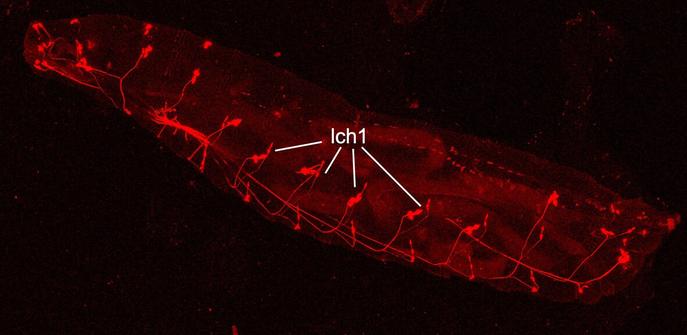
Damaged insect ciliated neurons regrow axons as effectively as other neurons

Most animal neurons pick up information through branching structures, called dendrites, before sending sensory signals to the neuron's axon, which then passes the signal to the central nervous system for processing. But not all neurons are constructed this way. The neurons of many invertebrates pick up sensory signals through slender structures called cilia, which can communicate the senses of vision, smell and body position. While the damaged axons of conventional neurons are capable of regeneration, no one knew whether injured ciliated neuron axons could recover. As Drosophila larvae are packed full of sensory ciliated neurons and the insects come complete with a box of molecular tools – which allows researchers to answer specific physiological questions – Melissa Rolls and her colleagues, Michelle Stone and Abigail Mauger, all from Pennsylvania State University, USA, decided to find out whether the severed axons of Drosophila larva ciliated neurons could recover and, if so, how.But first the trio had to select the ideal type of neuron for their experiment. Realising that they would require one that was close to the surface of the larva's body, so they could see it with ease, they selected the lateral monoscolopidial chordotonal organ (lch1), which projects cilia into the side of the larva and detects stretching as it moves. Then, the team severed several lch1 axons with a high-precision UV laser, to be sure that the neuron could survive the injury. Fortunately, 24 h after the procedure, the neurons were still alive. Cutting them had not been fatal, but could they regrow a new axon?Cutting the lch1 axons of 33 larvae near the tip – 70 μm along the length of each – the team was impressed to see that more than half of the severed axon stumps regrew, with some re-joining the same bundle of nerves, while others joined a different nerve nearby, just like the regrowing axons of neurons with dendrites. But what would happen if a ciliated neuron's axon was removed entirely, after being severed close to the cell body at the heart of the neuron? Could the ciliated neuron recover from this more severe damage?Impressively, yes. Almost all of the severed ciliated neurons began sprouting new structures called neurites – which can eventually grow into axons – 96 h later and they did this from different locations on the neuron, including the cell body, the remaining axon stump and even the base of the sensory cilium. The team admits that this was surprising, as conventional neurons regrow axons from the base of dendrites. In addition, newly grown axons from neurons with dendrites follow the path of other axons and are unbranched, whereas the ciliated neuron's regrown neurites were branched. And when the team checked whether the ciliated neurons were using the same cellular mechanism as conventional neurons to trigger neurite growth, they found they were, even though the resulting neurite growth looked so different from conventional axon regrowth.But would the new neurites of ciliated neurons eventually develop into axons or some other cellular component, such as a dendrite? Checking for signs that the neurites were destined to become axons, the team found strong evidence that they were, although some of the branching structures also had the characteristics of dendrites.Having suspected that insect ciliated neurons wouldn't be capable of regrowing damaged axons as effectively as conventional neurons, Rolls and her colleagues were impressed by the cell's versatility. Not only can they regenerate completely severed axons, but they do so using the same mechanism as damaged conventional neurons to successfully rebuild injured insect sensory systems.

The Company of Biologists

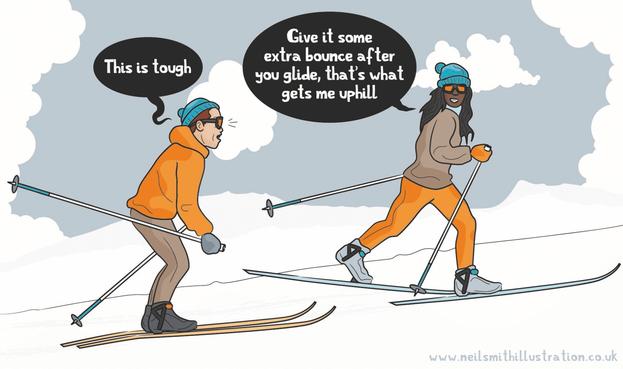
Going up hills while cross country skiing is hard. Amelie Werkhausen & co show how cross country skiers use their muscles and tendons to glide across the snow while going uphill.
https://journals.biologists.com/jeb/article/226/12/jeb246219/316765

#Biomechanics #Biology #Science

Read the full research here
https://journals.biologists.com/jeb/article/226/12/jeb245474/316764

Cross-country skiers bounce to glide and slide uphill

Using almost every muscle in the body and with a low risk of injury, cross-country skiing has a reputation for being one of the healthiest sports, but the pastime is not without challenges. Coordinating all four limbs on a slippery surface can have its moments, and athletes have to manoeuvre themselves up hills while gliding across the snow. But how do cross-country skiers propel themselves as they glissade up gradients? Are they effectively running as they glide on one ski while stepping forward with the other, do they store bouncy energy in the Achilles tendon of the sliding leg in preparation for the next stride, and how do the calf muscles contribute? To find out, Øyvind Gløersen (SINTEF Digital, Norway), Amelie Werkhausen and Anders Lundervold (both from the Norwegian School of Sport Sciences, Norway) filmed 13 competitive cross-country skiers on roller skis as they propelled themselves uphill on a sloping treadmill while recording calf muscle activity to find out how the skiers use energy while gliding along.Recording the athletes manoeuvres with 12 cameras to reconstruct their movements as they roller skied on different inclines on the treadmill, the team saw the skiers kick off with one leg to swing it forward while gliding on the other, before touching down with the first leg to glide forward as the second leg kicked off, propelling the skier. Then, they analysed the complicated relationship between the calf muscle contraction and the Achilles tendon stretching to store energy as the skiers climbed and realised that the athletes’ movements were similar to those of runners. However, instead of bouncing into the air as they travelled forward, the skiers remained in contact with the treadmill, gliding forward on one ski. The researchers also realised that as the skiers prepared to push off with one leg, at the end of gliding on that ski, they contracted the calf muscles to store energy in the Achilles tendon, which is exactly what we do when preparing to jump. In addition, when the skiers propelled themselves up a steeper gradient, they contracted their calf muscles more to store a larger amount of energy in the Achilles tendon, to power the stronger kick they require.So, cross-country skiers effectively run, but instead of bouncing into the air like runners, they glide forward across the snow, while benefiting from the power of jumping to ski up gradients that other skiers would be happier to descend.

The Company of Biologists

In her #JEB100 ECR Spotlight, Chloe Fouilloux tells us about her #research, where she discovered that #poisonfrog #tadpoles that develop in cloudy #water are less likely to evade a predator than tadpoles reared in clear water and why she thinks having great mentors is the secret to success.

https://journals.biologists.com/jeb/article/226/12/jeb246168/316749

You can find Chloe's full research paper at https://journals.biologists.com/jeb/article/226/12/jeb245822/316751

#zoology #neuroethology #biology #predator #mentorship

ECR Spotlight – Chloe Fouilloux

ECR Spotlight is a series of interviews with early-career authors from a selection of papers published in Journal of Experimental Biology and aims to promote not only the diversity of early-career researchers (ECRs) working in experimental biology during our centenary year, but also the huge variety of animals and physiological systems that are essential for the ‘comparative’ approach. Chloe Fouilloux is an author on ‘ Visual environment of rearing sites affects larval response to perceived risk in poison frogs’, published in JEB. Chloe Fouilloux is a PhD researcher in the lab of Bibiana Rojas at University of Jyväskylä, Jyväskylä, Finland, investigating the evolutionary ecology of animals, especially with respect to decision-making and social relationships.

The Company of Biologists

As part of our #JEB100 celebrations, we are launching two new grants to support junior faculty within five years of setting up their first lab. To find out more:
https://biologists.com/grants/kickstart-travel-grants/

The deadline for the first round of applications is 15 July so don't miss this fabulous opportunity

#comparativephysiology #zoology #biology

Research Partnership Kickstart Travel Grants

About Research Partnership Kickstart Travel Grants To celebrate its 100th anniversary in 2023, Journal of Experimental Biology launched two new grants to support junior faculty staff: Research Partnership Kickstart Travel Grants and Early-Career Researcher (ECR) Visiting Fellowships. Research Partnership Kickstart Travel Grants aim to support junior faculty staff (e.g. Lecturer, Assistant Professor, Group Leader, Principal[...] Read More

The Company of Biologists

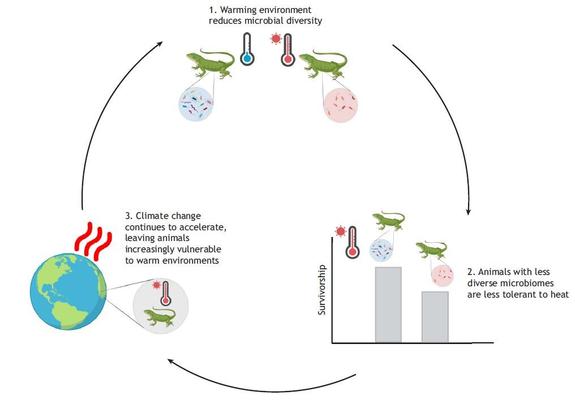
In their #JEB100 Commentary, @sammiefontaine & @KevinDKohl discuss how #microbiomes can influence the #thermaltolerance of #ectotherms, although questions remain regarding the role that microbes play in the thermal ecology & evolution of their hosts

https://journals.biologists.com/jeb/article/226/12/jeb245761/316644

#comparativephysiology #climatechange

Ectotherm heat tolerance and the microbiome: current understanding, future directions and potential applications

Summary: Microbiomes can influence the thermal tolerance of ectothermic animals; however, many questions remain regarding the role that microbes play in the thermal ecology and evolution of their hosts.

The Company of Biologists

In her #JEB100 ECR Spotlight Estelle Moubarak discusses how light pollution is making it hard for #glowworms to find mates and her fascination with insect vision and her hope of starting her own lab
https://journals.biologists.com/jeb/article/226/11/jeb246167/313488

Read Estelle's full research article here
https://journals.biologists.com/jeb/article/226/11/jeb245760/313487

#entomology #LightPollution #zoology #biology #science

ECR Spotlight – Estelle Moubarak

ECR Spotlight is a series of interviews with early-career authors from a selection of papers published in Journal of Experimental Biology and aims to promote not only the diversity of early-career researchers (ECRs) working in experimental biology during our centenary year, but also the huge variety of animals and physiological systems that are essential for the ‘comparative’ approach. Estelle Moubarak is an author on ‘ Artificial light impairs local attraction to females in male glow-worms’, published in JEB. Estelle is a Postdoctoral Research fellow in the lab of Jeremy Niven at University of Sussex, UK, investigating visual ecology and physiology of nocturnal insects and the impact of artificial light pollution on individual fitness.

The Company of Biologists
Meet the JEB Editors at #SEBConference2023 including Craig Franklin Trish Schulte Sanjay Sane John Terblanche & the in-house team at stand 13/15 on 6 July - Talk about your research, find out more about the journal & learn how we support researchers

Issue 11 has closed and issue 12 is open

https://journals.biologists.com/jeb/issue/226/11

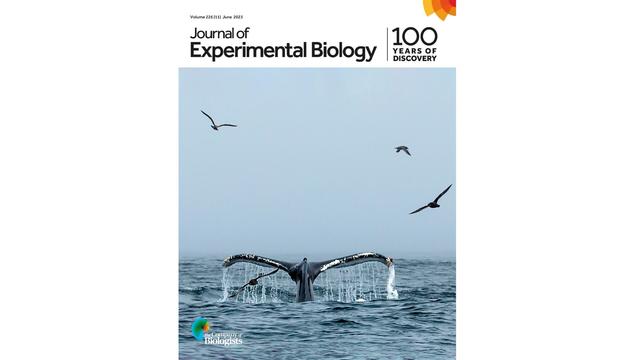
The cover image by Mike Baird shows the flukes of a whale as it prepares to dive and accompanies the Commentary by Costello & co, discussing how wings and fins bend in remarkably similar ways, regardless of whether they are in water of air and why this is a benefit for animal locomotion

https://journals.biologists.com/jeb/article/226/11/jeb245346/316662

#biomechanics #locomotion #zoology #Biology

Journal of Experimental Biology

The Company of Biologists

Listen to Jeremy Niven speaking to the BBC World Service about his new JEB paper 'Artificial light impairs local attraction to females in male glow-worms' (12:00 mins into the show)

#LightPollution #zoology #biology #comparativephysiology

https://www.bbc.co.uk/sounds/play/w172z2sjyv7354s

The Newsroom - 13/06/2023 22:06 GMT - BBC Sounds

The world's Newsroom brings you global events as they happen

BBC

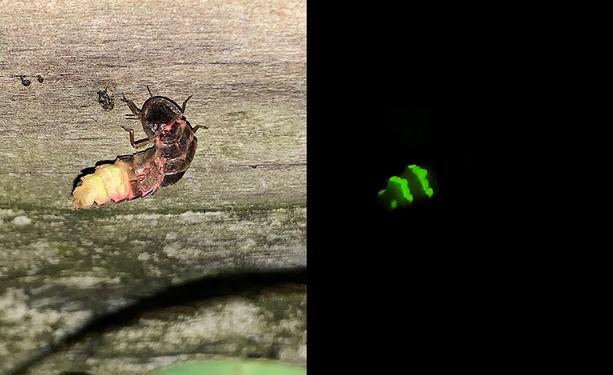
Glow-worms have lit up the fields of Europe and Asia for millions of years, but Moubarak & co show that human light pollution makes male #glowworms unable to find their glowing mates and could extinguish their twinkle for good.

https://journals.biologists.com/jeb/article/226/11/jeb246089/313485

Read the full research by Moubarak & co here
https://journals.biologists.com/jeb/article/226/11/jeb245760/313487

#lightpollution #comparativephysiology #zoology #science #biology

Brighter nights risk extinguishing glow-worm twinkle

The bright lights of big cities are wonders of the modern world, intended to help us work, stay safe and enjoy the world around us long after the sun has set. Although artificial light has been great for increasing human productivity, some nocturnal animals, and even people, pay a price for this illumination. From increasing the amount of time that predators are active to disrupting migrations, light pollution affects many animals; but how do animals that use their own luminescence to lure food or attract mates fare against this new, brighter background? Female common glow-worms (Lampyris noctiluca) emit a green glow from their abdomen to attract flying males, but they are unable to fly themselves to new locations to escape light pollution. Because of this, Estelle Moubarak, Sofia Fernandes, Alan Stewart and Jeremy Niven of the University of Sussex, UK, wondered how hard it is for male common glow-worms to find mates in an ever-brighter environment.After collecting glow-worms at night from the South Downs, UK, the researchers transported them back to the lab, before beginning the tricky task of transferring the male insects to a Y-shaped ‘maze’ without exposing them to artificial light. The team placed the male glow-worms at the bottom of the Y-maze and a green LED, which mimicked a female's glow, at the top of one of the arms, which the male had to walk towards. They then recorded if and how long it took the males to find the fake female. Then, the team switched on a white light above the maze, ranging from 25 lx (25 times brighter than moonlight) to 145 lx (equivalent to the light beneath a streetlamp). Although all of the glow-worms found the LED in the dark, only 70% found the LED at the dimmest levels of white light, and just 21% of the insects found their potential mate in the brightest light.Not only did the white light affect the glow-worm's ability to find a female, but it also caused them to take longer to reach the LED. In the dark, the worms took ∼48 s to reach the female-mimicking LED; however, it took the same glow-worms ∼60 s to reach the LED in the lowest white light levels. Illuminating the maze also caused the male glow-worms to spend more time in the bottom part of the maze without moving towards a female. In the dark, the insects only spent ∼32 s in the bottom of the Y-maze, whereas they spent ∼81 s in the bottom of the maze in the brightest conditions.Moubarak suggests that male glow-worms were unable move towards the females when dazzled by white light because they cover their compound eyes with a head shield, which acts like a pair of sunglasses, reducing the amount of bright light they see. In fact, when the white light illuminated the area with the fake female LED, the glow-worms shaded their eyes for ∼25% of the trial compared with only ∼0.5% of the time when the maze was in the dark. ‘Keeping their eyes beneath their head shield shows male glow-worms trying to avoid exposure to the white light, which suggests that they strongly dislike it,’ says Niven. So, although our bright night-time world has helped give rise to our modern society, it has had a drastic impact on male glow-worms and their ability to find mates. If this trend persists, meadows and heaths across Europe and Asia that have lit up with the twinkling of the female glow-worms for millions of years will fall dark.

The Company of Biologists