@FundamentalTime

4 Followers
3 Following
16 Posts
What the Universe Cannot Forgethttps://ifield-laboratory.netlify.app/

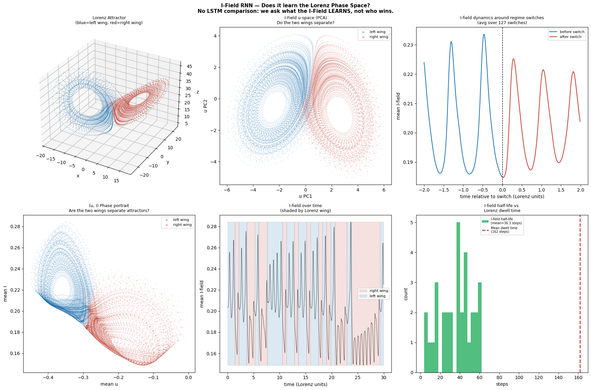
We didn't tell it about the two wings of the butterfly.
It found them anyway.
I-Field RNN trained on Lorenz reconstruction , the learned phase space spontaneously mirrors the attractor's bistable topology. And the I-field drops before every regime switch. Critical slowing down. Emergent.
Preprint: https://doi.org/10.5281/zenodo.20767066

This is what happens when your recurrent unit has a phase space.

#DynamicalSystems #MachineLearning #Chaos #Neuroscience #IField #Bifurcation
Most RNNs are black boxes. This one isn't.

I built a recurrent unit with a defined phase space — bistability, hysteresis, and limit cycles emerge naturally from the equations. No gates. No black magic. Just nonlinear dynamics.

The I‑Field RNN: memory of its own activity.

📄 https://doi.org/10.5281/zenodo.20767066

#MachineLearning #DynamicalSystems #Neuroscience #RNN #Bifurcation

Beyond Black-Box RNNs: A Recurrent Architecture with Emergent Bistability, Hysteresis, and Interpretable Timescales

Most recurrent neural networks rely on high‑dimensional hidden states that lack an explicit dynamical interpretation and cannot autonomously generate multistability, hysteresis, or sustained oscillations. We introduce the I‑Field RNN, a low‑dimensional recurrent unit derived from a biophysical conductance‑based neuron model through adiabatic elimination. The unit is governed by two interpretable variables: a fast synaptic current and a slow internal field with learnable refractory feedback.   This design yields a well‑defined phase space with several emergent properties. For a range of the refractory coefficient, the system undergoes a saddle‑node bifurcation, creating bistability and hysteresis; a brief input pulse permanently switches the unit between attractors, producing a transparent memory switch. With inhibitory feedback, a supercritical Hopf bifurcation ($l_1 = -7.38 < 0$) generates sustained limit cycles.   We validate the model on synthetic binary event streams with a known refractory period, using a context window shorter than the refractory period to force reliance on the internal field. The field decay rate $\alpha_I$ shows a sharp two‑regime adaptation: for short refractory periods it increases significantly to accelerate the field decay, while for long periods it remains at its biophysically motivated slow initialisation ($p = 0.0013$, t‑test). The refractory coefficient $\rho$ provides complementary modulation. These results confirm that the unit actively uses its structural memory rather than relying solely on opaque recurrent weights.   The I‑Field RNN bridges dynamical systems theory and differentiable computation, offering a transparent, multistable, and oscillatory alternative to black‑box recurrent architectures.

Zenodo

Update: the site is now live in three languages — English, Deutsch, Français — and the first blog post is up:

"What the Universe Cannot Forget: An Introduction to I-Field Theory"

No prior physics required. Just curiosity about why the past cannot be undone.

https://ifield-laboratory.netlify.app/blog

The vacuum is not empty. It remembers.

#IField #Thermodynamics #OpenScience #neuroscience #Physics #irreversibility #theoreticalPhysics

A. Lyoubi-Idrissi | I-Field Laboratory - Blog

Introducing the I-Field Laboratory.

A new research platform dedicated to the science of irreversibility,
where thermodynamics meets field theory and theoretical neuroscience.

The vacuum is not empty. It remembers.

Explore the theory, read the papers, and challenge the math.

🚶‍➡️ https://ifield-laboratory.netlify.app

#Neuroscience #Thermodynamics #Physics #OpenScience #FieldTheory #Irreversibility #TheoreticalPhysics #Neurodegeneration #Alzheimer #Parkinson #ALS #Preprint

A. Lyoubi-Idrissi | I-Field Laboratory -

New preprint

Alzheimer's, Parkinson's, ALS, and Huntington's disease, four different molecular pathologies, one thermodynamic collapse.
We propose that their diverse molecular signatures are not independent accidents, but different entry points into the same physical failure: the irreversible accumulation of entropy in neural tissue.

📄 Neurodegeneration as Thermodynamic Failure
https://doi.org/10.5281/zenodo.20414888
#Neuroscience #Thermodynamics #Alzheimer #Parkinson #ALS #Huntington #OpenScience #Preprint

Neurodegeneration as Thermodynamic Failure: A Unified Framework for Alzheimer's, Parkinson's, ALS, and Huntington's Disease

We introduce a unified field-theoretic framework that identifies neurodegeneration as a fundamental failure of thermodynamic stability. The core of this theory is the I-field, a scalar field representing the local density of accumulated entropy. This field accumulates wherever neural tissue dissipates energy, propagates along axonal pathways, and modulates ionic conductances through a conformal suppression mechanism. Its evolution is governed by a single master equation:$$\gamma\,\partial_t\mathcal{I} - D\,\nabla^2\mathcal{I} + m^2\,\mathcal{I} + \lambda\,\mathcal{I}^3 = \kappa\,P_\text{diss}$$       We demonstrate that the four primary neurodegenerative pathologies represent specific and predictable failure modes of this dynamics. Alzheimer’s disease emerges as a failure of metabolic clearance. Parkinson’s disease is characterized by a blockade of spatial transport. Amyotrophic lateral sclerosis results from the hyper-production of entropy, and Huntington’s disease is driven by the collapse of the field’s structural self-regulation.       By analyzing these field dynamics, we derive a dimensionless collapse index, $\Phi$, which quantifies the thermodynamic distance between a healthy state and the point of no return. When this index exceeds unity, the functional attractor of the neural substrate vanishes, making clinical collapse a thermodynamic necessity.      Unlike traditional models, this framework avoids reliance on empirical rate functions or fitted parameters. It provides a first-principles bridge between non-equilibrium thermodynamics and neural electrophysiology. This approach yields falsifiable predictions regarding representational drift rates and spatial field signatures, offering a new physical foundation for the early diagnosis and thermodynamic classification of neurodegenerative disease.

Zenodo

Second desk-rejection for my I-Field Theory manuscript from Foundations of Physics (same editor), again without technical feedback or peer review.

Rejections without reasons prevent productive dialogue and make it impossible to address concerns I don't know about.

The paper remains on Zenodo for anyone who wants to engage with the physics: https://zenodo.org/records/20390108

#Physics #TheoreticalPhysics #SpringerNature #OpenScience #AcademicPublishing #Entropy #FoundationsOfPhysics

The Irreversibility Field (I-Field):A Classical Framework for Fundamental Irreversibility in Physics

 We present the I-field: a classical scalar field minimally coupled to matter whose equation of motion contains an explicit time-asymmetric dissipation term, derived from the Euler-Lagrange-Rayleigh (ELR) formalism [@rayleigh1877]. The field does not modify the gravitational sector: Einstein's field equations are unchanged, and the total stress-energy tensor of matter plus I-field is covariantly conserved. In the limit $\gamma \to 0$ the theory reduces exactly to standard classical field theory.  The dissipation term $\gamma u^\mu \partial_\mu \mathcal{I}$, where $u^\mu$ is the four-velocity of the cosmological rest frame and $\gamma > 0$ is a coupling constant, is odd under time reversal while every term derived from a Lagrangian is even. This explicit breaking of time-reversal symmetry at the level of the field equation --- rather than through boundary conditions or statistical postulates --- has three consequences derived as theorems within the framework:   1. The I-field carries a covariant entropy production density   $\sigma_{\mathcal{I}} = \gamma\dot{\mathcal{I}}^2 \geq 0$   pointwise, establishing the second law of thermodynamics as   a field-theoretic identity rather than a postulate.     2. The energy transferred from matter to the I-field is strictly   non-negative, providing a microscopic account of dissipation   without invoking a heat bath or environment.     3. The preferred time direction is globally well-defined,   identified with the cosmological rest frame in which the   cosmic microwave background is isotropic [@fixsen2009].     The theory is self-contained and makes no modifications to the gravitational sector. The framework provides a minimal, classical extension of standard field theory in which irreversibility is fundamental rather than

Zenodo

New preprint submitted to Classical and Quantum Gravity:

GR is time-symmetric. That symmetry is the root of singularities, information loss, and the arrow of time.

We propose the opposite: irreversibility is fundamental.

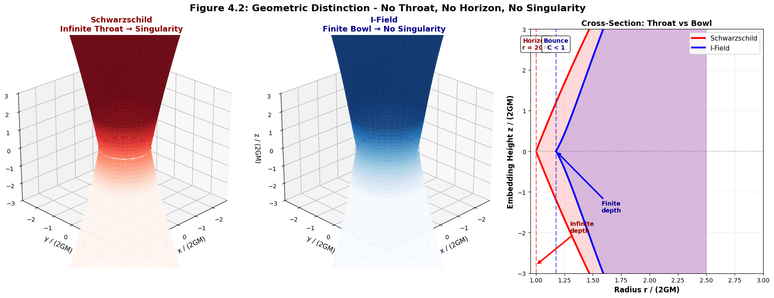
Main result: gravitational collapse halts before any trapped surface forms. C_max < 1. No quantum gravity needed.

📎 https://doi.org/10.5281/zenodo.19240251

#GeneralRelativity #ArrowOfTime #TheoreticalPhysics

Entropic I‑Field Theory: Fundamental Irreversibility and the Resolution of Singularities, Information Loss, and the Arrow of Time

General relativity is time-symmetric. This symmetry is the root of its three deepest puzzles: singularities, information loss, and the arrow of time. All existing approaches treat irreversibility as emergent — a statistical mirage atop a reversible microreality. We propose the opposite.   Irreversibility is fundamental. It is encoded in a classical scalar field $I$ — the I-field — that couples universally to gravity and matter. Its dynamics are governed by an Euler-Lagrange-Rayleigh action, where a dissipation term $\gamma u^\mu \nabla_\mu I$ breaks time-reversal symmetry at the level of the field equation. The modified Einstein equations introduce a dimensionless stabilization index $\eta$ that quantifies I-field backreaction.  The consequences are direct:  -   Gravitational collapse halts at a finite critical density $\rho_c$, before a trapped surface can form. The maximal compactness satisfies $\mathcal{C}_{\max} < 1$.  -   No event horizon ever appears — information remains causally accessible throughout the evolution.  -   The arrow of time emerges from the field dynamics, not from boundary conditions or statistical postulates.  Three foundational problems are thus resolved within a single classical framework, from first principles, without invoking quantum gravity. 

Zenodo

I developed a new field theory of gravitational collapse — no singularities,
no event horizons, information preserved by construction.

Submitted to EPJC: desk rejected, not read.
Submitted to GRG: rejected after review, zero reviewer comments.

I am an independent researcher. The mathematics does not change
depending on who signs the cover letter.
The paper is publicly available: https://doi.org/10.5281/zenodo.18818991
Genuine criticism welcome.
#physics #generalrelativity #openscience #independentresearch

The I-Field Theory: Fundamental Irreversibility and Gravitational Collapse Without Horizons

 We introduce the Entropic I-Field Theory, establishing fundamental irreversibility as a new physical principle through an Euler-Lagrange-Rayleigh action formalism. The framework extends Einstein's equations by coupling to a universal scalar field—the I-field—whose dynamics break time-reversal symmetry via an explicit dissipation term $\gamma u^\mu \nabla_\mu I$. The field couples to matter through $\mathcal{J} = \rho/m_I$, where $\rho$ is the energy density and $m_I$ the I-field mass scale, ensuring dimensional consistency.    We define the dimensionless **Stabilization Index** $\eta = (g_I^2 m_I/\gamma) \cdot [\lambda I^2/(\lambda I^2 + m_I^2)]$, which quantifies I-field backreaction strength and exhibits natural saturation behavior. Through rigorous analysis of the modified Friedmann equations, we prove that the I-field generates negative pressure $p_I \propto -\rho^2$ at high densities. This pressure opposes gravitational attraction, causing collapse to halt at a critical density $\rho_c$ where the acceleration reverses. The system reaches a finite minimal radius and subsequently re-expands, with maximal compactness $C_{\text{max}} < 1$ that precludes trapped surface formation.    The framework provides unified conceptual resolution of three foundational problems: (1) **Singularity avoidance**—gravitational collapse stabilizes at finite radius without horizons or curvature singularities; (2) **Information preservation**—the absence of event horizons ensures all information remains causally accessible; (3) **Arrow of time**—temporal asymmetry emerges from fundamental field dynamics encoded in the dissipation term, rather than from statistical postulates or boundary conditions.    The theory satisfies the correspondence principle, smoothly recovering general relativity in the limit $\gamma \to 0$ while preserving all established tests. This work establishes irreversibility as a fundamental rather than emergent feature of gravitational dynamics, extending physics from the time-symmetric framework of "Being" to the irreversible dynamics of "Becoming.

Zenodo

What if black holes don't form event horizons?

New work shows collapse can halt at C_max = 0.85 < 1 through
fundamental irreversibility—extending GR with dissipation.

Key results:
- No trapped surfaces form
- Singularities avoided
- Information preserved
- Mechanism: p_I ~ -ρ² reverses collapse

Preprint: https://doi.org/10.5281/zenodo.18818991

Rigorous critique especially appreciated—that's how science advances.

#GravitationalPhysics #BlackHoles #TheoreticalPhysics #OpenScience #Physics

Warum erleben wir Zeit, wenn Licht selbst zeitlos ist?
In der Relativität gilt: Für Photonen vergeht keine Eigenzeit.
Dennoch ist die physikalische Realität irreversibel.
Das deutet darauf hin, dass Zeit nicht nur ein Parameter ist, sondern dynamische Physik.

#Physik #Zeit #Grundlagen