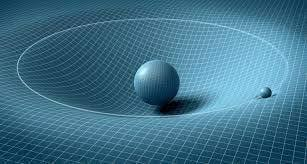
Is Dark Matter the Unknown God?

Published in Creation magazine 37(2):22-24, 2015.

Over years of researching cosmology and astrophysics, I have argued that ‘dark matter’ is a sort of ‘god of the gaps’,1 the ‘unknown god’. It is proposed mainly to rescue the standard big bang model from problems when a mismatch is found between the theory and some observations. However, secular cosmogonists (scientists who study the beginning of the universe) usually believe the big bang worldview to be correct as well as all its associated astrophysics. So they must postulate something invisible to explain the discrepancy. This ‘something’ is ‘dark matter’, a hypothetical substance that emits no light or radiation, so cannot be seen.

Several years ago, astronomers claimed that they now had direct empirical proof of the existence of ‘dark matter’.2 This was dutifully repeated in the popular media.3 It was claimed that this demolishes the criticisms of ‘dark matter skeptics’. The section entitled “Dark Matter Proof?” (below) explains this further, and shows how there are many competing explanations for the same evidence.

However, even if those alternate gravity theories were disproven, this would still not prove dark matter. Let’s be clear: ‘dark matter’ is not an explanation for what we see; it’s an admission that no one has an explanation. Perhaps a more accurate headline would have been, ‘Scientists have proved that they haven’t got a clue what the universe is made of’, rather than, ‘Dark matter revealed!’4 because it isn’t revealed. But if you give a name to an admission of gross ignorance—‘dark matter’, ‘dark energy’—then you may eventually believe you have explained something!

Fudge factor eliminated by correct physics

Dark matter is also invoked to explain certain motions in galaxies that appear not to follow the laws of physics. In spiral galaxies, outer stars often orbit faster than inner ones, unlike the solar system where inner planets orbit faster because of the stronger gravity close to the sun. Most astronomers propose a dark matter halo around the galaxy to explain these anomalies.

But dark matter is reminiscent of the scientific proposal, popular in the late 1800s to early 1900s, about the existence of another planet, Vulcan. No, not the home of Mr Spock, but a hidden planet that allegedly perturbed Mercury’s orbit and thus explained why it did not follow Newtonian physics. But the proposed planet Vulcan could not be observed, because it was postulated that it orbited such that the sun would always hide it from observers on the earth. But that makes no sense, since any planet near Mercury must orbit the sun much faster than Earth does.

Nowadays, this proposal is regarded as quaint, because Einstein’s theory of general relativity explained the anomaly in the orbit of Mercury. That is, rather than introducing a fudge factor that really explained and predicted nothing, what was needed was new physics that both explained observations at the time and predicted new ones.

I am not the only modern physicist/cosmologist who thinks that ‘dark matter’ is the Vulcan of today. It is a ‘god of the gaps’ for modern astrophysicists. It is a ‘fudge’, with unknown properties, and strange behaviour, such as being in a non-collapsing spherical halo around galaxies, and concentrated outside the galaxy more than in its centre. In fact, it is invoked many times in big bang cosmology to explain away anomalies.

The equivalent of general relativity in the Vulcan saga, i.e. the new physics required to do away with this whole ‘dark matter fudging’, could well be a new theory such as that proposed by the late Israeli cosmologist /physicist Moshe Carmeli. His 4D space-velocity metric explains the flatness of the universe (the fact that the universe has Euclidean geometry)5—without dark matter or other fudge factors. It also explains perfectly the anomalous galaxy rotation issues mentioned earlier.6 Just as Einsteinian relativity did to Newtonian physics, Carmelian relativity encompasses today’s physics but explains more data.

Dark matter—vital for big bang believers

The most powerful driver and motivator behind the ‘dark matter’ proposal is the perceived need to prop up the failing paradigm of the standard big bang cosmology. This includes not only the hypothetical beginning of the universe in a ‘big bang’, but also its structure and evolution.

For example, the big bang would result in hot gas, which could not form stars, galaxies and galaxy clusters without dark matter to help condense the gas. Also, testing of the big bang model with type Ia supernova measurements supposedly shows accelerating expansion where dark energy is also needed.7 Dark matter is also invoked to explain tiny irregularities in the Cosmic Microwave Background radiation, allegedly the fireball from the big bang. Also, without dark matter, big bang nucleosynthesis (formation of light elements like helium and the hydrogen isotope deuterium in the hot big bang fireball) won’t work, either.8

In short, to get the big bang theory to work, the matter content of the universe must comprise 85% dark matter, hence only 15% normal matter, like protons and neutrons. That’s you, me, the magazine you’re reading, everything—to which add 85% dark matter.9 So there is a huge incentive to prove that the dark-matter skeptics (like me), who dispute the existence of the stuff, are wrong.

Conclusion

The solution is simple—dark matter never existed in the first place. That is why it is missing. It is invisible because it is not there. The standard big bang universe formation theory is wrong. Dark matter is needed to form stars and galaxies in the big bang theory. But galaxies don’t form naturalistically by themselves. They can’t.

The Bible says that on Day 4 of Creation Week, God “… made the stars also.” (Genesis 1:16) That means God created the stars, and hence the galaxies also, at that time.

Dark matter (an unknown god) is not needed when you have the Creator.

References and notes

  • Evolutionists wrongly accuse creationists of invoking a ‘god-of-the-gaps’, claiming ‘God did it’ where current science is uncertain, i.e. a ‘gap’ in our knowledge. But as science expands, supposedly these gaps shrink more and more. In reality, informed creationist arguments are based on what we do know about chemistry, information, genetics, catastrophic geology, etc. See also Weinberger, L., Whose god? The theological response to the god-of-the-gaps, Journal of Creation 22(1):120–127, 2008; creation.com/gaps
  • Clowe, D., et al., A direct empirical proof of the existence of dark matter, Astrophysical J. 648(2): L109, 2006, arxiv.org/pdf/astroph/0608407v1.pdf.
  • Cain, F., Galaxy Collision Separates Out the Dark Matter, universetoday.com, 21 August 2006 (accessed 8 September 2014).
  • Roach, J., Dark matter revealed! nbcnews.com, accessed 8 September 2014.
  • Oliveira, F.J. and Hartnett, J.G., Carmeli’s cosmology fits data for an accelerating and decelerating universe without dark matter or dark energy, Foundations of Physics Letters 19(6):519–535, November 2006, arxiv.org/pdf/astro-ph/0603500v5.pdf.
  • Hartnett, J.G., Spiral galaxy rotation curves determined from Carmelian general relativity, International Journal of Theoretical Physics 45(11):2118–2136, November 2006, arxiv.org/pdf/astroph/0511756v3.pdf.
  • Hartnett J.G., Big bang fudge factors, December 24, 2013.
  • Nucleosynthesis refers to the generation of new atomic nuclei from particles such as neutrons and protons. Big bang nucleosynthesis refers to the belief that certain nuclei formed in the early stages of the supposed big bang. See Hartnett, J.G., Dark Matter and the Standard Model of particle physics—a search in the ‘Dark’.
  • Not to mention dark energy, which is even stranger than dark matter.
  • Dark Matter Proof?

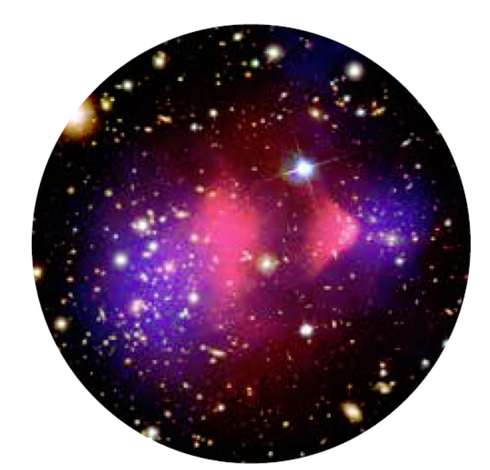
    Image: The famous Bullet cluster where one smaller sub-cluster (the bullet) appears to have passed through a larger cluster. Source: NASA/CXC/CIA/STSci/ Magellan /Univ. of Ariz./ESO.

    The authors of one study claimed that the Bullet cluster (shown below) is a unique merger of two clusters, and that their analysis has “… enable[d] a direct detection of dark matter … .” The supposed evidence comes from visible arcs seen in and around galaxies in the two Bullet sub-clusters. The arcs were interpreted as the result of gravitational lensing from unseen matter.1

    Gravitational lensing is a prediction of Einstein’s general theory of relativity. It describes the situation where a foreground galaxy (or cluster of galaxies) acts like a giant light lens and focuses the light of a more distant background galaxy and hence magnifies it like a normal lens would do. According to the theory, the lens distorts the galaxy image, often looking like a cross or a ring around the closer ‘lensing’ galaxy.

    Is it really dark matter?

    ‘Direct proof’ was claimed. But that seems to be stretching things a bit, to put it mildly, given the many assumptions and interpretations necessarily involved. In this case they were out to disprove some alternate gravity theories that purport to explain the anomalies without the need to invoke ‘dark matter’. However, another researcher claims that they are mistaken and that at least one of the alternate theories can explain the arcs observed in this cluster—as gravitational lensing, yes, but without the need for ‘dark matter’.2 And another refutes3 their claims by introducing new physics, while yet another cautioned against “simple interpretations of the analysis of weak lensing in the bullet cluster”.4 In short, cosmology is not operational science5 and there may be many competing explanations for the same evidence. (Ironically, the section below entitled “The Detection of ‘Missing’ Dark Matter” highlights another situation where gravitational lensing was used to detect the non-existence of dark matter in a lensing galaxy.)

    References and notes

  • American astronomer Halton Arp (1927–2013) suggested that these arcs, which are very prominent in the Abell 2218 cluster, are not the result of gravitational lensing but ejections of galaxies and matter from other clusters. Of course that flies in the face of standard big bang cosmology, which assumes all matter originated in the initial big bang. See H. Arp, Seeing red, redshifts, cosmology and academic science. Montreal: Apeiron, 1998; and review, Hartnett, J.G., The heavens declare a different story! Note also that the redshift of the Bullet cluster is near 0.3 which is one of the discrete values that Arp claims is associated with ejection events of one galaxy giving birth to another.
  • Moffat, J., Gravitational Lensing in Modified Gravity and the Lensing of Merging Clusters without Dark Matter, 30 August 2006, arxiv.org/pdf/astro-ph/0608675v1.pdf.
  • Milgrom’s perspective on the Bullet Cluster, (accessed 8 September 2014).
  • Angus, G.W., Famaey B. and Zhao, H., Can MOND take a bullet? Analytical comparisons of three versions of MOND beyond spherical symmetry, MNRAS 371(1): 138–146, 2006, arxiv.org/pdf/astro-ph/0606216.pdf.
  • James Gunn, cited in Cho, A., A singular conundrum: How odd is our universe? Science 317:1848–1850, 2007; creation.com/gunn.
  •  The Detection of ‘Missing’ Dark Matter

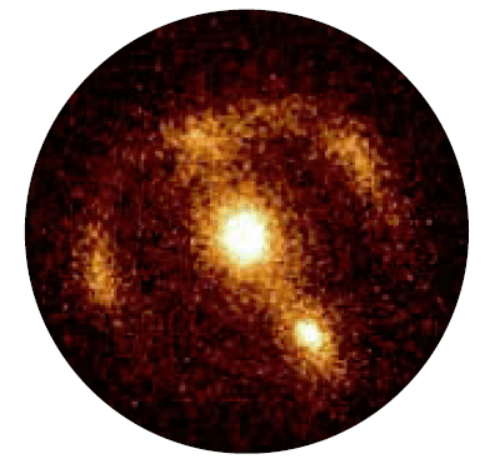
    Image: The claimed gravitationally-lensed galaxy seen as an irregular ring of radiation around the distant galaxy in the centre of this 2.2-micron CCD photograph, made with the 10-meter Keck telescope on Hawaii. Credit: ESA and the W. M. Keck Observatory

    Recently, several earth-based radio and optical telescopes and the Herschel Space Observatory were used to image an object, shown here (right), where a gravitational lens (the middle and lower galaxies) is claimed to image a very distant galaxy, allegedly still in early formation. This is the faint ring around the central galaxies.

    The central ‘lensing’ galaxy was found to radiate much more far-infrared radiation than the model predicts. So they reported that the central lensing galaxy “… contains an unexpectedly low fraction of mysterious dark matter ….”.1

    Here is a situation where according to the standard big bang model and the theory of galaxy formation more unseen dark matter should exist in the lensing galaxy than expected from modelling the lensing galaxy. No dark matter is actually seen, but the missing matter is mostly missing. Thus, whereas gravitational lensing was used as part of the claimed ‘direct’ detection of the existence of dark matter in the Bullet cluster (See Section “Dark Matter Proof?” above) here it is used to detect its non-existence in a ‘lensing’ galaxy.

    References and notes

  • Herschel Space Observatory is key to discovery of spectacular gravitational lens, astronomy.com, 13 June 2014. See also Missing matter mostly missing in lensing galaxy.
  • Recommended Reading

    Follow me

    To be notified by email put your email address in the box at the bottom of your screen. You’ll get an email each time we publish a new article.

    Click this image to make a secure Donation (Stripe) !

    #BigBang #BigBangTheory #CosmicMicrowaveBackgroundRadiation #DarkEnergy #DarkMatter #Einstein #GeneralRelativity #MosheCarmeli #theUnknownGod #Universe
    Anyone here fluent in General Relativity? And brave enough to read through my weird derivation below.

    TL;DR: The coefficients of the metric tensor depend on the choice of coordinate system. So the values are "meaningless" (not invariant). I stumbled over the "coordinate speed of light" and now can't decide whether it is invariant or not. The derivation on the linked page (mine) seems to suggest it is. But 🤷 ?

    https://blog.miamao.de/blog/Speed_of_Light_from_Metric.html

    #GR #GeneralRelativity #MetricTensor #physics

    Haralds Blog — Speed of Light from Metric

    I wondered what the metric tensor of #GR says about a point in space. I was disappointed to learn the coefficients are somewhat arbitrary, as they depend on the coordinate system.

    But it does tell the speed of light as measured by an observer far away from gravitational sources. And:

    1. This is a physical value (invariant).
    2. It is dependent on direction.

    Don't miss the links in

    https://blog.miamao.de/blog/Speed_of_Light_from_Metric.html

    if you get confused.

    #metric_tensor #physics #generalRelativity

    Haralds Blog — Speed of Light from Metric

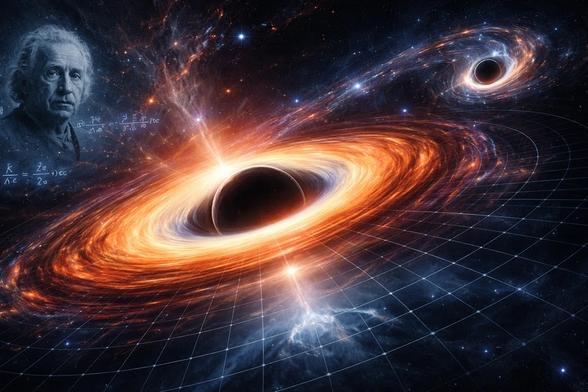
    "Did you know time can slow down near black holes by up to 30%?

    According to Einstein's theory of general relativity, massive objects warp spacetime, causing time dilation near event horizons. This effect is predicted to be extreme, potentially slowing down time by millions of years.

    As Einstein said, "Time and space are not independent of each other."

    What's the weirdest consequence of time dilation you can think of?

    #BlackHoles #TimeDilation #GeneralRelativity"

    Weekly Update from the Open Journal of Astrophysics – 16/05/2026

    It’s Saturday once again, so time for another update of activity at the Open Journal of Astrophysics. Since the last update we have published a further five papers, bringing the number in Volume 9 (2026) to 104 and the total so far published by OJAp up to 552. It took us until late July to pass 100 last year.

    I will continue to include the posts made on our Mastodon account (on Fediscience) to encourage you to visit it. Mastodon is a really excellent service, and a more than adequate replacement for X/Twitter (which nobody should be using); these announcements also show the DOI for each paper.

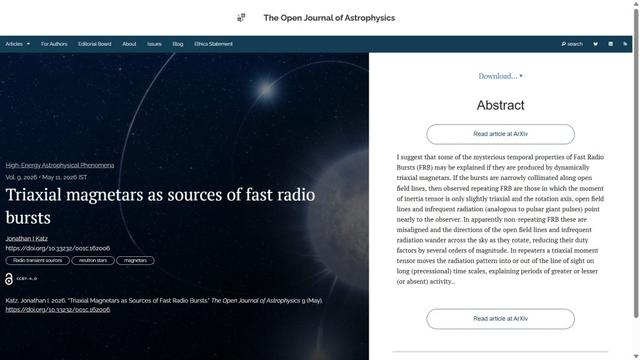
    The first paper to report this week, published on Monday 11th May in the folder High-Energy Astrophysical Phenomena is “Triaxial magnetars as sources of fast radio bursts” by Jonathan I Katz (Washington University, USA). This paper suggests that the mysterious properties of Fast Radio Bursts (FRB) could be explained by triaxial magnetars, with their activity levels influenced by precessional time scales.

    The overlay for this paper is here

    You can find the officially accepted version on arXiv here and the announcement on Fediverse here:

    https://fediscience.org/@OJ_Astro/116554775791392800

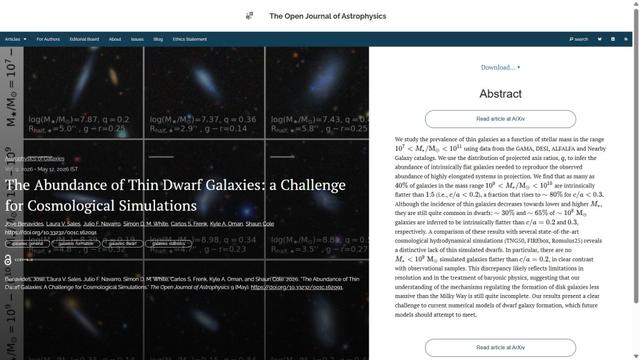
    The second paper for this week, published on Tuesday 12th May in the folder Astrophysics of Galaxies, is “The Abundance of Thin Dwarf Galaxies: a Challenge for Cosmological Simulations” by Jose Benavides & Laura V. Sales (UC Riverside, USA), Julio F. Navarro (U. Victoria, Canada), Simon D. M. White (MPA Garching, Germany), and Carlos S. Frenk, Kyle A. Oman & Shaun Cole (U. Durham, UK). Depending on mass up to 40% of galaxies are intrinsically flat, a fraction that numerical models of galaxy formation struggle to reproduce suggesting the models are incomplete.

    The overlay for this one is here:

    The official version of the paper can be found on arXiv here and the Fediverse announcement here:

    https://fediscience.org/@OJ_Astro/116560106342500157

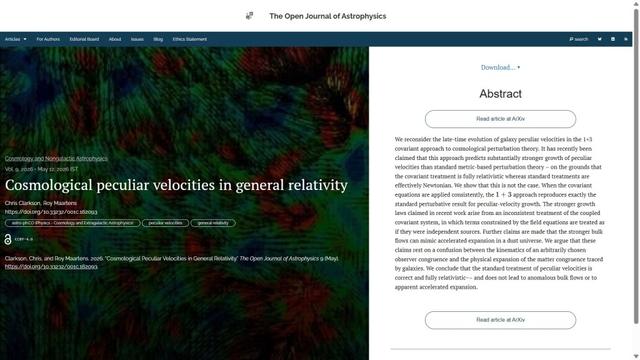
    Next one up, the third paper of the week, also published on Tuesday 12th May but in the folder Cosmology and Nongalactic Astrophysics is “Cosmological peculiar velocities in general relativity” by Chris Clarkson (Queen Mary, University of London, UK) and Roy Maartens (U. Western Cape, South Africa). This paper refutes claims that the 1+3 covariant approach to cosmological perturbation theory predicts stronger growth of galaxy peculiar velocities, arguing that standard treatments are correct and fully relativistic.

    The overlay for this one is here:

    The final, accepted version can be found on arXiv here and the Mastodon announcement is here:

    https://fediscience.org/@OJ_Astro/116560224426499932

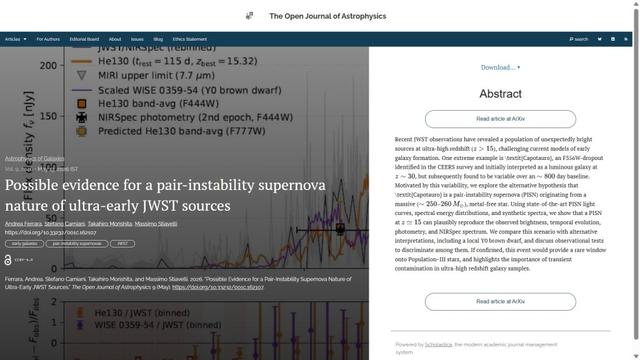
    The fourth paper this week, published on Wednesday May 13th “Possible evidence for a pair-instability supernova nature of ultra-early JWST sources” by Andrea Ferrara & Stefano Carniani (Scuola Normale Superiore, Pisa, Italy), Takahiro Morishita (California Institute of Technology, USA), and Massimo Stiavelli (Space Telescope Science Institute, USA). Published in the section Astrophysics of Galaxies. This paper argues that recent observations challenge early galaxy formation models, suggesting that the bright source, Capotauro, could be a supernova from a massive, metal-free star, not a luminous galaxy as initially thought.

    The overlay is here:

    The officially accepted version can be found on arXiv here and here is the Mastodon announcement:

    https://fediscience.org/@OJ_Astro/116566147448743997

    The fifth and final article of this week was also published on Wednesday 13th May but in the folder Cosmology and Nongalactic Astrophysics. The title is “Evolving and interacting dark energy: photometric and spectroscopic synergy with DES Y3 and DESI DR2” and it is by Maria Tsedrik and Benjamin Bose (University of Edinburgh, UK). The study investigates the Dark Scattering interacting dark energy scenario, using data from various sources. Results show no evidence of dark-sector interaction and a preference for the Chevallier-Polarski-Linder parametrisation.

    The overlay is here:

    You can find the authorized version of this paper on arXiv here and the Fediverse announcement is here:

    https://fediscience.org/@OJ_Astro/116566165139100860

    And that concludes this week’s update. I’ll do another next Saturday.

    #arXiv251211035v3 #arXiv260104953v3 #arXiv260107374v3 #arXiv260314511v2 #AstrophysicsOfGalaxies #Capotauro #ChevallierPolarskiLinder #cosmicShear #cosmologicalSimulations #CosmologyAndNonGalacticAstrophysics #DarkEnergy #DarkEnergySpectroscopicInstrument #DarkEnergySurvey #DarkScattering #DiamondOpenAccess #DiamondOpenAccessPublishing #dwarfGalaxies #fastRadioBursts #galaxyFormation #generalRelativity #HighEnergyAstrophysicalPhenomena #JWST #Magnetars #OpenAccess #OpenAccessPublishing #peculiarVelocities #supernova
    My #paperOfTheDay was "Galilei invariance, action-reaction principle, and center of mass theorem" from 1983.
    This is an article about #generalRelativity , without anything quantum. From daily experience, we know that every object has a mass, but thinking more closely, the parameter we call mass actually appears in different ways in #physics, and it is not a priory clear how they are logically related. Einstein's famous thought experiment was about the "falling elevator", that is, if you are in a box and can't look outside, you can not distinguish whether you fall freely, or you are located far away from a planet where there is no gravitational field. This "weak equivalence principle" asserts the equivalence between "inertial mass", the parameter which determines how hard it is to accelerate something, and "passive gravitational mass", the parameter that determines how strongly a gravitational field acts on an object.
    But there is a third type of mass, the "active gravitational mass", which determines how much gravitational field is generated by an object. The "strong equivalence principle" asserts that all three masses are the same.
    The present article demonstrates that, as far as classical celestial mechanics is concerned, the strong equivalence principle can not been distinguished from the weak one. That is, the observed motion of celestial bodies can already be explained by the weak equivalence principle, regardless of whether the strong one holds or not.
    I don't know what the current state of affairs is in that question, in particular regarding quantum theory.
    https://link.springer.com/article/10.1007/BF01889417
    Galilei invariance, action-reaction principle, and center of mass theorem - Foundations of Physics

    The Galilei invariance of classical dynamics does not automatically imply the third Newtonian axiom and the center of mass theorem. For the deduction of these theorems from Galilei invariance we must have, generally, a “kinematical potential” (Helmholtz) and a “potential function” (Clausius), respectively. In celestial mechanics it is possible to have conservation of the motion of the center of gravity but not of the mass center. In this case, the active and the passive masses are different quantities.

    SpringerLink
    Discover whether Einstein’s theory of relativity can fully explain black hole singularities, where gravity becomes infinite, or if quantum physics is needed to solve the mystery.
    #EinsteinRelativity #BlackHoleSingularity #QuantumGravity #GeneralRelativity #UniverseSecrets
    https://www.scientificworldinfo.com/2026/04/can-relativity-explain-black-hole-singularities.html
    Can Einstein’s Relativity Explain the Behavior of Black Hole Singularities?

    Einstein’s Theory of General Relativity predicts the existence of black hole singularities but cannot fully explain their behavior, as the e...

    Blogger

    Well that takes a load of my mind - I'm glad we got to the bottom of this!

    Researchers @ University of Pennsylvania have confirmed that gravity's strength weakens with distance almost exactly as predicted by the equations developed by Newton and later incorporated into Einstein's theory of general relativity. https://phys.org/news/2026-04-gravity-newton-einstein-cosmic-scales.html #Gravity #Newton #Einstein #GeneralRelativity #TheoreticalPhysics #Physics #Astrophysics #Universe #Galaxies #UniversityofPennsylvania

    New preprint submitted to Classical and Quantum Gravity:

    GR is time-symmetric. That symmetry is the root of singularities, information loss, and the arrow of time.

    We propose the opposite: irreversibility is fundamental.

    Main result: gravitational collapse halts before any trapped surface forms. C_max < 1. No quantum gravity needed.

    📎 https://doi.org/10.5281/zenodo.19240251

    #GeneralRelativity #ArrowOfTime #TheoreticalPhysics

    Entropic I‑Field Theory: Fundamental Irreversibility and the Resolution of Singularities, Information Loss, and the Arrow of Time

    General relativity is time-symmetric. This symmetry is the root of its three deepest puzzles: singularities, information loss, and the arrow of time. All existing approaches treat irreversibility as emergent — a statistical mirage atop a reversible microreality. We propose the opposite.   Irreversibility is fundamental. It is encoded in a classical scalar field $I$ — the I-field — that couples universally to gravity and matter. Its dynamics are governed by an Euler-Lagrange-Rayleigh action, where a dissipation term $\gamma u^\mu \nabla_\mu I$ breaks time-reversal symmetry at the level of the field equation. The modified Einstein equations introduce a dimensionless stabilization index $\eta$ that quantifies I-field backreaction.  The consequences are direct:  -   Gravitational collapse halts at a finite critical density $\rho_c$, before a trapped surface can form. The maximal compactness satisfies $\mathcal{C}_{\max} < 1$.  -   No event horizon ever appears — information remains causally accessible throughout the evolution.  -   The arrow of time emerges from the field dynamics, not from boundary conditions or statistical postulates.  Three foundational problems are thus resolved within a single classical framework, from first principles, without invoking quantum gravity. 

    Zenodo

    Today my paper "Topological consequences of null-geodesic refocusing and applications to $Z^x$ manifolds" got published in the Journal of Geometry and Physics!

    The paper defines: A globally hyperbolic spacetime $(X,g)$ is observer-refocusing if there exists a point $p$ and a timelike curve $\gamma$ in $X$ so that all lightrays emitted from $p$ intersect $\gamma$. The paper proves that spacetimes $(X,g)$ with $\dim(X)\geq 3$ which are observer-refocusing with respect to a compact timelike curve have compact Cauchy surfaces with finite fundamental group. This extends known results on strongly refocusing spacetimes, which are spacetimes with points $p,q$ so that all lightrays through $p$ go through $q$. Further, observer-refocusing spacetimes of dimension at least $3$ with an analytic metric are strongly refocusing.

    These results lead to immediate corollaries in Riemannian geometry: Let $(M,h)$ be a connected, complete Riemannian manifold and let $x \in M$. We call $(M,h)$ a $Z^x$ manifold if all geodesics starting at $x$ return to $x$. We show that if $\dim(M) \geq 2$ and if the return time of unit-speed geodesics starting at $x$ is uniformly bounded, then $M$ is compact with finite fundamental group. Further, if the metric of a $Z^x$ manifold is analytic, then all unit-speed geodesics starting at $x$ return to $x$ at a common time. This resolves the question "Are all $Z^x$ manifolds $Y^x_l$ manifolds for some $l>0$?" posed in Besse's book "Manifolds all of whose geodesics are closed" affirmatively for analytic manifolds.

    https://doi.org/10.1016/j.geomphys.2026.105834
    https://arxiv.org/abs/2503.23565

    #DifferentialGeometry #MathematicalPhysics #GeneralRelativity