TOPIC>
Auroras

The following thread will be about auroras, the colorful phenomena whose scientific backgrounds are just as exciting and wonderful as their appearance. I hope you enjoy this as much as I do.

Auroral Hummingbird over Norway
* Image Credit & Copyright: Mickael Coulon
https://www.instagram.com/mickael_coulon_astrophoto/

Explanation:
Is this the largest hummingbird ever? Although it may look like a popular fluttering nectarivore, what is pictured is actually a beautifully detailed and colorful aurora, complete with rays reminiscent of feathers. This aurora was so bright that it was visible to the unaided eye during blue hour -- just after sunset when the sky appears a darkening blue. However, the aurora only looked like a hummingbird through a sensitive camera able to pick up faint glows. As reds typically occurring higher in the Earth's atmosphere than the greens, the real 3D shape of this aurora would likely appear unfamiliar. Auroras are created when an explosion on the Sun causes high energy particles to flow into the Earth's atmosphere and excite atoms and molecules of nitrogen and oxygen. The featured image was captured about two weeks ago above Lyngseidt, Norway.

https://apod.nasa.gov/apod/ap250210.html

#space #earth #aurora #astrophotography #photography #NASA #science #physics #nature #education #4sAur

Auroras
by Rachel Lense
https://science.nasa.gov/sun/auroras/

Also known as the northern lights (aurora borealis) or southern lights (aurora australis), auroras are colorful, dynamic, and often visually delicate displays of an intricate dance of particles and magnetism between the Sun and Earth called space weather.

When energetic particles from space collide with atoms and molecules in the atmosphere, they can cause the colorful glow that we call auroras.

Aurora is the Latin word for "dawn" and is also the name of the Roman goddess of the dawn. Europeans living far from the Arctic Circle usually experienced auroras as a faint red glow to the north, resembling the reddish glow in the east at dawn. Aurora borealis translates to “northern dawn.”

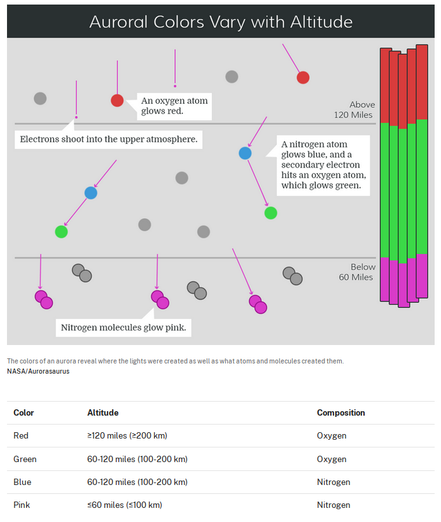
Why Are Auroras Colorful?

An aurora can appear in a variety of colors, from an eerie green to blue and purple to pink and red. When particles from space bombard gases in the atmosphere, they can give the atoms and molecules of the gases extra energy that’s released as tiny specks of light.
The color of an aurora depends on the type of gas that is hit and where that gas is located in the atmosphere.
Oxygen excited to different energy levels can produce green and red. Green occurs roughly between 60 to 120 miles (100-200 km) altitude, and red occurs above 120 miles (200 km).
Excited nitrogen gas from about 60 to 120 miles (100-200 km) glows blue. Depending on the type and energy of the particle it is interacting with, nitrogen can give off both pink and blue light. If it is below about 60 miles (100 km), it gives the lower edge of the aurora a reddish-purple to pink glow.
Sometimes, the light emitted by these gases can appear to mix, making the auroras seem purple, pink, or even white.

#space #earth #aurora #astrophotography #photography #NASA #science #physics #nature #education #4sAur

Researching Auroras

Ground-Based Measurements

Using ground-based scientific equipment, we can learn a lot about auroras. With tools like magnetometers that show changes in Earth's magnetic field and radar networks that monitor particle activity in the upper atmosphere, scientists can analyze the various effects that occur during auroral displays. Some ground stations even provide real-time views of auroras using special wide-field cameras called all-sky imagers.

Different countries and agencies collaborate to conduct aurora research using ground stations worldwide, representing just how collaborative science can truly be.

https://www.nasa.gov/?search=auroras
https://www.nasa.gov/science-research/heliophysics/auroras/

* Credits:
NASA/Goddard Space Flight Center/Scientific Visualization Studio/Tom Bridgman

#space #earth #aurora #astrophotography #photography #NASA #science #physics #nature #education #4sAur

2024 October 13
Aurora Timelapse Over Italian Alps
* Video Credit & Copyright: Cristian Bigontina
https://www.instagram.com/notti_delle_dolomiti/

Explanation:
Did you see last night's aurora? This question was relevant around much of the world a few days ago because a powerful auroral storm became visible unusually far from the Earth's poles. The cause was a giant X-class solar flare on Tuesday that launched energetic electrons and protons into the Solar System, connecting to the Earth via our planet's magnetic field. A red glow of these particles striking oxygen atoms high in Earth's atmosphere pervades the frame, while vertical streaks dance. The featured video shows a one-hour timelapse as seen from Cortina d'Ampezzo over Alps Mountain peaks in northern Italy. Stars from our Milky Way Galaxy dot the background while streaks from airplanes and satellites punctuate the foreground. The high recent activity of our Sun is likely to continue to produce picturesque auroras over Earth during the next year or so.
https://science.nasa.gov/blogs/solar-cycle-25/

https://apod.nasa.gov/apod/ap241013.html

#space #earth #aurora #astrophotography #photography #NASA #science #physics #nature #education #4sAur
2025 January 7

A New Year's Aurora and SAR Arc
* Image Credit & Copyright: Alessandra Masi
https://www.instagram.com/alessandramasi_21/

Explanation:
It was a new year, and the sky was doubly red. The new year meant that the Earth had returned to its usual place in its orbit on January 1, a place a few days before its closest approach to the Sun. The first of the two red skyglows, on the left, was a red aurora, complete with vertical rays, caused by a blast from the Sun pushing charged particles into Earth's atmosphere. The second red glow, most prominent on the far right, was possibly a SAR arc caused by a river of charged particles flowing across Earth's atmosphere. Although both appear red, the slight color difference is likely due to the aurora being emitted by both oxygen and nitrogen, whereas the higher SAR arc was possibly emitted more purely by atmospheric oxygen. The featured image was taken on January 1 from near Pieve di Cadore in Italy.

https://apod.nasa.gov/apod/ap250107.html

#space #earth #aurora #astrophotography #photography #NASA #science #nature #education #4sAur

Discover the Physics of Auroras

Magnetospheres and Geomagnetic Storms

Many planets, including Earth, are surrounded by a large magnetic shield called a magnetosphere. On Earth, this shield stems from the churning molten metal core inside the planet and extends far out into space.

Our magnetosphere protects us from harmful charged particles in the space environment. As these particles collide with the magnetosphere, they can transfer energy to the magnetosphere itself. However, if certain regions become overloaded, a geomagnetic storm can erupt, just as rain clouds swell with water droplets preceding a thunderstorm.

During a geomagnetic storm, much of the accumulated energy in the magnetosphere flows down along Earth's magnetic field lines, precipitating into the atmosphere like a summer downpour on the prairie. This type of particle precipitation injects millions of amps into the atmosphere, leading to impressive auroral displays in places far from Earth’s poles.

https://science.nasa.gov/sun/auroras/#deeper-science

Credits:
NASA/Goddard Space Flight Center/Scientific Visualization Studio/AJ Christensen

** --> Uploading animated files in ".gif" format is a bit of a trick, because the originals are usually too big. The free software imagemagick does a great job here when it comes to resizing your file! You can try it yourself with the following command:

$convert(or "magick" depending on your version) in.gif -coalesce -resize (desired size eg:"256")x -deconstruct out-deconstruct.gif

#space #earth #aurora #astrophotography #photography #NASA #science #physics #nature #education #4sAur

"Yes, I know, from the Christian holidays we are already at Pentecost! But I still hope that you can enjoy this aurora as well .. "

2024 December 23

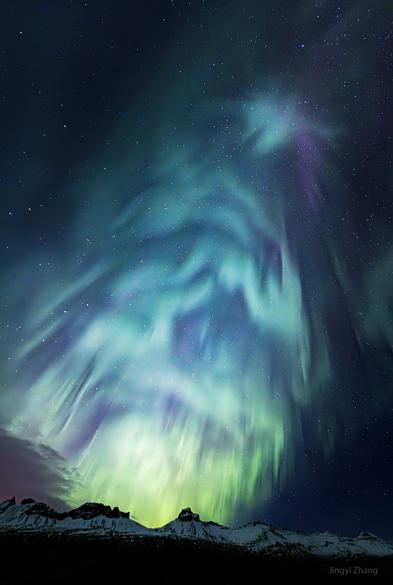
Christmas Tree Aurora
* Image Credit & Copyright: Jingyi Zhang

Explanation:
It was December and the sky lit up like a Christmas tree. Shimmering, the vivid green, blue, and purple auroral colors that formed the tree-like apparition were caused by high atmospheric oxygen and nitrogen reacting to a burst of incoming electrons. Collisions caused the orbital electrons of atoms and molecules to jump into excited energy states and emit visible light when returning to their normal state. The featured image was captured in Djúpivogur, Iceland during the last month of 2023. Our Sun is currently in its most energetic phase of its 11-year cycle, with its high number of active regions and sunspots likely to last into next year. Of course, the Sun has been near solar maximum during this entire year, with its outbursts sometimes resulting in spectacular Earthly auroras.
https://en.wikipedia.org/wiki/Solar_maximum
https://www.aps.org/apsnews/2000/10/discovery-of-the-electron
https://periodic.lanl.gov/8.shtml
https://periodic.lanl.gov/7.shtml
https://www.youtube.com/shorts/m3C7Pv9u2l0
http://funkot.ru/wp-content/uploads/2013/12/kotik-v-shapochke.jpg

https://apod.nasa.gov/apod/ap241223.html

#space #earth #aurora #astrophotography #photography #NASA #science #nature #education #4sAur

The Heliosphere and Solar Wind

Just as planets with churning cores like Earth produce magnetic shields, the Sun’s dense, ever-roiling interior also produces a magnetic shield — on a much larger scale. The Sun’s magnetic shield is called the heliosphere, and it fills the solar system.

As the Sun seethes, it radiates its energy throughout the heliosphere. Planets and other objects in the solar system experience much of this radiation as a continuous stream of charged particles and magnetic fields blowing by. This stream of fields and particles is called the solar wind.

When the solar wind blows past Earth, it buffets Earth’s magnetosphere like a strong breeze flapping a flag.
https://science.nasa.gov/sun/what-is-the-solar-wind/

Credits:
NASA/Goddard Space Flight Center/Conceptual Image Lab/Jonathan North

** --> Uploading animated files in ".gif" format is a bit of a trick, because the originals are usually too big. The free software imagemagick does a great job here when it comes to resizing your file! You can try it yourself with the following command:

$convert(or "magick" depending on your version) in.gif -coalesce -resize (desired size eg:"256")x -deconstruct out-deconstruct.gif

#space #earth #aurora #astrophotography #photography #NASA #science #physics #nature #education #4sAur

"Other planets in our solar system also have the aurora phenomenon. You can also enjoy a solar light show there. In my simple mind, I think of a drive-in cinema with planets instead of cars and the sun as a projector. But there is probably a different movie on each planet..?"

2024 December 8

Aurora around Saturn's North Pole
* Image Credit: NASA, ESA, Hubble, OPAL Program, J. DePasquale (STScI), L. Lamy (Obs. Paris)

Explanation:
Are Saturn's auroras like Earth's? To help answer this question, the Hubble Space Telescope and the Cassini spacecraft monitored Saturn's North Pole simultaneously during Cassini's final orbits around the gas giant in September 2017. During this time, Saturn's tilt caused its North Pole to be clearly visible from Earth. The featured image is a composite of ultraviolet images of auroras and optical images of Saturn's clouds and rings, all taken by Hubble. Like on Earth, Saturn's northern auroras can make total or partial rings around the pole. Unlike on Earth, however, Saturn's auroras are frequently spirals -- and more likely to peak in brightness just before midnight and dawn. In contrast to Jupiter's auroras, Saturn's auroras appear better related to connecting Saturn's internal magnetic field to the nearby, variable, solar wind. Saturn's southern auroras were similarly imaged back in 2004 when the planet's South Pole was clearly visible to Earth.
https://en.wikipedia.org/wiki/Solar_wind
https://apod.nasa.gov/apod/ap050219.html

https://apod.nasa.gov/apod/ap241208.html

#space #earth #aurora #astrophotography #photography #NASA #science #physics #nature #education #4sAur

" @[email protected] but before that, we have to talk about Coronal Mass Ejections: "

Coronal Mass Ejections

Occasionally, magnetic storms on the Sun eject large amounts of solar material into the solar atmosphere. These huge, flying blobs of Sun-stuff are called coronal mass ejections, or CMEs.

If directed at Earth, fast-moving CMEs can reach our planet in as little as 15 hours. (The Sun is approximately 93 million miles away from Earth. A CME arriving here in 15 hours means that it’s traveling around 6.2 million miles per hour, or about 0.9% the speed of light. At those speeds, you could fly from San Francisco to Washington, D.C. in ~1.5 seconds!)

As they billow away from the Sun, fast CMEs can overtake slower-moving charged particles ahead of them in the solar wind. These particles are accelerated as they’re swept into the careening solar ejecta, increasing the risk and intensity of a radiation storm when they reach Earth.

Under certain conditions, CMEs can supercharge the magnetosphere as they blow past, creating powerful geomagnetic storms in response.
https://science.nasa.gov/sun/solar-storms-and-flares/#coronal-mass-ejection

#space #earth #aurora #astrophotography #photography #NASA #science #physics #nature #education #4sAur

This animation shows all L3 WISPR full-field observations from the twenty-first PSP Mission Encounter (2024-09-25 - 2024-10-05). We have superimposed a grid showing helioprojective longitude and latitude, and a scale representation of the size and location of the Sun in the observations using the SDO/HMI Carrington map for this time period. The velocity and distance metrics displayed on the movies correspond respectively to the spacecraft's heliocentric velocity in kilometers per second, and its distance from the Sun's center in units of solar radii (where 1 solar radius = 695,700km). The "FOV Range" label provides the plane-of-sky distance limits of the inner and outermost edges of the fields of view, in units of solar radii. The horizontal blue line indicates the orbital plane of PSP. The timespan of this composite movie covers only the nominal science window when the spacecraft was within 0.25 au; a limited amount of data outside of this range may be available at the below links.
You can download this movie directly as an 101MB mp4 file. This sequence is also available as data processed via the LW Algorithm developed by Dr. Guillermo Stenborg (JHUAPL) and detailed in Appendix A of Howard et al. 2022 (ApJ, 936, id.43. DOI 10.3847/1538-4357/ac7ff5). Please contact the team for access to this data, which will be posted here one year after the acquisition of those observations. Team contact information can be found in Section 1.2 of the WISPR User's Guide
https://wispr.nrl.navy.mil/sites/wispr.nrl.navy.mil/files/wispr_data_user_guide_v3.pdf [PDF link].

[Credit: NASA/NRL/JHUAPL. Movie processed/compiled by Guillermo Stenborg (JHUAPL) and Karl Battams (NRL). SDO inset courtesy of NASA/SDO and the AIA, EVE, and HMI science teams.]

/*grobi: for a better resolution go to:
https://wispr.nrl.navy.mil/encounter21-summary but that's a huge file !:D

#space #solarsystem #sun #parker #astrophotography #photography #science #astronomie #nature #NASA #4sAur

2024 October 16

Colorful Aurora over New Zealand
* Image Credit & Copyright: Tristian McDonald
https://cre8tivestr3k.com/info-contact

Explanation:
Sometimes the night sky is full of surprises. Take the sky over Lindis Pass, South Island, New Zealand one-night last week. Instead of a typically calm night sky filled with constant stars, a busy and dynamic night sky appeared. Suddenly visible were pervasive red aurora, green picket-fence aurora, a red SAR arc, a STEVE, a meteor, and the Moon. These outshone the center of our Milky Way Galaxy and both of its two satellite galaxies: the LMC and SMC. All of these were captured together on 28 exposures in five minutes, from which this panorama was composed. Auroras lit up many skies last week, as a Coronal Mass Ejection from the Sun unleashed a burst of particles toward our Earth that created colorful skies over latitudes usually too far from the Earth's poles to see them. More generally, night skies this month have other surprises, showing not only auroras -- but comets.

https://apod.nasa.gov/apod/ap241016.html

#space #earth #aurora #astrophotography #photography #NASA #science #nature #education #4sAur

"A special box seat for the phenomenal earthly light shows belongs to the members of Expedition 71 and such wonderful views are part of the reward for the hard work. How nice that they share these beautiful pictures with us who stayed at home! We'll treat ourselves to a short film about it later .."

2024 September 13

Aurora Australis and the International Space Station
* Image Credit: NASA, ISS Expedition 71
https://www.nasa.gov/mission/expedition-71/

Explanation:
This snapshot from the International Space Station was taken on August 11 while orbiting about 430 kilometers above the Indian Ocean, Southern Hemisphere, planet Earth. The spectacular view looks south and east, down toward the planet's horizon and through red and green curtains of aurora australis. The auroral glow is caused by emission from excited oxygen atoms in the extremely rarefied upper atmosphere still present at the level of the orbiting outpost. Green emission from atomic oxygen dominates this scene at altitudes of 100 to 250 kilometers, while red emission from atomic oxygen can extend as high as 500 kilometers altitude. Beyond the glow of these southern lights, this view from low Earth orbit reveals the starry sky from a southern hemisphere perspective. Stars in Orion's belt and the Orion Nebula are near the Earth's limb just left of center. Sirius, alpha star of Canis Major and brightest star in planet Earth's night is above center along the right edge of the southern orbital skyscape.
https://earthobservatory.nasa.gov/images/1346/aurora-australis
https://science.nasa.gov/earth/earth-atmosphere/earths-atmosphere-a-multi-layered-cake/
https://apod.nasa.gov/apod/ap240913.html

https://apod.nasa.gov/apod/ap240913.html

#space #earth #aurora #astrophotography #photography #NASA #science #nature #education #4sAur

"And now finally (thank you p
@[email protected] for your generous p atience) we come to the point of magnetic reconnection. I'll spare you as linking to Youtube and Google with this simulation generously provided by the Goddard Space Flight Center. "

Magnetic Reconnection

As we’ve seen, the solar wind emanating from the Sun flows around Earth’s magnetosphere like a river rushing around a rock. This onrush of charged particles stretches Earth’s magnetosphere away from the Sun, creating a long wake known as the magnetotail.

The magnetic shields of the Sun and Earth are polarized, like refrigerators and the magnets that adhere to them. The polarity of Earth’s magnetic shield is mostly stable, but the Sun’s can vary due to its more dynamic nature.

Sometimes, the magnetic polarity of the solar wind is opposite that of Earth’s magnetosphere. When the solar wind buffets the magnetosphere under these conditions, the field lines of the Sun and Earth snap together, similar to when an everyday magnet connects to a fridge. This is called magnetic reconnection.

The continuously blowing solar wind then pushes these newly connected Sun-Earth field lines, wrapping them around the magnetosphere and stretching them out toward the magnetotail. Eventually, these field lines stretch to their limit and snap like a rubber band. This severs the direct Sun-Earth magnetic connection, releasing energy back along the field lines and reinstating the original magnetic configuration in the process.
https://en.wikipedia.org/wiki/Magnetic_reconnection
https://www.energy.gov/science/articles/solving-plasma-physics-mystery-magnetic-reconnection
https://heliophysics.ucar.edu/sites/default/files/heliophysics/resources/presentations/2012_Bhattacharjee_Reconnection.pdf

#space #earth #aurora #astrophotography #photography #NASA #science #physics #nature #education #4sAur

"And sometimes you don't even have to travel that far north, especially in the last year 2024, some of us suddenly and unexpectedly had such a light show on our doorstep"

2024 August 14

Meteors and Aurora over Germany
* Image Credit & Copyright: Chantal Anders
https://www.instagram.com/wetter_eule/

Explanation:
This was an unusual night. For one thing, the night sky of August 11 and 12, earlier this week, occurred near the peak of the annual Perseid Meteor Shower. Therefore, meteors streaked across the dark night as small bits cast off from Comet Swift-Tuttle came crashing into the Earth's atmosphere. Even more unusually, for central Germany at least, the night sky glowed purple. The red-blue hue was due to aurora caused by an explosion of particles from the Sun a few days before. This auroral storm was so intense that it was seen as far south as Texas and Italy, in Earth's northern hemisphere. The featured image composite was built from 7 exposures taken over 26 minutes from Ense, Germany. The Perseids occur predictably every August, but auroras visible this far south are more unusual and less predictable.
https://www.swpc.noaa.gov/news/severe-g4-geomagnetic-storms-observed-12-aug-2024
https://science.nasa.gov/solar-system/meteors-meteorites/perseids/

https://apod.nasa.gov/apod/ap240814.html

#space #earth #aurora #astrophotography #photography #NASA #science #nature #4sAur

"These wonderful surprising moments in places where we do not expect those views are most likely caused by the following powerful phenomenon: "

Geomagnetic Substorms

While the huge auroral displays caused by geomagnetic storms are fun to see, they’re relatively rare since the Sun’s and Earth’s magnetic fields need to align just right for them to occur. Auroras that stay near the Arctic and Antarctic circles are much more frequent. They’re created by geomagnetic substorms, magnetic disturbances affecting portions of the magnetosphere. Geomagnetic storms, in contrast, are large-scale disturbances that distort the whole geomagnetic system. The everyday flow of charged particles within Earth’s magnetosphere can create small regions of magnetic imbalance that cause geomagnetic substorms.
https://en.wikipedia.org/wiki/Substorm
https://heliophysics.ucar.edu/sites/default/files/heliophysics/resources/presentations/2007_Toffoletto_GeomagneticStormsSubstorms.pdf

Credits:
NASA/Goddard Space Flight Center/UNH/J. Raeder

#space #earth #aurora #astrophotography #photography #NASA #science #physics #nature #education #4sAur

2024 June 12

Aurora over Karkonosze Mountains
* Image Credit & Copyright: Daniel Koszela
https://www.instagram.com/danielkoszelaphotography/

Explanation:
It was the first time ever. At least, the first time this photographer had ever seen aurora from his home mountains. And what a spectacular aurora it was. The Karkonosze Mountains in Poland are usually too far south to see any auroras. But on the amazing night of May 10 - 11, purple and green colors lit up much of the night sky, a surprising spectacle that also appeared over many mid-latitude locations around the Earth. The featured image is a composite of six vertical exposures taken during the auroral peak. The futuristic buildings on the right are part of a meteorological observatory located on the highest peak of the Karkonosze Mountains. The purple color is primarily due to Sun-triggered, high-energy electrons impacting nitrogen molecules in Earth's atmosphere. Our Sun is reaching its maximum surface activity over the next two years, and although many more auroras are predicted, most will occur over regions closer to the Earth's poles.
https://theconversation.com/are-the-northern-lights-caused-by-particles-from-the-sun-not-exactly-174019
https://www.nasa.gov/news-release/solar-cycle-25-is-here-nasa-noaa-scientists-explain-what-that-means/

https://apod.nasa.gov/apod/ap240612.html

#space #earth #aurora #astrophotography #photography #NASA #science #nature #education

2024 May 22

Green Aurora over Sweden
* Image Credit & Copyright: Göran Strand
https://astrofotografen.se/

Explanation:
It was bright and green and stretched across the sky. This striking aurora display was captured in 2016 just outside of Östersund, Sweden. Six photographic fields were merged to create the featured panorama spanning almost 180 degrees. Particularly striking aspects of this aurora include its sweeping arc-like shape and its stark definition. Lake Storsjön is seen in the foreground, while several familiar constellations and the star Polaris are visible through the aurora, far in the background. Coincidently, the aurora appears to avoid the Moon visible on the lower left. The aurora appeared a day after a large hole opened in the Sun's corona, allowing particularly energetic particles to flow out into the Solar System. The green color of the aurora is caused by oxygen atoms recombining with ambient electrons high in the Earth's atmosphere.
https://www.webexhibits.org/causesofcolor/4D.html
https://www.nasa.gov/image-article/earths-atmospheric-layers-3/

https://apod.nasa.gov/apod/ap240522.html

#space #earth #aurora #astrophotography #photography #NASA #science #nature

"I'm thinking about designing my next TOPIC> as 'FOLLOWERS ONLY' .. would that be ok for you?
Bots-requests would not be accepted."

"Would you like to see more auroras from orbit? Then go through this gate"

Auroras Seen from Orbit

The International Space Station orbits roughly 250 miles (400 km) above Earth's surface. At that height, astronauts regularly fly over (and sometimes through!) brilliant auroral displays. Many astronauts document their auroral experiences with photos and videos, but did you know the space station has high-definition cameras on board? Photos and time-lapses are uploaded regularly to NASA's online Gateway to Astronaut Photography of Earth.

https://eol.jsc.nasa.gov/
!>> https://eol.jsc.nasa.gov/beyondthephotography/crewearthobservationsvideos/Aurora.htm

#space #earth #aurora #astrophotography #photography #NASA #science #nature

2024 May 20

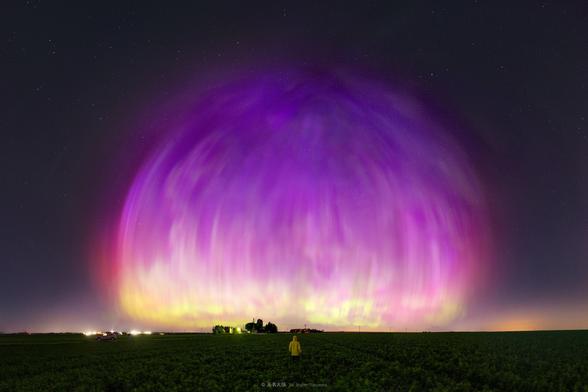
Aurora Dome Sky
* Image Credit & Copyright: Xuecheng Liu & Yuxuan Liu

Explanation:
It seemed like night, but part of the sky glowed purple. It was the now famous night of May 10, 2024, when people over much of the world reported beautiful aurora-filled skies. The featured image was captured this night during early morning hours from Arlington, Wisconsin, USA. The panorama is a composite of several 6-second exposures covering two thirds of the visible sky, with north in the center, and processed to heighten the colors and remove electrical wires. The photographer (in the foreground) reported that the aurora appeared to flow from a point overhead but illuminated the sky only toward the north. The aurora's energetic particles originated from CMEs ejected from our Sun over sunspot AR 3664 a few days before. This large active region rotated to the far side of the Sun last week, but may well survive to rotate back toward the Earth next week.

https://apod.nasa.gov/apod/ap240520.html

#space #earth #aurora #astrophotography #photography #NASA #science #nature

2024 May 17

Aurora Banks Peninsula
* Image Credit & Copyright: Kavan Chay
https://www.instagram.com/kchayphotos/

Explanation:
This well-composed composite panoramic view looks due south from Banks Peninsula near Christchurch on New Zealand's South Island. The base of a tower-like rocky sea stack is awash in the foreground, with stars of the Southern Cross at the top of the frame and planet Earth's south celestial pole near center. Still, captured on May 11, vibrant aurora australis dominate the starry southern sea and skyscape. The shimmering southern lights were part of extensive auroral displays that entertained skywatchers in northern and southern hemispheres around planet Earth, caused by intense geomagnetic storms. The extreme spaceweather was triggered by the impact of coronal mass ejections launched from powerful solar active region AR 3664.
https://spaceweather.com/
https://science.nasa.gov/blogs/solar-cycle-25/

#space #earth #aurora #astrophotography #photography #NASA #science #nature

2024 May 16

Aurora Georgia
* Image Credit & Copyright: Wright Dobbs
https://www.instagram.com/wrightdobbs/

Explanation:
A familiar sight from Georgia, USA, the Moon sets near the western horizon in this rural night skyscape. Captured on May 10 before local midnight, the image overexposes the Moon's bright waxing crescent at left in the frame. A long irrigation rig stretches across farmland about 15 miles north of the city of Bainbridge. Shimmering curtains of aurora shine across the starry sky, definitely an unfamiliar sight for southern Georgia nights. Last weekend, extreme geomagnetic storms triggered by the recent intense activity from solar active region AR 3664 brought epic displays of aurora, usually seen closer to the poles, to southern Georgia and even lower latitudes on planet Earth. As solar activity ramps up, more storms are possible.

https://apod.nasa.gov/apod/ap240516.html

#space #earth #aurora #astrophotography #photography #NASA #science #nature

2024 May 12

Red Aurora over Poland
* Image Credit & Copyright: Mariusz Durlej
https://tkalniakietrz.pl/wystawa-astrofotografii-mariusza-durleja/

Explanation:
Northern lights don't usually reach this far south. Magnetic chaos in the Sun's huge Active Region 3664, however, produced a surface explosion that sent a burst of electrons, protons, and more massive, charged nuclei into the Solar System. A few days later, that coronal mass ejection (CME) impacted the Earth and triggered auroras that are being reported unusually far from our planet's north and south poles. The free sky show might not be over -- the sunspot rich AR3664 has ejected even more CMEs that might also impact the Earth tonight or tomorrow. That active region is now near the Sun's edge, though, and will soon be rotating away from the Earth. Pictured, a red and rayed aurora was captured in a single 6-second exposure from Racibórz, Poland early last night. The photographer's friend, seeing an aurora for the first time, is visible in the distance also taking images of the beautifully colorful nighttime sky.

https://apod.nasa.gov/apod/ap240512.html

#space #earth #aurora #astrophotography #photography #NASA #science #nature

"So honestly, if this mysterious Aurora doesn't remind you of Harry Potter, you either don't read any books or have and don't know any children .. (just joking)"

2024 February 25
A green aurora fills a star filled sky. A mountain and a lake are in the foreground. The aurora may resemble, to some, a flying or rising Phoenix.

A Phoenix Aurora over Iceland
* Image Credit & Copyright: Hallgrimur P. Helgason; Rollover Annotation: Judy Schmidt

Explanation:
All of the other aurora watchers had gone home. By 3:30 am in Iceland, on a quiet September night, much of that night's auroras had died down. Suddenly, unexpectedly, a new burst of particles streamed down from space, lighting up the Earth's atmosphere once again. This time, surprisingly, pareidoliacally, the night lit up with an amazing shape reminiscent of a giant phoenix. With camera equipment at the ready, two quick sky images were taken, followed immediately by a third of the land. The mountain in the background is Helgafell, while the small foreground river is called Kaldá, both located about 30 kilometers north of Iceland's capital Reykjavík. Seasoned skywatchers will note that just above the mountain, toward the left, is the constellation of Orion, while the Pleiades star cluster is also visible just above the frame center. The 2016 aurora, which lasted only a minute and was soon gone forever -- would possibly be dismissed as a fanciful fable -- were it not captured in the featured, digitally-composed, image mosaic.
https://harrypotterinsights.com/the-enigmatic-phoenix-symbolism-and-significance-in-the-wizarding-world/

https://apod.nasa.gov/apod/ap240225.html

#space #earth #aurora #astrophotography #photography #NASA #science #nature

"Our solar film projector does not stop conjuring up magical mythical creatures on our atmospheric screen"

2024 January 14

Dragon Aurora over Iceland
* Image Credit & Copyright: Jingyi Zhang & Wang Zheng

Explanation:
Have you ever seen a dragon in the sky? Although real flying dragons don't exist, a huge dragon-shaped aurora developed in the sky over Iceland in 2019. The aurora was caused by a hole in the Sun's corona that expelled charged particles into a solar wind that followed a changing interplanetary magnetic field to Earth's magnetosphere. As some of those particles then struck Earth's atmosphere, they excited atoms which subsequently emitted light: aurora. This iconic display was so enthralling that the photographer's mother ran out to see it and was captured in the foreground. Our active Sun continues to show an unusually high number of prominences, filaments, sunspots, and large active regions as solar maximum approaches in 2025.

https://apod.nasa.gov/apod/ap240114.html

#space #earth #aurora #astrophotography #photography #NASA #science #nature

@grobi gotta admit my first reaction was “fake”
Damn…