 Sebastian Stautz
 Information Is Beautiful
How rich people avoid paying tax
(Originally by Instgram user @newmoney.blog)
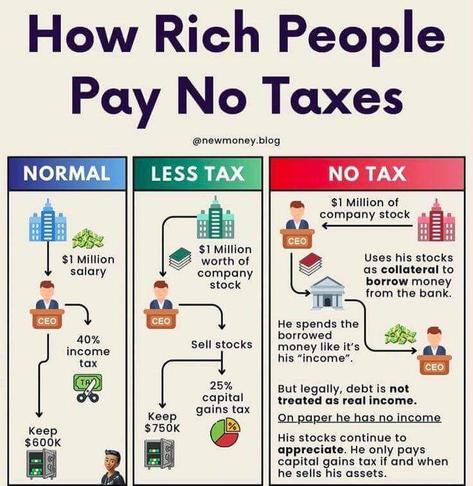
How rich people avoid paying tax
(Originally by Instgram user @newmoney.blog)
@marjolica @infobeautiful Market crashes screw over *EVERYONE* not just the CEOs and board.
That said... it seriously looks like we're borderline getting there anyway. No one learned anything from the "Great Recession" and we're headed towards a lot of very bad things coming to a head. (The biggest one being the fake "AI" scam bubble. That's going to pop *hard*.)
@nazokiyoubinbou @infobeautiful much of this growth and wealth is illusory.
We would be no less well off, in fact we would be better off, if the AI bubble were to burst now.
I agree people with claims on notional AI 'assets ' including those of us with pensions in funds that have not been able to avoid being sucked in will lose wealth. But AI data centres and AI mind worms are societally counterproductive. There would be more resource, less pollution and more jobs available to do useful things if they were to simply disappear.
At the moment most of us are living in the Tech Bros' AI Bezzle, the moment in time when the mark for what is in this case the AI fraud does not realise that they have been a victim, and may even feel that they have gained in the short term, only to being disillusioned later on.
@marjolica @infobeautiful Oh I agree. I'd like the bubble to burst *before* it would take whole systems down with it and screw us all over though...
Either way though, if markets crash, depressions happen. That hurts normal people too. To be clear though, there's a difference between a market crashing and a bubble popping. If it's not too late, the bubble won't take markets down too.
I keep seeing signs that *seem* to point to it possibly doing so really soon. But who really knows?
@nazokiyoubinbou @marjolica @infobeautiful
Market crashes screw over people with limited liquidity.
Even the Wall Street Crash only wiped out a small number of companies. People who had diversified portfolios saw their value recover after a few years. The people who went bankrupt were the ones who had been buying shares ‘on the margin’ (with money borrowed against other shares as collateral). When the value of their shares went down, they got margin calls (the loans had to be repaid or covered by other assets).
The people who did well were rich people who had cash or non-stocks assets that they could borrow against. When the market crashed, these people bought shares that doubled (or more) in value over the next few years.
The same pattern repeated in the 2008 and 2020 crashes: a market crash is a buying opportunity for people who plan ahead. This is why a lot of investors are quietly building cash reserves at the moment, waiting for the AI crash.
When the housing market tanked in 2008, the US government bailed out the banks instead of homeowners.
I worry that an AI crash will lead to a bailout of big tech paid for by the rest of us.
yeah this is why i get sad when i see "tax the rich" posts
the problem is when you have a lot of money, you can hire teams of accountants who spend their days inventing new ways to avoid paying taxes
i'm not saying we shouldn't tax the rich, nor am i saying to give up on trying to get them to contribute what they owe. what i am saying is that it is a harder more difficult problem. it's whack-a-mole. we need some sort of universal approach that catches *all* possible loopholes
For simplicity, wouldn't a minimum tax based on wealth, with assets assessed at market value, be a start?
There are challenges to this - eg venture capital & startups, art & collectibles, wine collections - which might be difficult to value/audit - but those are, I think, harder to monetize via loans.
(I dream of a minimum tax based on expenditures but suspect it would be too easy to game)
zero argument
mainly because i'd just be talking out of my ass. it is an extremely complicated topic. we think we have something comprehensive, then some accounting genius figures out a way to game it. it's a very hard problem. but vital to tackle
my personal thinking is that this pool of plutocrat billionaires is not large. so it's almost like you have to spearfish them individually. the idea we have to have a comprehensive law isn't practical, i think
@benroyce @PaulWermer What bothers me the most about this idea is that we'd have to report all our assets to the government.
And who pays for all the assessing required? I have no clue how much my stuff is worth and wouldn't want an auditor poking their nose into every nook and cranny of my life on a regular basis.
understood but this is not really the topic. the topic is getting billionaires to pay their fair share. so unless you're a billionaire this isn't on your back
@benroyce I get your point, but a fair taxation system has to be fair across the board, imo.
If there's some sort of threshold, then someone like Warren Buffet might fall under it. He plows his earnings back into his businesses, and lives relatively frugally.
Maybe that would be acceptable? But it's hard to qualify via law.
@solitha
I don't think it would be all that difficult to do fairly. For example, most people pay an income tax, based on their income less certain expenses. And (at least in the US) the standard deduction is part of Federal (maybe state as well) taxes - similar could be applied to wealth tax. I expect far fewer than 5% of households would be subject to a wealth tax.
And the data for assessing the wealth tax for those above the standard deduction is pretty easy to find. The financial institutions (banks, brokerages) & businesses know who owns what, and their value. Property taxes are assessed, and ownership is a matter of record. Much of the related data is already reported on taxes.
Outside of personal property, pretty much everything of value is already on record for pretty much everyone. Not publicly available, but related to info reported to the IRS. (Except, of course, for those trying to hide ownership through chains of LLPs & tax haven accounts)
The problem is an inversion of your concept of fairness. We write the code, then those with money find ways to cheat. In such a way, to be "unfair" to the ultrarich is in fact being fair, since they aren't being fair
So what I'm saying is lose the concept of some overarching code. It won't work. Go after the ultrarich uniquely, since their situation is so extraordinary. *That* is fair
There is no concept of "fairness for all" that applies or could apply to the outliers
@benroyce I specified fairness because it would have to withstand court challenge.
Whole lot of ideas that would be morally fair, but not legally so. But then again I suppose this is all a reach anyway, and laws would have to be changed.
so you just word the law properly: "when it comes to wealth of {X} amount the state is allowed to take extraordinary actions to maintain a fair and proper contribution"
of course it's new law, but there's no reason the law can't recognize extraordinary circumstances. the law already does so on many topics
@benroyce Yeah I'm sure the lawyer-ish types could manage some sort of framework. It'd have to be ironclad to withstand challenges from the very people in question.
@PaulWermer I didn't ignore your post. I just realized this is quickly going over my head.
@benroyce Global Minimum Tax (GMT) is one such law that has changed the landscape for multinational corporations. Min of 15% tax payable on reported earnings. It has prompted many tax havens to change their laws so that they collect at least 15%. Otherwise the tax would go to the domicile of the parent company.
That doesn't solve the issue illustrated here. But it's still a massive coordinated global change, that I've been quite surprised was able to pass. It indicates change is possible.
i agree but i can't shake the feeling they'll just find a creative workaround
The alt text implies the illustration is satirical. But it isn't. It's true.
It's known as Buy, Borrow, Die (& Step-up). It's explained here in the first paragraph:
https://taxpolicycenter.org/taxvox/richs-real-tax-trick-isnt-buy-borrow-die
@rogue_cells
I would not bet on a ban of "borrowing money against the value of their stock, spending the borrowed money as if it were income, and then claiming they have no income for tax purposes."
@rogue_cells It'd be interesting to know what you find.
I see there are a double handful of German billionaires. I don't know if they aren't as profligate due to taxation, or less wealth imbalance, or both.
@solitha @maugendre I asked a friend of mine, who worked at EY for a long time and he said that in Germany that "hack" is far less powerful than in the US.
What the sharepic is unclear about is that this is only deferring the tax payments, not eliminating them. Due to US tax law, at your death, the deferred taxes are deleted.
In German tax law, there is apparently an upper limit to how long you can defer the payment with that method, so at one point, the tax office will come after you.
@solitha @maugendre You can do method 2 in Germany and pay less, but you can't get rid of the taxes entirely. Companies are also paying fairly high taxes beforehand, so the entire "just profit" chain is nerfed from the start.
And many ways of "saving taxes" are classified as tax evasion here as well.
There is a saying in Germany, that there is one crime worse than murder: messing with the tax office 😂
Yet there are other quite wild ways of avoiding the relatively high taxation here.
@rogue_cells
Intent in law is efficient 😄
Thank you for reporting back.
If we cannot tax so-called unrealized gains (potential income), it should be illegal to borrow money on unrealized income (gains).
There is a loophole and double-standard here and that needs to be addressed.
@KatieLoves2Read @infobeautiful
Most places do, but the third panel is missing the bit that debts are paid out of the estate before inheritance duty is paid. So the death triggers the loans coming due. The executor may sell shares to cover them but will most likely arrange with the banks to take shares in payment so that they don’t tank the stock price. Then they will pay inheritance tax on the remainder, and then the inheritors will have their capital-gains counter reset: they are due capital gains only on increases after they inherit them.
@xeroxed by doing IPO of another, larger company?
This never stops to amaze mi. It is like Ponzi scheme, but only tricking himself, so it is fine, perhaps.
@xeroxed @infobeautiful
If the lender has the ability to manage the stocks the person loaned against (e.g. to sell them if the value drops below a threshold), then the bank may only require payment of the interest (which might be very low and is itself a tax deduction). When the person dies, the stocks step up in basis to the current market value, so when they're sold to pay off the debt there is effectively no capital gains tax.
Tax break on top of tax break, etc
 MarjorieR
 Nazo
Nazo mark
mark Zee
Zee David Chisnall (*Now with 50% more sarcasm!*)
 Kargas
 ᴮᵉⁿ ᴿᵒʸᶜᵉVOTE IN THE PRIMARIES
 Mark Koek
 Maximummium Overacticans
 unkx
unkx Chao-c'
 Paul Wermer, CC BY-NC-SA 4.0
 Solitha
 lizzzzard
 PapyrusBrigade
 Lynn D
 🇵🇸 em mohamed 🍉
 James Zimmerman
 Sepia Fan
 bushwald
 ℂ𝕖𝕝𝕖𝕤𝕥𝕖
 Eric Maugendre about carbon
 Netscape Navigator
 Thibaultmol 🌈
 Zee
Zee
 MidgePhoto
 Cap de Cirera

 MyYeeHaa
 Sasha
Sasha Aoi_X_Kaizaki