 Information Is Beautiful
How rich people avoid paying tax
(Originally by Instgram user @newmoney.blog)
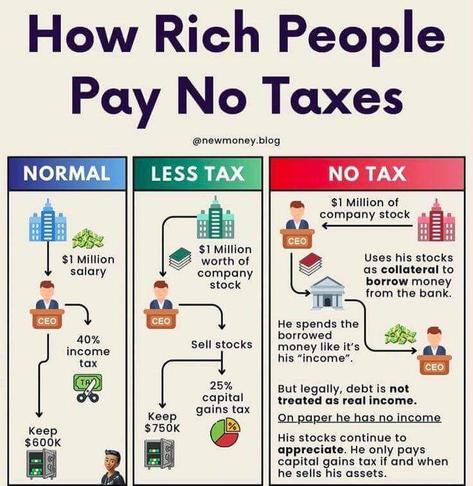
How rich people avoid paying tax
(Originally by Instgram user @newmoney.blog)
yeah this is why i get sad when i see "tax the rich" posts
the problem is when you have a lot of money, you can hire teams of accountants who spend their days inventing new ways to avoid paying taxes
i'm not saying we shouldn't tax the rich, nor am i saying to give up on trying to get them to contribute what they owe. what i am saying is that it is a harder more difficult problem. it's whack-a-mole. we need some sort of universal approach that catches *all* possible loopholes
For simplicity, wouldn't a minimum tax based on wealth, with assets assessed at market value, be a start?
There are challenges to this - eg venture capital & startups, art & collectibles, wine collections - which might be difficult to value/audit - but those are, I think, harder to monetize via loans.
(I dream of a minimum tax based on expenditures but suspect it would be too easy to game)
zero argument
mainly because i'd just be talking out of my ass. it is an extremely complicated topic. we think we have something comprehensive, then some accounting genius figures out a way to game it. it's a very hard problem. but vital to tackle
my personal thinking is that this pool of plutocrat billionaires is not large. so it's almost like you have to spearfish them individually. the idea we have to have a comprehensive law isn't practical, i think
@benroyce @PaulWermer What bothers me the most about this idea is that we'd have to report all our assets to the government.
And who pays for all the assessing required? I have no clue how much my stuff is worth and wouldn't want an auditor poking their nose into every nook and cranny of my life on a regular basis.
understood but this is not really the topic. the topic is getting billionaires to pay their fair share. so unless you're a billionaire this isn't on your back
@benroyce I get your point, but a fair taxation system has to be fair across the board, imo.
If there's some sort of threshold, then someone like Warren Buffet might fall under it. He plows his earnings back into his businesses, and lives relatively frugally.
Maybe that would be acceptable? But it's hard to qualify via law.
@solitha
I don't think it would be all that difficult to do fairly. For example, most people pay an income tax, based on their income less certain expenses. And (at least in the US) the standard deduction is part of Federal (maybe state as well) taxes - similar could be applied to wealth tax. I expect far fewer than 5% of households would be subject to a wealth tax.
And the data for assessing the wealth tax for those above the standard deduction is pretty easy to find. The financial institutions (banks, brokerages) & businesses know who owns what, and their value. Property taxes are assessed, and ownership is a matter of record. Much of the related data is already reported on taxes.
Outside of personal property, pretty much everything of value is already on record for pretty much everyone. Not publicly available, but related to info reported to the IRS. (Except, of course, for those trying to hide ownership through chains of LLPs & tax haven accounts)
The problem is an inversion of your concept of fairness. We write the code, then those with money find ways to cheat. In such a way, to be "unfair" to the ultrarich is in fact being fair, since they aren't being fair
So what I'm saying is lose the concept of some overarching code. It won't work. Go after the ultrarich uniquely, since their situation is so extraordinary. *That* is fair
There is no concept of "fairness for all" that applies or could apply to the outliers
@benroyce I specified fairness because it would have to withstand court challenge.
Whole lot of ideas that would be morally fair, but not legally so. But then again I suppose this is all a reach anyway, and laws would have to be changed.
so you just word the law properly: "when it comes to wealth of {X} amount the state is allowed to take extraordinary actions to maintain a fair and proper contribution"
of course it's new law, but there's no reason the law can't recognize extraordinary circumstances. the law already does so on many topics
@benroyce Yeah I'm sure the lawyer-ish types could manage some sort of framework. It'd have to be ironclad to withstand challenges from the very people in question.
@PaulWermer I didn't ignore your post. I just realized this is quickly going over my head.
 ᴮᵉⁿ ᴿᵒʸᶜᵉVOTE IN THE PRIMARIES
 Paul Wermer, CC BY-NC-SA 4.0
 Solitha