"A cynical $13 million advertising campaign launched by #FossilFuel interests in 1997 to prevent US ratification of the #Kyoto #climate treaty made the case that the US was doing more than its fair share ... in efforts to mitigate #ClimateChange.

Public opinion on climate has never shaken that mentality: Americans have long felt they carry an unfair burden but, surprisingly, #EmergingEconomies are the ones making the big gains on #renewables."

https://www.bloomberg.com/opinion/articles/2023-06-25/china-and-india-not-the-us-and-eu-lead-fight-against-global-warming

China and India Do More Than You Think to Fight Global Warming

Americans have long felt they carry an unfair burden but, surprisingly, emerging economies are the ones making the big gains on renewables.

Bloomberg
"#CleanEnergy technologies — including #wind and #solar power, #battery storage and #ElectricVehicles — are now competitive and in many cases cheaper than coal, oil or gas. That progress has been led not only by #Europe, but by #China, #India and other emerging markets such as #Chile, #Morocco and #Vietnam. The world’s cheapest electricity today is generated by the sun in the oil-rich United Arab Emirates."

#EnergyTransition
https://www.bloomberg.com/opinion/articles/2023-06-25/china-and-india-not-the-us-and-eu-lead-fight-against-global-warming
China and India Do More Than You Think to Fight Global Warming

Americans have long felt they carry an unfair burden but, surprisingly, emerging economies are the ones making the big gains on renewables.

Bloomberg

" It is true that #China is building #coal-fired power plants at a record pace — more the rest of the world combined. ... However, analysts suspect that many will never find major use, and they are being swamped by renewable power. In spite of all those coal plants, China already gets more of its power from #renewables than the #US — 50% vs. 40%. "

https://www.bloomberg.com/opinion/articles/2023-06-25/china-and-india-not-the-us-and-eu-lead-fight-against-global-warming?

China and India Do More Than You Think to Fight Global Warming

Americans have long felt they carry an unfair burden but, surprisingly, emerging economies are the ones making the big gains on renewables.

Bloomberg

There are a lot of surprising numbers in this piece, but the most surprising thing is that the numbers are surprising.

.
This tells you two things:
1. Always ask where you got an idea from.
2. Always check for updates on numbers or ideas you have in your head. The world changes, and sometimes the change is fast and drastic.

https://www.bloomberg.com/opinion/articles/2023-06-25/china-and-india-not-the-us-and-eu-lead-fight-against-global-warming

China and India Do More Than You Think to Fight Global Warming

Americans have long felt they carry an unfair burden but, surprisingly, emerging economies are the ones making the big gains on renewables.

Bloomberg

"Still, many energy analysts think #China’s #coal use could peak as early as next year.

To be sure, lowering #emissions is not the only motive here. What China wants is #EnergyIndependence. It’s building coal plants to replace expensive, imported gas. It is fast-tracking solar and wind so it can move away from coal imports.

But in #climate terms, it doesn’t matter why countries reduce their carbon emissions, only that they do."

https://www.washingtonpost.com/opinions/2023/07/13/china-renewables-ev-peak-emissions/

Good news for climate comes from the world’s greatest user of coal

China’s emissions are set to peak ahead of target — and where one global power leads, others are compelled to follow.

The Washington Post

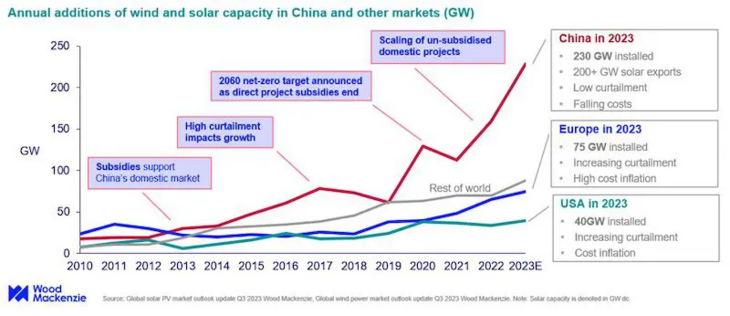
"In terms of capacity, 230GW of new #wind and #solar is expected to have been brought online this year, more than double that seen in the United States and Europe combined."

#China #EnergyTransition #RenewableEnergy
https://reneweconomy.com.au/china-to-install-record-breaking-230-gw-of-wind-and-solar-in-2023/

China to install record-breaking 230 GW of wind and solar in 2023

China is quietly reorganising its entire power sector to support rapid electrification and renewables uptake – and smashing records along the way.

RenewEconomy

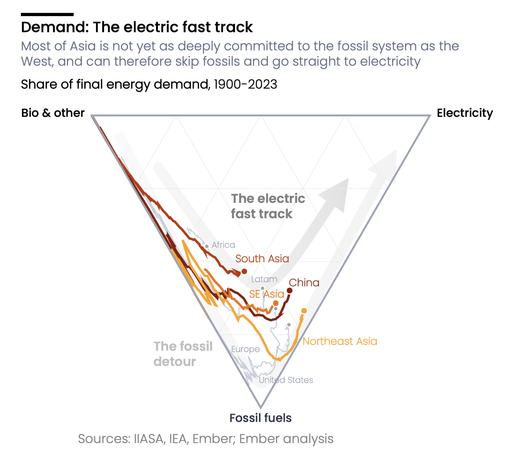
"If the defining economic story of the century is the rise of Asia, the defining energy story is the rise of electricity. The two are usually told apart. This report argues they are one: Asia’s rise is electric, and the electric age hastens Asia’s rise."

https://ember-energy.org/latest-insights/electric-asia/

This is the nuts and bolts version of the geopolitical story often covered in magazines like Foreign Policy: that whoever controls the means of energy production has the hegemony.

Electric Asia | Ember

How Asia is leading the electric age, powering its rise and reshaping the global order.

Ember

Two things are happening:

"The first is that Asia is taking an electric path.

The second runs deeper. It is a change in what energy is. Coal, oil and gas are commodities, dug from the ground. Solar panels, batteries and wind turbines are technologies, built on a production line. The energy revolution *is* the shift from extraction to manufacturing."

https://ember-energy.org/latest-insights/electric-asia/

Electric Asia | Ember

How Asia is leading the electric age, powering its rise and reshaping the global order.

Ember

This graphic is telling, and the label even more so: "Fossil Fuel Detour".

The fossil fuel path concentrated wealth and power in the hands of a few while it sacrificed human and planetary health at a vast scale.

That path - the detour - is being bypassed by the energy revolution, and the less countries are vested in fossil fuels, the more direct the path to clean energy is. Some African countries have very shallow paths on this diagram.

https://ember-energy.org/latest-insights/electric-asia/

Here is a whole thread on the "leapfrogging" by countries who are going straight to electrification, because fossil fuel austerity has not been great for them.

https://mastodon.social/@CelloMomOnCars/116352449287518899

At the top of the thread is the story of Pakistan: government policy led to power cuts and very expensive electricity. Households bypassed it, and within a few years the country became the world's sixth largest market for solar.

In Africa the revolution is not government driven, either, but by startups.

@CelloMomOnCars
Interesting. Are these mostly off-grid solutions? In this country, if the grid goes down, so does your local solar (apart from continuing to charge your battery, if you have one). Which makes sense if there isn’t an isolator, or you’d be back-supplying the whole neighbourhood, but would be a real pain if power cuts were frequent.

@KimSJ

If you go through the thread you will see that the leapfrogging happens mostly off grid: the grid is part of the system being leaped over.

@CelloMomOnCars
Engineering a reliable national infrastructure from this starting point is going to be challenging!

@KimSJ @CelloMomOnCars But perhaps the notion of “Reliable National Infrastructure” is a relic of centralized generation?

In an era of highly distributed, locally autonomous generation, does it matter that a town on the other side of the country has an outage? You generate your own energy, store it
locally and export on your own terms.

Perhaps the function of infrastructure
now is to provide a clearing house of bid-ask contracts for energy supply and consumption? Like CBOE for commodities

@jonshell @KimSJ

Precisely!

I mean, a lot of leapfroggers live where the existing grid is painfully unreliable: that was the impetus for people to take their energy into their own hands.

Also many of these countries are simply terribly large, and building an equitable grid that would reach everyone was always a tall order. You need locally optimised solutions, and getting away from centralised coal or gas plants is the way to bring electricity to many rural areas. Worked for Australia.

@KimSJ

I agree with @jonshell that the role of governments has shifted in this landscape, from builder to enabler.

@CelloMomOnCars @jonshell
Maybe a national or regional solution is unrealistic (and arguably not needed), but local connectivity probably still makes sense? (Willing to be shown to be wrong, if I am. 😉)
@KimSJ @CelloMomOnCars Like so much of the renewable space right now, the likely answer is "all of those things", iow yes, local connectivity, and yes, nationwide energy trading liberalization (managed by govt naturally) and yes, local consumption first for energy independence.
@jonshell @CelloMomOnCars
My instinct is that shared infrastructure allows for more efficient use of resources. If everyone has enough solar to cook dinner, that’s likely to be a lot more generation capacity than would be needed with some degree of resource sharing. And panels and batteries are not exactly carbon-free in manufacture.

@KimSJ @jonshell

PV panels are not (yet) carbon free in their making, but generate at least 7 times more energy over their lifetime than it cost to make them. Sounds like a win to me.

Also microgrids are a thing. The efficiency depends very much on the local conditions.

@CelloMomOnCars @jonshell
It’s not just an energy calculation. There’s rare earths, metals, etc…

@KimSJ @jonshell

Sure. Those are Dig Once Use Forever.

Unlike fossil fuels where you have to keep on drilling, digging, fracking.

@CelloMomOnCars @KimSJ Not to mention the materials recovery dimension.

The materials are not lost at the end of life, unlike fossil, which costs you at least twice: once when you burn, then post-consumption when you have to somehow recover the CO2 you emitted when destroying the resource.

We don't even have a good story for CO2 recapture yet, unlike battery and panels recycling.

I know you know this. Just worth saying it again.

@CelloMomOnCars The leapfrogging happened in Africa first with telecoms and then with banking. People from elsewhere are shocked how insecure US banking is... Checks? They've heard about them along with telegrams.

@HayiWena

Those also happened partly because the existing infrastructure (landlines, banks in buildings) didn't meet people's needs.

Sort of like the fossil fuel austerity today.

@CelloMomOnCars Lack of landline infrastructure vs cellular networks, and then cellular networks enabled full digital banking, e.g. M-Pesa. People who traditionally are under-banked embraced banking because of the crime risk with carrying cash. https://www.m-pesa.africa/ WhatsApp also made cellphone use more affordable.
@CelloMomOnCars However, coal, oil & gas are consumables, generating continuing revenues. Batteries etc. are capital products, witha different revenue flow profile, dependent on service life.

@clfh

glad you got the point