 WE AND THE COLOR
Marina Capdevila’s La Malika del regateo Mural Turns a Market Negotiation into Monumental Art
Street art rarely stops you cold. Most murals register as decoration—something large, colorful, and forgotten by the next corner. Marina Capdevila’s La Malika del regateo is not that. Painted on a building facade in Rabat, Morocco, during the 2026 edition of the JIDAR Street Art Festival, this mural announces itself differently. It presents an older woman mid-negotiation at a market stall, finger raised, jaw set, satisfaction already visible in her posture. She is not asking. She is closing the deal.
Capdevila, the Barcelona-based artist known for her vibrant, exaggerated portraits of elderly subjects, has spent years building a body of work that refuses to treat aging as a footnote. With La Malika del regateo—translated loosely as “The Queen of Bargaining”—she takes that practice into a new city, a new culture, and a monumental scale. The result is one of the most quietly radical murals produced in recent years. It deserves close attention.
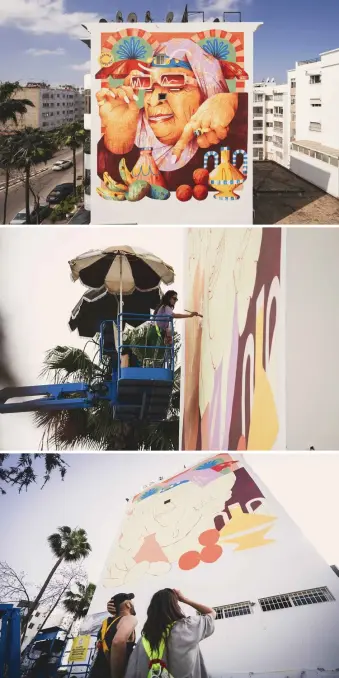
Mural in Rabat, Morocco by Marina CapdevilaWhat Does La Malika del regateo Actually Say About Power?
The woman at the center of the mural performs a gesture familiar across the Arab world, the Mediterranean, and, honestly, every street market that has ever existed. She points and insists, and she knows exactly what the item is worth and exactly what she will pay for it.
Capdevila calls this moment “a form of affirmation, confidence, and authority.” That framing matters. The market negotiation is frequently dismissed as trivial—a domestic skill, a thrifty habit, a social ritual with low stakes. Capdevila reframes it entirely. In her reading, the woman who bargains effectively exercises real power. She holds knowledge that cannot be taught in a classroom: product quality, fair price, the rhythm of the exchange, when to push, and when to wait.
This is what the mural argues on its surface, and it does so through scale alone. A woman haggling at a souk, painted across multiple stories of a Rabat building, becomes monumental. The formal language of public art—the mural tradition historically reserved for rulers, battles, and national myths—now frames a market negotiation between a woman and a vendor. The subversion is precise and entirely intentional.
The Concept of Everyday Authority in Capdevila’s Practice
A useful term for what Capdevila creates is Quotidian Authority: the exercise of real social and economic power through acts so common they go unrecognized. Bargaining, cooking, caregiving, organizing—these actions carry weight but rarely receive formal recognition. Capdevila’s project, across her full body of work and concentrated in this mural, is to make Quotidian Authority visible.
She is not the first artist to work in this territory. But she may be the most effective at doing it with humor rather than solemnity, which is what keeps her images alive. A portrait rendered with too much reverence becomes hagiography. Capdevila keeps her subjects human-scale, slightly playful, and vibrant in a way that makes you feel you know them.
Marina Capdevila and the JIDAR Street Art Festival in Rabat
JIDAR—the Arabic word for “wall”—launched in Rabat in 2015 under the initiative of EAC-L’Boulvart, an organization promoting urban culture in Morocco since 1999. Its 2026 edition, the eleventh, ran under the theme “Urban Dialogues” from April 16 to April 26. The festival distributed artists across multiple Rabat neighborhoods, with Capdevila working in the El Youssoufia and Agdal-Riad districts.
JIDAR operates on a clear curatorial principle: murals should be rooted in the social context of each neighborhood. That principle sets a high bar for international artists. It demands more than a technically impressive wall painting. It demands genuine engagement with place.
Capdevila met that standard by building her visual vocabulary from close observation. She incorporated ceramics, fruit, parasols, market textures, and the visual rhythms of everyday Moroccan urban life. Rather than importing a Spanish aesthetic wholesale, she built an image that acknowledges local visual culture while maintaining her own distinct voice.
Cross-Cultural Visual Dialogue: A Framework for Reading the Mural
What Capdevila achieves here can be described as Contextual Visual Integration—a process in which an outside artist incorporates local visual references not as costume or decoration but as structural elements that shape meaning. The market scene in La Malika del regateo works precisely because its details are accurate. The ceramics are Moroccan ceramics. The parasols are from that street, that light, that city. The woman could live in that neighborhood.
Contextual Visual Integration distinguishes serious cross-cultural public art from tourism-inflected exoticism. Capdevila has spoken directly about this distinction: rather than constructing “an exotic image of Morocco,” she wanted to focus on “something lived and recognizable.” That is the difference between an artist visiting a place and an artist actually looking at it.
Aging, Femininity, and the Visual Politics of the Mural
Capdevila has made the representation of older women a central and sustained commitment in her work. Her grandmother serves as a recurring muse, and through her, Capdevila has built an argument about whose face gets enlarged on public walls. Historically, that answer skewed male, young, heroic, or allegorical. Capdevila’s answer is different: an older woman, specific, alive, slightly amusing, entirely dignified.
In La Malika del regateo, this commitment intersects with a feminist reading of the market space itself. Capdevila describes markets as “spaces where many women exercise an informal but undeniable power.” She is correct, and this is something both anthropology and feminist geography have documented extensively. The informal economy has long been a site of female agency, even in societies where formal economic participation was restricted.
The mural makes this visible without lecturing. The woman’s authority shows in her posture, her gesture, and her expression. The feminist perspective, as Capdevila has noted, “appears quietly, through negotiation, insistence, and the awareness of one’s own value.” This is the most effective form of political art: the kind that doesn’t announce itself but lodges itself in your memory.
The Role of Humour in Capdevila’s Feminist Practice
Capdevila is specific about what her humor does and does not do. “Humour in my work is never about ridicule,” she says. “It’s a way of observing and amplifying what already exists.” This distinction is critical. A smirking portrait of an older woman bargaining could easily tip into condescension. Capdevila avoids that precisely because her humor comes from recognition, not from superiority.
The slight exaggeration in her style—the vibrancy that pushes just past realism—creates what might be called Affectionate Estrangement: the sensation of seeing something familiar rendered unfamiliar enough that you actually look at it. You’ve seen this woman before. You’ve had this interaction before. But you’ve never seen it this large, this colorful, this unapologetically present.
Affectionate Estrangement is a precise tool in public art. It bypasses the viewer’s habitual inattention to their surroundings. It makes the building facade impossible to ignore without making the image aggressive. The mural asks for your attention and then rewards it with warmth.
The Market as Civic Space: Reading La Malika del regateo in Urban Context
Public murals always exist in relation to the spaces they occupy. La Malika del regateo appears in Rabat, a city that holds UNESCO World Heritage status for its medina and its layered architectural history. It is a city of souks and avenues, of traditional markets and contemporary neighborhoods. Capdevila’s mural lands precisely in that tension.
The choice to depict a market negotiation in a city whose social life is substantially organized around markets is not coincidental. It mirrors the surrounding urban reality onto the wall, creating a form of Spatial Mirroring—when public art reflects the actual life of its immediate context rather than imposing an external visual narrative.
Spatial Mirroring generates a particular kind of resonance for local viewers. When you walk past a mural that depicts a scene from your own daily life, rendered with care and at monumental scale, something shifts. The message is implicit but unmistakable: this is worth seeing. This is worth preserving. This matters.
Contemporary Meets Traditional: The Visual Language of the Mural
Capdevila has described the mural as blending “contemporary and traditional references, reflecting the coexistence of both realities within the city.” This dual register is visible in the formal choices she makes. Her style is undeniably contemporary—painterly, exaggerated, energetic. But the subject matter draws from a visual tradition as old as Moroccan market culture itself.
The ceramics, the parasols, the textures of produce and fabric all carry cultural memory. They reference a visual vocabulary that Moroccan viewers recognize immediately. Capdevila borrows from that vocabulary without appropriating it, because she uses it to celebrate the people who actually inhabit it, not to decorate an outsider’s fantasy about them.
Why La Malika del regateo Belongs in Conversations About Contemporary Street Art
Street art criticism tends to reward the technically spectacular: the hyperrealistic portrait, the surrealist dreamscape, and the politically confrontational image. Capdevila’s work is none of these things and is more interesting for it. Her murals reward the viewer who slows down, who reads the gesture, who notices the quality of the humor.
This makes her work harder to photograph in a single memorable image and easier to actually experience in person. It is art that benefits from proximity, from time, from the willingness to stand in front of it and let the details accumulate. In an era when murals are primarily distributed as Instagram images, that is a counterintuitive bet. Capdevila makes it anyway.
The mural also enters a specific conversation about whose stories get told at scale in public space. That conversation is ongoing and urgent. Across North Africa, the Middle East, and Europe, the question of which subjects are worthy of monumental representation is being actively renegotiated. La Malika del regateo offers a clear answer: an older Moroccan woman at a market, doing exactly what she does every day, is more than worthy. She is the queen.
Marina Capdevila’s Ongoing Artistic Project
Capdevila describes this mural as a continuation of her “ongoing exploration of aging, femininity, and the subtle forms of power that emerge through everyday life.” That framing positions La Malika del regateo within a larger body of work rather than as a standalone intervention, which is how it should be read.
Her practice spans painting, drawing, and mixed media. She participates in workshops and art education initiatives. Her grandmother remains a central reference point, functioning as both personal anchor and philosophical position: a declaration that old age is not a subject to be avoided but a territory to be explored with full artistic seriousness.
What Capdevila has developed over the years of this practice is coherent visual ethics. She knows what she wants to say, she knows how to say it, and she refuses the shortcuts that make so much public art feel hollow. That combination of clarity and craft is rare. The work in Rabat demonstrates it at its best.
Predictions: How La Malika del regateo Will Influence Street Art Practice
Predicting the influence of a single mural is speculative, but certain patterns are worth naming. As street art festivals increasingly demand local contextual engagement from international artists, Capdevila’s approach here will serve as a model. Her method—deep looking, selective visual borrowing, humor without condescension—offers a workable template for cross-cultural public art that doesn’t flatten its subjects.
The sustained critical attention to aging and femininity in public visual culture is also accelerating. More artists will work in this territory over the coming decade. Capdevila’s body of work, and this mural specifically, will function as an early and well-developed reference point in that conversation.
Finally, the intersection of feminist politics and humor in public art will continue to be underexplored. Solemnity remains the default register for serious feminist art. Capdevila’s demonstration that humor can carry the same weight without sacrificing rigor is a lesson the wider field has not yet fully absorbed.
Frequently Asked Questions
What is La Malika del regateo?
La Malika del regateo is a large-scale mural by Spanish artist Marina Capdevila, created in Rabat, Morocco, as part of the 2026 JIDAR Street Art Festival. The title translates roughly as “The Queen of Bargaining.” It depicts an older woman negotiating at a market, surrounded by visual elements drawn from Moroccan market culture, including ceramics, fruit, and parasols.
Who is Marina Capdevila?
Marina Capdevila is a Barcelona-based Spanish artist known for her vibrant, exaggerated portraits of elderly subjects. Her work explores themes of aging, femininity, identity, and the informal forms of power embedded in everyday life. She uses painting, drawing, and mixed media, and her grandmother serves as a recurring muse in her practice.
What is the JIDAR Street Art Festival?
JIDAR is an annual international street art festival held in Rabat, Morocco. It launched in 2015 under the initiative of EAC-L’Boulvart. The festival distributes artists across multiple Rabat neighborhoods, commissioning murals that engage with local social contexts. Its 2026 edition was the eleventh, running under the theme “Urban Dialogues” from April 16 to 26.
What is the feminist significance of the mural?
The mural centers a form of everyday female authority that is rarely depicted at monumental scale: the market negotiation. Capdevila positions bargaining as an act of confidence, knowledge, and social power. The feminist perspective in the work is understated but precise, emerging through the subject’s gesture, posture, and expression rather than explicit political imagery.
How does Capdevila avoid exoticizing Morocco in the mural?
Capdevila built her visual vocabulary for the mural from direct observation of Moroccan market life. She incorporated locally specific elements—ceramics, parasols, produce, urban textures—as structural components of the image rather than decorative references. This approach, which she describes as focusing on “something lived and recognizable,” keeps the mural grounded in the actual visual culture of Rabat rather than an outsider’s impression of it.
What neighborhoods in Rabat feature Capdevila’s mural?
Capdevila’s work for the 2026 JIDAR festival was located in the El Youssoufia and Agdal-Riad districts of Rabat, along with murals by other international and Moroccan artists, including Guillem Font, Jumu Monster, Azpeger, Rosh, Ritanosko, Mizmiz, and RDS.
What role does humor play in Capdevila’s work?
Capdevila describes humor as a way of “observing and amplifying what already exists” rather than a tool of ridicule. In her work, slight visual exaggeration creates what functions as Affectionate Estrangement—rendering familiar subjects just unfamiliar enough that viewers actually stop and look. This approach allows the work to carry political and feminist weight without becoming didactic or heavy-handed.
All images © Marina Capdevila. Don’t hesitate to browse WE AND THE COLOR’s Art category for more.
#artist #MarinaCapdevila #Morocco #mural #streetArt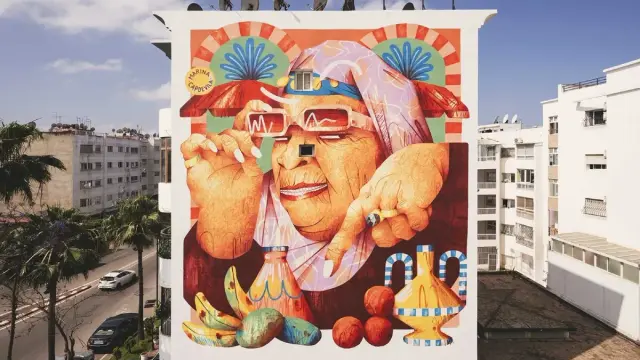
 The Mad Cat Lady


 Cpaphil
 Cpaphil
 AllQuakes - EMSC