Over the weekend it has become clear that the Facist Frog may have made a political miss-step in his call for 'pure cold rage' in response to the killing of Henry Nowak... going against the family's direct public plea for calm & (perhaps too obviously) trying to turn the case to his own ends.

Initial polling in Makerfield seems to be indicating that this has not gone down well with voters who might(!) have considered voting ReformUK;

perhaps we have passed peak-Farage?

#politics #ReformUK

@ChrisMayLA6 Politics is usually a realm of shifting sands. Even when the overall numbers remain static, the reality on the ground is always of a lot of movement between camps. Stability is when the flows balance.

In this case, Farage has damaged his attraction to newcomers. But the old trio of Lab/Con/LibDem are stale and unappealing. Burnham is getting a worth-a-try vote, rather than passion. Any boost he brings to Labour will be short. It will probably be followed by angry disappointment.

@2legged

Yes, there is a lot of data on more volatile & less committed voting - in a sense the short-termism that has taken over the political cycle has also encouraged voters to want (see) immediate results & when they don't appear (or couldn't due to over-promising) to switch voting intentions (serially, it now seems)

@ChrisMayLA6 The short-termism is interesting. On one hand, it makes good govt almost impossible. Serious projects need a decade.

OTOH, it has been clear for 20 years that the UK's governing parties have had no coherent 10-year plan.

When they've had 2 years to voyage plan the ship of state, but are still bouncing off the harbour walls, voters are right to turn away.

But how could we create a politics of parties with actual plans? Is it really now impossible?

@2legged

I'd say that's almost the defining malaise of UK politics.... and sadly I do not have any sort of plausible answer

@ChrisMayLA6 Sadly, it's not just British politics.

In Ireland, all 3 parties of the former 2½ party system are hollowed-out wrecks. FF, FG, Labour, all empty.

In Germany, the SPD & CDU & FDP are hollow. Even Die Grunen seems ill.

France is a step ahead. Old parties gone, the new now En Marche has failed.

The modern political party was a 19th century Irish invention. Now the whole model seems to have run its course.

@2legged

Which I suppose raises the Q. what will replace it; with more focussed (non- 'big tent') parties, the optimal voting system must be PR, so for the UK, we might have a difficult period before enough of the political class recognise the demands from voters to see PR voting

@ChrisMayLA6 Sadly, political debate in Britain is stuck on the broad category of #ProportionalRepresentation (PR). This mostly means #dHondt or the #AdditionalMemberSystem (#AMS).

#SingleTransferableVote (STV) is used in Scottish local elections, and in Northern Ireland. #STV is vastly better PR, 'cos it facilitates new entrants, removes tactical voting, and disempowers parties. Ideal for our times, and invented by a Brit: Thomas Hare.

And STV has been used for the House of Commons.

>>

@ChrisMayLA6 #STV was used for the Commons university constituencies, from 1918 to 1950. The last STV election to the Commons was the Combined Scottish Universities by-election in November 1946.

For decades thereafter, the Liberal Party and it's successors the #LibDems championed STV. But their enthusiasm lapsed after the disastrous #AV referendum in 2011. Now in a fragmented landscape, LibDems are slight beneficiaries of #FPTP, and seem uninterested in electoral reform.

>>

@ChrisMayLA6 #LibDems were in coslition with Scittish Labour 1999–2007, and got #STV for Scittish local elections.

But LibDems were later almost wiped out in Wales. So when #PlaidCyrmu and #WelshLabour agreed to abandon #AMS for the #Senedd, there was no strong LibDem voice for STV. The Senedd is now #dHondt only.

2024 showed how #FPTP is clearly broken in Westminster elections. Labour's ⅔ of seats on ⅓ of votes was so obscene that there should have been huge, destructive riots.

>>

@ChrisMayLA6 I am now worried that as the UK starts to move beyond #FPTP for Westminster elections, it won't unpack the term #PR.

Pure #dHondt or #AMS are the likely winners, although #AndyBurnham is muddying the waters by mendaciously labelling #AV as #PR. It isn't.

There is a serious risk that as political parties decline, the UK will adopt an electoral system which hands more power to the dying parties. Who will champion #STV?

@2legged

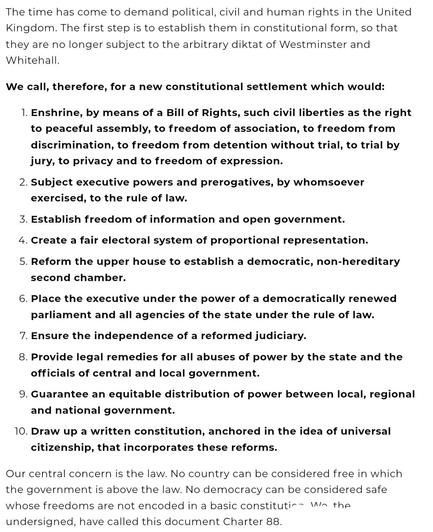
This is a significant issue; when I worked for Charter 88 we had a pamphlet on the various forms of PR (and 'near-PR') which set out C88's position on which was preferable, but its a long time ago & I cannot recall if it *was* STV.

But the key issue we had was that while many C88 supporters were pro-PR, getting any sort of agreement on the system to champion (in your words) pretty much stopped further discussion, as it would always dissolve into the pros & cons of different systems

@ChrisMayLA6 I don't want to appear to blame you for a wider cultural problem. But there are some huge problems here, e.g.:

1/ Irish politics is almost unreported in Britain. Even in political circles there is near-zero understanding of STV in action.

2/ early 1980s Bennism was followed by a wave of uncritical pro-Europeanism, with near reverence for West Germany's SPD. That drove the adoption of Germany's AMS in devolution and pure d'Hondt in EP elections. But that waa 40 yrs ago.

>>

@ChrisMayLA6 Now UK politics is a very different landscape to 1988. he old parties have fractured, the whole promise of social democracy has broken. Quasi-fascism is the most popular option.

Britain, esp England, now desperately needs to have those discussions about electoral systems which weren't possible in 1988. Otherwise it's going to drift into an even more party-centric voting system in the age when parties are dying.

@2legged

Oh I agree; the reporting of politics in this country is largely dysfunctional & C88 although it was campaigning into the mid-90s never really resolved the PR issue (largely because the members & small staff could not reach anything like a consensus & so lapsed into a position of presenting the choice(s))

@ChrisMayLA6 Yes. #C88 did a lot of crucial work opening up new agendas, but it couldn't do everything. There was always going to be a set if issues that had to be parked or left aside. But C88's legacy is of a radically changed culture of human rights, transparency, democracy. It's hugely important stuff.

But now the children & grandchildren of C88 face a wildly different landscape. I really hope they can look back on C88 as a stepping stone, and take big leaps in new directions.

@2legged

Thanks for that; sometimes it feels like people have forgotten Charter 88....

Ah, @ChrisMayLA6. I get that. The name #Charter88 is rarely mentioned. I have my own scars from similar fadings.

But political groups are usually transitory. Often at their best when they live fast and die young.

What matters to me is the fate of their ideas. #C88 achieved some solid wins (#FOI, #HRA), but its wider programme underpins most of liberal/left culture in the UK. The institutions are in trouble, but most progressive politics in the UK walks on C88 paths, even tho labels faded.

@2legged

That's really kind of you to say; I may have been too near (having worked there for two years, with the scars to show for it) & don't see it so clearly

@2legged @ChrisMayLA6 simply untrue. The current LibDem policy, which was in the manifesto is STV for all elections in England and UK Parliamentary elections. The other LibDem state parties in the UK want the same but the UK parliament isn’t the vehicle for delivering it, it’s the devolved administrations who can

Oioioi, @Mickft. Go easy, Mick.

Nothing I wrote is "untrue", let alone "simply untrue".

I didn't say #LibDem policy had changed. I said they seemed uninterested in STV. I stand by that. Big difference between manifesto mention and campaign headline.

In the 1980s theAlliance / #LibDems campaigned heavily on electoral reform. They had #JohnCleese do a good video on #STV: https://youtu.be/0qWDPauV_p4.

Nothing like that in the 2020s. Little mention since the #FibDem #AV defeat in 2011.

@ChrisMayLA6

John Cleese Explains STV

YouTube
@2legged @ChrisMayLA6 it is untrue. Almost every speech by Ed Davey at conference after conference includes a section of the need to introduce STV. It’s hardly his fault if the media don’t report it. If anything the emphasis on STV is stronger than ever. I’d worry more on selling out in coalition negotiations as happened in 2010. I have been pressing for some time to make it clear that STV is non negotiable and that it should be introduced as a condition of any coalition deal. No STV no deal.

@2legged @ChrisMayLA6 I think this is a myopic view. Malta uses STV and has absolute two-party domination - unlike smaller democracies with party lists.

The Sainte-Lague method and open lists solve the issues with D'Hondt and closed lists. Claims about "party strength", both its desirability and the effect of these methods, seem subjective.

And where a method was invented is irrelevant; you mentioning STV's origin looks like a cheap rhetorical trick. Is there nothing better to say about it?

@brunoparga You neglect to mention that Malta's voters chose two-party dominance. In the last election, the two dominant parties won 96.45% of the first-preference votes. Not a typo: 96.45%.

Your choice to omit that central fact while criticising Malta's electoral outcome is more than a mere "rhetorical trick". IIt is a blatant attempt to deceive.

The idea that electoral systems are unconnected to culture is curiously dessicated. This isn't just maths.

@ChrisMayLA6

@brunoparga The fundamental distinction between #STV and list systems is that STV is focused on individuals, whereas list systems are focused on parties. Bolting complexity onto lists doesn't alter that distinction.

STV allows voters to rank candidates by whatever basis they choose. That may be age, experience, locality, qualification, personality type, or party, or some combination threreof. But lists make party the primary issue.

@ChrisMayLA6

@2legged @ChrisMayLA6

"STV is focused on individuals, list systems on parties."

The evidence from the other country using it doesn't agree.

"Bolting complexity onto lists doesn't alter that distinction"

Even panachage?

"STV allows voters to rank candidates by whatever basis they choose."

Okay, but elections are not about good feels at polling booth, but electing a good government. Lists focus on parties because Parliament forms a government based on them, not age or personality type.

@[email protected] Are you innumerate, or just a liar?

96.45% of voters in Malta chose 2 parties of the 6 on offer. You omitted that figure in order to blame the 2-party outcome on the voting system. And you are still at it.

In 5-seat constituencies, any vaguely proportional electoral system will give all 5 seats to the two parties which share 96.45% of votes.

I see no point in continuing discussion with you. #Bye!

@ChrisMayLA6

@brunoparga @2legged @ChrisMayLA6 if you look at British local government it's all about individuals, as reform are now learning. You get elected by getting bins collected, drains cleaned, potholes filled and disorder managed. Wales is very actively looking at STV because a lot of people were deeply unhappy with party lists. Not sure the logic extends to England but in Wales people and knowing people matters a lot, perhaps because it's a much smaller population.

@etchedpixels @2legged @ChrisMayLA6

Open party lists are a thing, so is panachage (voting for multiple candidates from different lists).

STV is not bad; I just think the arguments in its favor and against the best list systems are often quite poor. People deserve better.

For example: Wales not only made the questionable decision to use closed lists but also the D'Hondt method, when Sainte-Lague is right there and significantly less biased.

@etchedpixels That knowing people thing is similar to Ireland, which is a similar size. It applies at all levels: national, local and European.

I am delighted to hear that Wales is looking at #STV. Is it concentrated in particular demographics? Do you have any pointers to discussion of it?

@ChrisMayLA6

@2legged @etchedpixels @ChrisMayLA6
All of this reminds me how much I admire the German/New Zealand version, where there are single-seat constituencies (which are FPTP, but would be better as AV) plus additional members allocated from party lists to reflect the popularity of each party, as measured by the second part of each ballot paper.

It seems to me this combines the best of having local MPs with achieving a truly proportional parliament.

I disagree entirely, @KimSJ.

AMS systens like Scotland and Germany retains the crooked FTP system for about half the seats. That's a disaster.

The local link is much better maintained by having a choice of local representatives. That way you dint get stuck with someone whose values are the polar opposite of yours.

In Ireland, national politics is hyper-local. STV makes politicians compete locally, so local link is much higher than under FtP or AMS.

@etchedpixels @ChrisMayLA6

@2legged @KimSJ @etchedpixels

Going back to an earlier moment in this exchange, while interesting these exchanges emphasise for me the issue that Charter 88 had with PR - it difficult to recommend a single system when there remains a reasoned debate as to the qualities & benefits of different systems (and experiences). Charter 88 was never able to engineer a consensus (at least while I was involved) among their members, even though in principle most if not all supported electoral reform.

@ChrisMayLA6 @2legged @etchedpixels
On the whole, I would accept *any* electoral reform. They’re all better than what we have. I think we need either a Royal Commission or (preferably!) a People’s Assembly to pick one, and just accept what they conclude.

The one thing I do not want to see is leaving it up to the politicians themselves to choose our future.

@KimSJ @2legged @etchedpixels

Yes, a people's assembly, perhaps travelling the regions to take both evidence & views?

@KimSJ I would vigorously oppose any system such as AMS or d'Hondt which hands more power to political parties. They have become machines for repressing democracy.

The UK's 3 main parties have disgraced themselves since 2010. The worst by far is Labour, which has been disastrously captured by a bunch of highly-funded crooks and strategic liars. STV gives voters the tools to demote and dismantle such malfunction.

Even AV is better than the party lists.

@ChrisMayLA6 @etchedpixels

@2legged @ChrisMayLA6 @etchedpixels
I’m not sure I share your dislike of political parties per se. For most voters, parties provide a useful shortcut to matching their choices to their views.

What is wrong is the existence of too-powerful *large* parties, a magnet for corruption and major donors. A system which allowed or encouraged the emergence and growth of smaller parties sounds attractive. (And yes, I agree, d’Hondt is an evil invention of large parties intent on garnering maximum power.)

@KimSJ Only STV gives voters the tools to disempower political parties, because

1/ only STV disempowers the party's power of selection. List systems exacerbate that power.

2/ under STV, parties still exist. That shortcut still exists for mentally lazy voters. Voters can choose by party if they want to. But under STV they don't have to use the shortcut.

@ChrisMayLA6 @etchedpixels

@ChrisMayLA6 @2legged @KimSJ I think one thing we've learned from Wales is that once people see a better voting system at work the discussion changes very rapidly from "FPTP v PR" to "how do we make PR work better".

Some of it is certainly political. Outside of the maths Plaid probably benefits from more individual focused choices whereas labour didn't use to (although that may have changed with the fallout from their suppporting genoicde position and the like.

@etchedpixels That's an interesting point. Welsh voters are now on their third voting system, with two new methods introduced for the Sebedd. Now possibly a fourth system

It's a great pity that the third option wasn't better chosen. AMS was causing horrible effects, and the system of 6-seat constituencies was a huge improvement. But the choice of d'Hondt voting was a real disappointment, a huge missed opportunity.

@ChrisMayLA6 @KimSJ

@etchedpixels Also, a bit of history. From 1932 to 2011, Irish politics was utterly dominated by Fianna Fâil. It repeatedly tried to rig elections in its favour.

FF did two big gerrymanders, in 1937 & 1947. Those needed only an ordinary act of the Oireachtas.

But their attempts to impose FPTP required a constitutional amendment. They tried twice in 1959 and 1968. They were defeated both times: narrowly in 1959, and by 60.8% in 1969.

@ChrisMayLA6 @KimSJ

@KimSJ @ChrisMayLA6

Germany is fortunately no longer FPTP. Now they use "proportional past the post" for their single-member districts - a system that works just fine but is a hard sell because some districts are represented by the second or maybe even third-place finisher. This fixed the issue where one didn't know the size of Parliament until after the election - theirs ballooned from a nominal 598 seats to 736 due to "overhang" seats.

@2legged @brunoparga @ChrisMayLA6

Which is why any kind of factionalist within a political party will favour a 'closed list' version of proportional representation - and perhaps why the #blair government introduced such a system for elections to the #europeanparliament from #greatbritain shortly after taking office in 1997. 😜