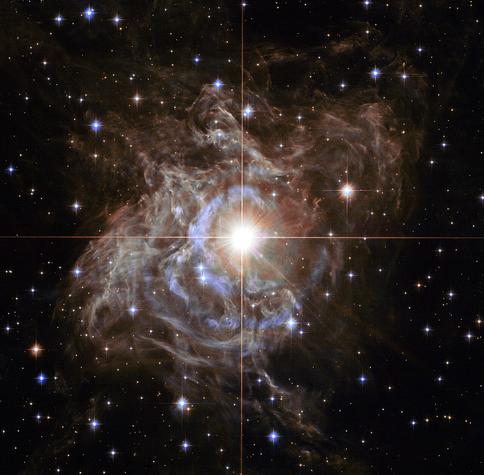

I have a bit of time on my hands, so let's do another 24h round of #AskAnAstrophysicist, but this time it's a thematic one.

⭐ What do you want to ask an astrophysicist about stars? ⭐

(I am a professional astrophysicist, part of whose work concerns itself with high mass stars & their winds and I've also taught a variety of astro university courses)

Boosts welcome. I may not be able to reply to all in case of many questions.

#SciComm #WissKomm

@vicgrinberg what does the night sky look like from space ? Getting above the atmosphere, with the naked eye how would it appear? Is the milky way still distinct ? All the photos I see tend to include earth.

#AskAnAstrophysicist

@quixoticgeek it's going to be pretty much the same - the stars are very far away and our atmosphere very thin, so get to outside of it does not change much in what we see. What we get rid off are the effect of the atmosphere - the twinkling is because of atmospheric effects (similar effect to warm air above a hot street), the stars themselves don't twinkle! So the view is in a way clearer.
@vicgrinberg In this year of our lord 2026 with that monstrosity in office I did not need to know that not only will there be no shining city on the hill if we can’t get the votes to save democracy but the stars don’t actually twinkle. @quixoticgeek
🤣 🤣 🤣

@Pineywoozle If it helps, some of them do pulsate (though I don't think this could ever be evident by eye).

https://en.wikipedia.org/wiki/Cepheid_variable

@vicgrinberg @quixoticgeek

Cepheid variable - Wikipedia

@internic @vicgrinberg @quixoticgeek
🤣 🤣 🤣 You’re a ray of sunshine on my dark day.

@vicgrinberg @quixoticgeek

I've clearly been misinformed about the reason for twinkling stars - if it's just the atmosphere wouldn't the planets twinkle too?

@OneInterestingFact @quixoticgeek you were, sorry! Stars twinkle because they are so far away that they are essentially point like. Planets are much closer by and thus actual tiny circle. Here a classroom experiment to see the same result: https://demos.smu.ca/demos/astronomy/25-non-twinkling-planets

@vicgrinberg @quixoticgeek

Hmm, ok. Yes, the explanation I was given about interstellar gas doesn't make sense either...

@OneInterestingFact @quixoticgeek sorry to hear that you got a wrong explanation (hope the person does not do this professionally! The twinkling question is one of the astro basics that keeps also coming up in outreach settings 😅 ) and glad I could clear things up.

@vicgrinberg @quixoticgeek

This was a very long time ago - probably one of my parents but I can't be sure.

Stars don’t twinkle? 🥺
@ohaijuli.bsky.social @quixoticgeek sorry 😅 see it this way: some of these stars may be someone else's Suns and those beings definitely would not want their Sun to twinkle...
Okay, fine. Hope the far away space people appreciate their non-twinkly suns. ^^
@ohaijuli.bsky.social @vicgrinberg just like we appreciate that our sun doesn't twinkle on us over the course of the day. But it does appear to the far away space people like it twinkles. Assuming they have an atmosphere like earth...
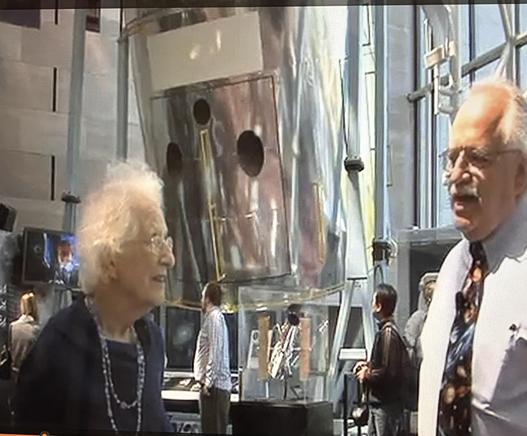
@vicgrinberg @quixoticgeek I had the honor of having this explained to me for the first time by Dr. Nancy Grace Roman. And we were standing in front of the Hubble Space Telescope when she did it!
@Spacehistory @quixoticgeek oh wow 😍😍😍
@vicgrinberg @quixoticgeek There was nothing more fun than watching Dr. Roman muscle her way through the National Air And Space Museum in time to catch a bus. Just this tiny, little 90 year-old woman zipping past 7000 tourists to get where she was going.
@vicgrinberg @quixoticgeek Also fun was watching all of the young astrophysics Ph.D. candidates who were working as docents for the summer, running up to her and offering to walk her to the ladies room. She was like Mick Jagger in that museum!
@vicgrinberg @quixoticgeek And so you know I’m telling the truth: This is Dr. Roman with Dr. David DeVorkin, who at the time was the curator of telescopes at the Smithsonian. I’m behind the camera, producing the segment.
@Spacehistory @quixoticgeek 🤩 (I had the honor to meet Jocelyn Bell Burnell but never Roman!
@vicgrinberg @quixoticgeek I lived near Dr. Roman, so throughout this project, I would go to her apartment in Maryland, and then drive her down to the Museum in DC. We had some great talks in the car.
@vicgrinberg @quixoticgeek Last one. Here’s part of her explanation.
@vicgrinberg can I ask a follow up question? What would the night sky look like on mars ? In all the photos I've seen the sky is a sort of muddy colour. I'm guessing thin atmosphere means less Rayleigh scattering? But at night, if you were stood on the martian surface would the view be similar to if you were somewhere like the Australian outback away from all the pollution?
@quixoticgeek yes, the atmosphere is very thin, but I'm not sure how dusty it is - Mars does tend to have sandstorms and similar... Sorry, planetary atmospheres in the solar system are not my expertise!
@quixoticgeek @vicgrinberg Stars look more clear from the top of mountains.
But Mars would be a very very high mountaintop.
The Martian atmosphere, thin though it is, thins out slower than ours as you go outward, under the smaller gravity. So the distance for light etc to be affected is at least further than one might expect.
I'm told that is one of several problems for meteors and spacecraft.
@vicgrinberg I boosted, but I never really learned anything about stars, so I feel totally inadequate to be asking a question. But thanks for doing this. :)
@johnnythan thanks for boosting - and it's also interesting for me to know that folks know nothing about stars. I'm so used to people knowing a lot about them in my everyday life 😊
@vicgrinberg @johnnythan This XKCD is more accurate than one might think. I've been guilty of it too.

@vicgrinberg @johnnythan

I know bits and I totally get what I saw in another part of this thread: Knowing for its own sake (curiosity) is cool and probably very human.

(And often enough some point later even "useful" stuff comes out from what starts as fundamental research.)

@johnnythan @vicgrinberg Seconded - I'm the same. I don't know enough to ask a question but am fascinated by the answers. And the questions! Thank you for sharing your time and knowledge. Great thread.
@CiaraNi @johnnythan @vicgrinberg Keep reading the QAs, maybe something will come up (at least it's what I hope :)

@vicgrinberg

What are some of the biggest unanswered questions about stars? What don't you know about stars that you wish you did? And might some of these questions be answered in the future with better equipment/technology/computing power?

@bkahn oh, there are still so many! I'll pick one I especially like: we do not understand the most massive stars that existed very early in the universe, when there were few heavier elements super well. Somehow, in their death, these stars have managed to create black holes that are just so bigger than we would have expectes - but we do have ideas what may be the cause, so we are working hard on finding out which one is correct.
@vicgrinberg @bkahn Interesting! So how do we know that these black holes were caused by single supermassive stars rather than having grown over time?
@thomastc @bkahn they are in (binary) systems where they cannot have grown by enough and there are too many such systems for it to be a fluke.
@vicgrinberg So to my knowledge stars tend to emit different visible and invisible wavelengths depending on a variety of factors. Our telescopes tend to focus on a given range of the full spectrum depending on their design, as a necessity of visualization and engineering.

My question is, are there any stars that we've studied in-depth enough to understand / visualize their complete spectral output, or is our data not that complete yet?
@celestiallavendar we do have a pretty good prediction for the overall shape of the emission of stars (they pretty much radiate as any body of a given temperature would, with well defined amounts of radiation in different wavelength bands) and we've got a lot of what we call "multiwavelength" coverage of many different stars. It doesn't mean that we are done, though - telescopes cover not only different wavelength ranges, but also have different resolution and there is more info in there.
@vicgrinberg I'll have to check out the multiwavelength coverage, that sounds very interesting. The fact that so much of what's out there we can't truly see constantly fascinates me, so I appreciate your answer!
@celestiallavendar I feel the same! This (or a variation thereof) https://asd.gsfc.nasa.gov/archive/mwmw/mmw_images.html is still one of my favorite images ever!
Multiwavelength Milky Way Images

Astrophysics researcg=h to support astroparticle (gamma-ray and cosmic-ray), x-ray, gravitational-wave, observational cosmology, exoplanet and stellar astrophysics.

@celestiallavendar @vicgrinberg
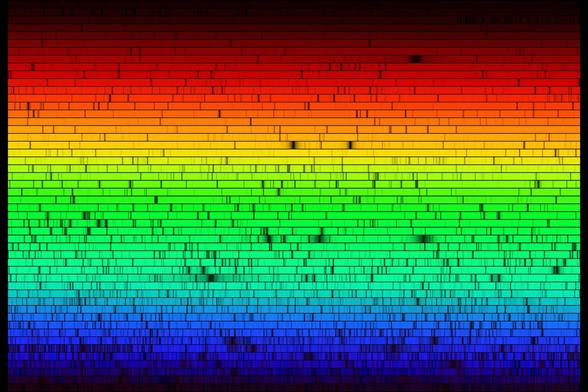
Hey friend, I wanted to drop in to say we have measured the Sun's full spectrum, which is of course a star.
Here's a really cool picture of its visible spectrum
https://noirlab.edu/public/images/noao-sun/
@vicgrinberg
Is Johnny Depp nice in person?

@vicgrinberg say you have a sci-fi spaceship that you can manipulate the propulsion from to take flight from the surface of a planet, at 1 m/s … because we live forever or something

What happens when the futuristic superforce of the motor pushing you at 1 m/s doesn’t come closer than that to escape velocity?

@Kierkegaanks @vicgrinberg
Escape velocity, V_e, is the distance that you can turn off your engines and not fall back to the planet. It depends on the strength of gravity, which falls off with distance. The formula for escape velocity is
V_e = sqrt(2GM/d)
(https://en.wikipedia.org/wiki/Escape_velocity)

G is newton’s gravitational constant
M is the mass of the planet
d is the distance to the center of the planet

So, if you have a 1 m/s drive, to reach escape velocity, you need to run it until the distance, d, is big enough that V_e < 1 m/s. Then you can turn it off.

Escape velocity - Wikipedia

@cdunnpasadena @Kierkegaanks @vicgrinberg

Yes the key is that escape velocity varies with distance because gravity's force varies with distance. When you are close to the surface of the earth the escape velocity of earth is quite high. But if earth went "poof" and ceased to exist, your escape velocity relative to say Jupiter would be pretty much not that big a deal. I mean, you don't feel like it's hard to get out of bed because of the pull of Jupiter right?

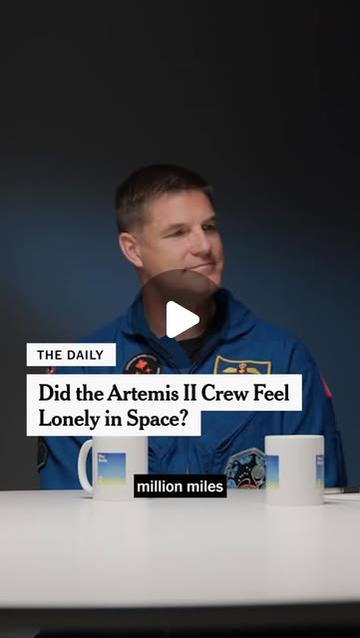
@vicgrinberg I recently saw an interview clip of the Artemis II crew, and I think either Reid or Victor said that something that surprised them was the “three-dimensionality” of space — that the stars appear more 3-D out there than they do when seen from Earth. Do you think you could expand on that? I’m having a hard time visualizing how much more “3-D” a field of distant points of light could look. Is it that the parallax effect on stars was more noticeable at their speed?
@bluejay I have no idea what the Artemis crew meant since I've never been to space or seen the interview. Parallax needs you to make measurements on two very far away locations. And depth perception does not work on high distances. What I imagine is that stars don't twinkle in space - twinkling comes from the atmosphere, so the view must be more clear and thus our brains plays interesting games with us interpreting this!

@vicgrinberg Thanks! I found a link to the clip, if you can access it; it’s actually Jeremy Hansen making the observation, near the start of the video.

https://www.instagram.com/reel/DYA2FZAgUys/

The New York Times on Instagram: "The astronauts of NASA’s Artemis II mission flew farther from Earth than any humans in history. They dealt with zero gravity, they stared into the dark void of space and contemplated our place in the universe. When they got back last month, they were hailed as heroes. “The Daily” asked kids to send in questions for the crew. The astronauts — three Americans and one Canadian — sat down with Rachel Abrams to answer them. Tap the link in bio to listen to or watch the full conversation. Video by The Daily Team/The New York Times"

36K likes, 348 comments - nytimes on May 6, 2026: "The astronauts of NASA’s Artemis II mission flew farther from Earth than any humans in history. They dealt with zero gravity, they stared into the dark void of space and contemplated our place in the universe. When they got back last month, they were hailed as heroes. “The Daily” asked kids to send in questions for the crew. The astronauts — three Americans and one Canadian — sat down with Rachel Abrams to answer them. Tap the link in bio to listen to or watch the full conversation. Video by The Daily Team/The New York Times".

Instagram
@bluejay @vicgrinberg I think it has more to do with how bright stars in front of dark clouds of the Milky Way stand out at a dark observing site. I've heard from a number of people who had that impression after observing from observatories on the Atacama desert and I have it there as well.
Was it really that dark in the Artemis capsule, though?

@PWei888 @vicgrinberg They did turn off the lights in the capsule to take photos, and even put T-shirts up over the windows facing the Earth to block out Earthshine. So maybe it got pretty dark?

I found the interview clip and posted it in another reply here. Jeremy Hansen talks about how he could see that some stars were closer than others, and how he found it hard to describe to people. Maybe you just had to be there.

@bluejay @PWei888 @vicgrinberg They were also in full eclipse at least twice, once by the earth and once by the moon.

@vicgrinberg i have a rather metaphysical question that has been torturing me a while. What's the purpose of doing all this great science out there in space, when we are just destroying our very own and only spaceship at the same time?

I am really struggling to find sense in my plasma phenomena thesis given the state of the world.

@Nephele to me, doing science is like doing art, it's deeply human. The first humans pressed their ocher red hands onto walls of caves and it still touches me. The same way science and trying to understand the world touches something deep in the human soul. When we stop doing art and trying to understand the world (so doing science), we stop being human.

And *hugs* it's hard times...

@vicgrinberg Yes, so very much this!

When doing outreach I regularly get similar questions, mostly from non-scientists with a business background. They try very hard (and fail) to see the “benefit” in business terms of fundamental research. It's not the point why we do science. And on a more personal note it still sometimes baffles me just how different people's world views can be.

@Nephele

@benknispel @vicgrinberg i mean, I don't know if my findings will ever be of use or if mankind just destroys itself before that... That's the problem with any fundamental stuff today.