I have a bit of time on my hands, so let's do another 24h round of #AskAnAstrophysicist, but this time it's a thematic one.

⭐ What do you want to ask an astrophysicist about stars? ⭐

(I am a professional astrophysicist, part of whose work concerns itself with high mass stars & their winds and I've also taught a variety of astro university courses)

Boosts welcome. I may not be able to reply to all in case of many questions.

#SciComm #WissKomm

@vicgrinberg what does the night sky look like from space ? Getting above the atmosphere, with the naked eye how would it appear? Is the milky way still distinct ? All the photos I see tend to include earth.

#AskAnAstrophysicist

@quixoticgeek it's going to be pretty much the same - the stars are very far away and our atmosphere very thin, so get to outside of it does not change much in what we see. What we get rid off are the effect of the atmosphere - the twinkling is because of atmospheric effects (similar effect to warm air above a hot street), the stars themselves don't twinkle! So the view is in a way clearer.
@vicgrinberg In this year of our lord 2026 with that monstrosity in office I did not need to know that not only will there be no shining city on the hill if we can’t get the votes to save democracy but the stars don’t actually twinkle. @quixoticgeek
🤣 🤣 🤣

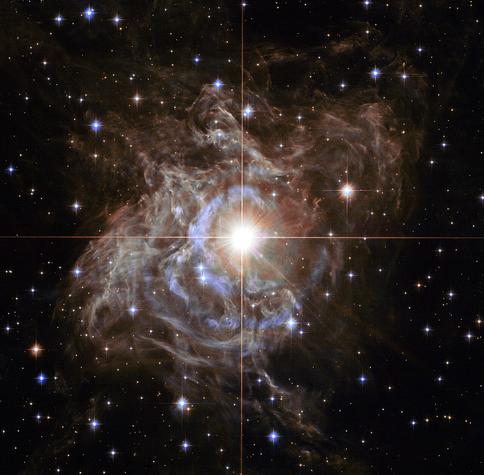
@Pineywoozle If it helps, some of them do pulsate (though I don't think this could ever be evident by eye).

https://en.wikipedia.org/wiki/Cepheid_variable

@vicgrinberg @quixoticgeek

Cepheid variable - Wikipedia

@internic @vicgrinberg @quixoticgeek
🤣 🤣 🤣 You’re a ray of sunshine on my dark day.

@vicgrinberg @quixoticgeek

I've clearly been misinformed about the reason for twinkling stars - if it's just the atmosphere wouldn't the planets twinkle too?

@OneInterestingFact @quixoticgeek you were, sorry! Stars twinkle because they are so far away that they are essentially point like. Planets are much closer by and thus actual tiny circle. Here a classroom experiment to see the same result: https://demos.smu.ca/demos/astronomy/25-non-twinkling-planets

@vicgrinberg @quixoticgeek

Hmm, ok. Yes, the explanation I was given about interstellar gas doesn't make sense either...

@OneInterestingFact @quixoticgeek sorry to hear that you got a wrong explanation (hope the person does not do this professionally! The twinkling question is one of the astro basics that keeps also coming up in outreach settings 😅 ) and glad I could clear things up.

@vicgrinberg @quixoticgeek

This was a very long time ago - probably one of my parents but I can't be sure.

Stars don’t twinkle? 🥺
@ohaijuli.bsky.social @quixoticgeek sorry 😅 see it this way: some of these stars may be someone else's Suns and those beings definitely would not want their Sun to twinkle...
Okay, fine. Hope the far away space people appreciate their non-twinkly suns. ^^
@ohaijuli.bsky.social @vicgrinberg just like we appreciate that our sun doesn't twinkle on us over the course of the day. But it does appear to the far away space people like it twinkles. Assuming they have an atmosphere like earth...
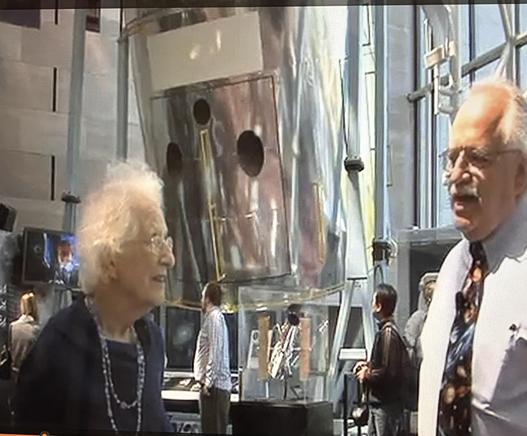
@vicgrinberg @quixoticgeek I had the honor of having this explained to me for the first time by Dr. Nancy Grace Roman. And we were standing in front of the Hubble Space Telescope when she did it!
@Spacehistory @quixoticgeek oh wow 😍😍😍
@vicgrinberg @quixoticgeek There was nothing more fun than watching Dr. Roman muscle her way through the National Air And Space Museum in time to catch a bus. Just this tiny, little 90 year-old woman zipping past 7000 tourists to get where she was going.
@vicgrinberg @quixoticgeek Also fun was watching all of the young astrophysics Ph.D. candidates who were working as docents for the summer, running up to her and offering to walk her to the ladies room. She was like Mick Jagger in that museum!
@vicgrinberg @quixoticgeek And so you know I’m telling the truth: This is Dr. Roman with Dr. David DeVorkin, who at the time was the curator of telescopes at the Smithsonian. I’m behind the camera, producing the segment.
@Spacehistory @quixoticgeek 🤩 (I had the honor to meet Jocelyn Bell Burnell but never Roman!
@vicgrinberg @quixoticgeek I lived near Dr. Roman, so throughout this project, I would go to her apartment in Maryland, and then drive her down to the Museum in DC. We had some great talks in the car.
@vicgrinberg @quixoticgeek Last one. Here’s part of her explanation.
@vicgrinberg can I ask a follow up question? What would the night sky look like on mars ? In all the photos I've seen the sky is a sort of muddy colour. I'm guessing thin atmosphere means less Rayleigh scattering? But at night, if you were stood on the martian surface would the view be similar to if you were somewhere like the Australian outback away from all the pollution?
@quixoticgeek yes, the atmosphere is very thin, but I'm not sure how dusty it is - Mars does tend to have sandstorms and similar... Sorry, planetary atmospheres in the solar system are not my expertise!
@quixoticgeek @vicgrinberg Stars look more clear from the top of mountains.
But Mars would be a very very high mountaintop.
The Martian atmosphere, thin though it is, thins out slower than ours as you go outward, under the smaller gravity. So the distance for light etc to be affected is at least further than one might expect.
I'm told that is one of several problems for meteors and spacecraft.