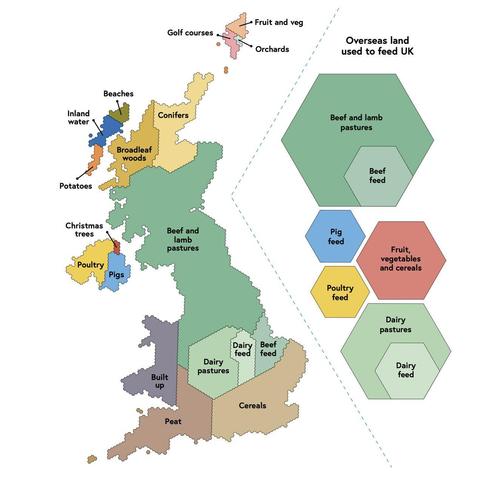
Carbon Brief have an excellent Q&A on the new “Land Use Framework” and what it means for food, nature and climate. One key takeaway is that renewable energy space for solar and wind will still take up less space than golf courses by 2050 at just 1%.

This graphic showing the current land use proportions is illuminating. The amount of land used for growing animal feed, in addition to the grazing area is huge! #ClimateChange #CleanEnergy #Renewables #Vegan #Vegetarian
https://www.carbonbrief.org/qa-what-englands-new-land-use-framework-means-for-climate-nature-and-food/

@MrLee

This is an amazing visualization!

@mapasmilhaud

#AmazingMaps

@MrLee

When talking about land-use, it is, however, important to understand that land is not something that is used and then thrown away (ok, there are some heavily destructive uses, e.g. mining).

Land provides multiple services (biodiversity, carbon storage, water cycling, recreation, agricultural production, space for building stuff...). Some land-uses reduce the capacity of land to provide these services.
The next issue is the order in which the services are priorized. Some services have a more or less evident price tag (agricultural production, or space for buildings), while other (ecosystem) services, like water purification, carbon storage or biodiversity, are usually not taken into account by the market, except by really motivated people(TM) or administrations treating these services as public goods that deserve protection.

So, to make a fair comparison, it is important to assess the capacity of the different land-uses to provide the land-related services. And here it gets somewhat messy because management comes into play. E.g. 'agriculture' can be an conventional, pesticide-based soil degrading extractive system with all the consequences for soil, water and biodiversity; however, you can also have an agroforestry system that provides its functions in the interest of society and nature.

And here comes into play that e.g. pastures, despite taking up a lot of land, can be quite well-managed and score high on ecosystem services (of course, capitalism promotes the opposite: land degradation an unnecessary suffering*).
Just wanted to provide this context to the great map.

* of ccourse, reducing meat intake is a goal the whole society should work towards.

#LandUse #EcosystemServices #Biodiversity #Pastures #Agroforestry #LandManagement

@earthworm Great points, which the article does mention.

@MrLee

totally, the article is as good as the map!

@earthworm @MrLee although ecologically sustainable agriculture can and does exist, the industry as a whole uses its promise and potential to deflect attention from the fact that the bulk of what they do is not sustainable. A lot of enthusiastic sustainable agriculture practitioners help them in this respect by focusing on "but you can graze sheep sustainably" etc, not the more important point that most farms still do not.
@bencourtice @earthworm @MrLee 'sustainable' is a word that can mean just about anything. There are 13 different definitions. When barnaby joyce uses it for instance he means 'economically profitable' Bureaucrats and politicians consequently love using the word.
@crn114 @earthworm @MrLee yes, I tacked the adjective "ecologically" on because of that

@MrLee This is really interesting data but the use of a map to display the land use is confusing, in my mind. Obviously the land use doesn't relate to the geographic area where it is shown but it took me a minute to figure that out.

Maybe I just need more coffee though!

@ccferrie @MrLee
It looks very inaccurate.
@raymaccarthy @ccferrie @MrLee
It is odd for the map to depict Britain when the report is specifically restricted to England - this rather undermines the message it is trying to convey.

@rogerb @ccferrie @MrLee
See Wales or the part of England full of orchards and Market gardens (Evesham, Worcester etc).
Nor is Co. Antrim in NI "Christmas trees". Only pigs & poultry shown in NI, which are mostly indoors, but plenty of sheep, cattle and other things outdoors.

It looks like a random AI map,

@ccferrie @MrLee, yes… according to that map, many (most? all?) of us live in Wales, and Kielder Forest is pasture.
@lp0_on_fire @ccferrie
Witch Climate Change that might actually happen! 😜

@MrLee
What it misses is not all land uses are exclusive uses of the land.

Eg. Solar panels can be placed on suitable roofs, or on grazing land (a number of studies indicate this increases productivity).

@jwi It says that in the report
"This estimate is based on the assumption that all extra solar will be installed on the ground, which the report says is a “highly conservative and unlikely scenario” given that many panels are anticipated to be placed on rooftops."
@MrLee
This graphic leaves me with many questions. Isn’t it a bit disingenuous to lump beef and lamb together? They typically use rather different terrains, some of which may have no other viable use. Or am I wrong? The graphic leaves me no way of knowing.
Also “golf courses” are not necessarily all fairways. Some have mature trees. I fear the full picture is a lot more nuanced than this simple graphic pretends.
@KimSJ
Much more nuanced and well worth reading the full report. 👍