 Amy Diehl, Ph.D.
Study (N=2,689) of men (18-34) finds 95.1% reported using strategies to get a woman to have sex who they knew did not want sex & had not consented; 65% successful. Consistent physical pressure & verbal coercion common; overt force, physical restraint, pain also used. https://journals.sagepub.com/doi/10.1177/08862605261432630
 cobalt
@amydiehl This is very distressing. When I think of the immense pressure on young women in this present US era, it’s very difficult to avoid aggressive cis male predation. Far more than when I was in my early 20’s. And I have 2 very strikingly beautiful granddaughters who often deal with it.
 Hannah Celsius
It has always been like this. In my early 10's, 20's, 30's, 40's, 50's and still now 60's. And long before. Hopefully not long after me.
First sentence introduction:
"What is striking about sexual aggression is that despite decades of research, public health initiatives, education, media attention, and policy focus, there has been no discernible decrease in rates since first assessed in the 1980s and 1990s."
 gabriel
@amydiehl OK, but the paper was focused on that demographic:
"This research was designed to focus on men who admit having intentionally and knowingly sexually aggressed against a woman who they knew did not want sex nor consented to it, including strategies to overcome her reluctance, circumstances, motivations, and positive and negative outcomes."
I'm not coming to argue "not all men", but from reading the tooth one walks away with the idea that 95% of men force women to have sex, and that is not what the article says at all. What it claims is that of a population that admits to intentionally sexually aggressed woman, 95% report to use strategies to get a woman to have sex when she hasn't consented.
I mean, clearly the paper itself claims "not all men".
 Tomás Hradcky
@gabriel And you are definitely coming here to argue ‘not all men’.
As I say, not me, is what the paper says. You can read it yourself and make up your mind.
I think we need to understand the literature to be able to have strategies to curve this situation. It would be very different if we are talking of 95% of the population or if it the number is different.
Therefore it is important to clarify, in my mind, what the study actually claims.
 Random Walsh
@gabriel @TomasHradcky The nuance is important indeed. And this has nothing to do with "not all men". The study is not just about perpetrators' modus operandi, it's also about methodology (anonymity and non-judgemental approach), which are essential to understand if one is to grasp the fact that these men know what they're doing (otherwise they'd confess by accident, which they obviously don't). This tells volumes about their line of defense ("oh I lost control"). They don't lose control at all.
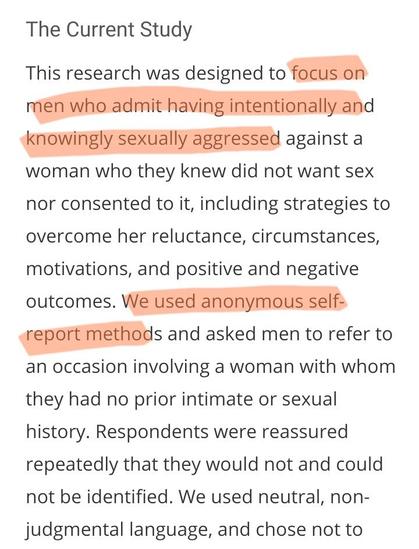
@gabriel @TomasHradcky Yet actually I'm quite surprised to read that "most men don't". For I'm afraid most men do. So my opinion on this is "while I think most men do, I also think that these study says the opposite (in which case I think it's interesting for the reasons stated above) , but at the same time it seems to say that most men are prepetrators". So honestly I don't know what to think ABOUT THIS STUDY (as far as masculinity is concerned I know what to think, unfortunately).
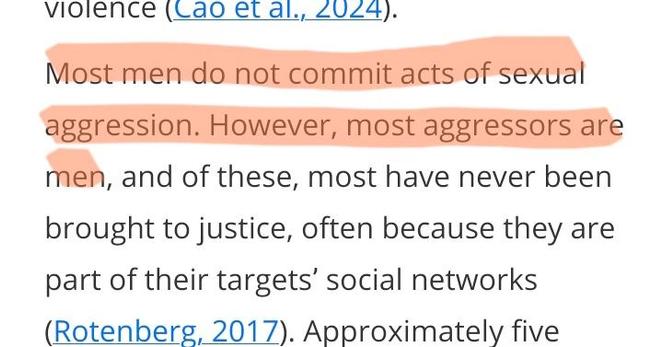
@gabriel @TomasHradcky But I'm pretty sure one doesn't have to be a masculinist to say or think that these study "doesn't say that". Tbh, before I commented, I was about to write "damn I knew it!". Discussion on this matter is legitimate. Should one be afraid to discuss this and that for fear that they might look suspicious ? Nobody here is impatient to take the study away with them and use it as an excuse to abuse women. All I see is people talking. So let's talk.
 Duckbilled Plattypus.
Again, you don't know it's not also 95% of all men. A number you claim is shocking to you.
And yet, you continue to insist 95% is too broad an assumption that upsets you because women might be asserting it's all men or a lot of men. No one except you brought up 100% all men. Then you got upset about it.
Sealion much?
I love that you insist on being blocked. Like 95% of all #Replyguys who responded to this post. 👍
If it is 95% of all men, then this would also imply that _at least_ 95% of all men who had sex in the last two years had multiple sexual partners. I find this figure to be quite strange, given what other studies of sexual behavior of younger generations show.
Now, I am answering in good faith, because I think we are having a conversation. But if you feel differently, feel free to block, I do not need the validation of your attention.👋🏽
 Joykill
What does having multiple partners have to do with this at all? Rape can happen in monogamous relationships too, you ghoul.
 Colman Reilly
@joykill @gabriel @pattykimura it specifies that they did not have a prior sexual/romantic relationship with the woman to separate out relationships.
 aeva
aeva iwein
iwein@gabriel
#notAllMen is the problem where this argument is used "to deflect attention away from men".
Imho you're not doing that.
Obviously, even if only a small fraction of men are doing this shit (and we know it's not a small fraction), all men are obligated to do better to make it stop. You didn't say anything against that. I wish you were not attacked over this and we could focus on the problem at hand with knowledge of the real data 🙇♀️
 Juno Jove
@iwein @gabriel
The plea is rather "All Men until No Men", where #NotAllMen tries to turn the argument away from the systemic matter, absolving one or some individuals, while ignoring the fact that even "nice" men benefit quite significantly every day from a system that oppresses women.
The plea is rather "All Men until No Men", where #NotAllMen tries to turn the argument away from the systemic matter, absolving one or some individuals, while ignoring the fact that even "nice" men benefit quite significantly every day from a system that oppresses women.
 Leslie Burns
@gabriel That is a misreading, IMO. The criteria for participation were, "Men were eligible if they self-identified as men, were in the age range 18 to 34 years, and reported having had a sexual encounter with a woman in the past 2 years."
Also, if it were only for those who admittedly coerced, etc., then the percentage would have been 100, not 95.1.
I'm not misreading, I'm quoting the paper.
Also, there may be subtleties that lead to the question to not have 100%. Maybe someone identifies as a sexual attacker but not as a strategist. Or they were misidentified and they are not part of the universe. Or...
I'm not claiming that the percentage of men who have sexually assaulted women is not 95%. I'm claiming that this paper was not set up to answer that question. And the quote seems to point into that direction.
That's fine, we can disagree. Have a nice evening.
 flafflar
@gabriel This is not a disagreement bro, you're straight-up misinterpreting the study
 Ted Lemon
@LeslieBurns @gabriel @amydiehl
One interesting thing they don't correct for is men who didn't have sex during the two-year period prior to the study.
Also, I worry this will be used to conclude, a la Dworkin/McKinnon that men are just naturally this way, rather than that we are socialized to behave this way pretty much from birth, and have to learn our way out of it, hopefully before we do something awful. The most commonly reported coercive technique is "tells her what she wants to hear..."
@LeslieBurns @gabriel @amydiehl
I mention this because it's been very clear to me for a long time that boys and young men need clear and explicit education on how to behave towards members of the desired sex (as do girls and young women).
And that ain't happening.
And bashing won't help.
I also concluded the same, that this could be used to argue that "men are this way". And while sexual aggression is a serious problem that is under-reported, a 95% is just too high. That's why I think it is important to clarify the number, and the context.
Unfortunately if this goes viral that won't be effective, because the first message is what people generally remember.
I grew up during the Dworkin/McKinnon period, and bear the scars—that's why I remember their names.
The problem with their work is that they just figured out who to blame, not what to do to fix the situation, and those of us who took them seriously wound up hating ourselves for the misdeeds of others instead of doing anything about it.
 スパックマン クリス
@LeslieBurns @gabriel @amydiehl
I believe you are correct. There are some language issues with the writing, imho, that may cause some confusion, but the paper clearly states that:
"Of the final sample of 2,689 men, 95.1% reported having recently used at least one of the strategies to force a woman to have sex" (Results section, para 1)
They then say that the ones who did not were demographically indistinguishable from the 95% group.
Likely the 95% group then received follow up questions.
@LeslieBurns @gabriel @amydiehl
Certainly, the wording of the original request for participants may have turned off many men who would never use the strategies --- the wording was basically "let's hear the men's side of the story". If you have never been in a he-said / she-said situation, you may not have signed up for the research.
My feeling is that this is important research, and further research is needed.
I think is really valuable work, and it is important to document in the literature the strategies that are used by aggressors to force woman to have sex.
But I also think that in this particular instance finding information towards their RQ1 (what % of men..) is in conflict with their other RQ (how effective are the strategies, etc).
@LeslieBurns @gabriel @amydiehl
Let me emphasize the "may not have signed up". We don't know. (So, more research.)
BUT, the number of men who do these things should be as close to zero as nature / nurture allows. There will always be some who are willing to hurt others for their own selfish reasons. However, there is no ethically acceptable reason for the # in any given society to be in double digits, much less 60, 80, or 95%.
We can do better. Seems like we could barely do worse.
You don't actually know, based on this study, what percentage of all males are in this self-identified category of sexually aggressive men. So maybe not all men, maybe 30% or 70% or 99%. What number is "not all men" enough for you? 1000 men responded to a similar study solicitation in 48 hours on reddit, according to this study.
You really did post simply to say "Not all men." Do you also post "Not all white people" too?
I was shocked by the 95% figure, so I downloaded the paper. In it, I found out that the universe of the study is not "all men" but "men who identify themselves as aggressors". Now, when I claim "not-all-men" here, is not a way to deviate the conversation. Is to focus on what the intent of the paper is, and which conclusions can be taken from it. One of them, we need to know what the actual % is. Or focus on what aggressive men do, goal of this particular paper.
 Jenniferplusplus
 theTangent.Space
 Jennifer Moore 😷
I just read the paper, and I'm not entirely satisfied with either mini-précis in the 2 toots above, or indeed the researchers' own framing.
"A sample of 3,011 self-identified men ages 18 to 34 (Mage = 27.31) was recruited in the Spring of 2023 using an online panel (Qualtrics Research Suite) that invited all men who met criteria into the study. The study was described as exploring positive and negative interactions between men and women in sexual situations. The consent form indicated that the survey was men’s opportunity “to provide their side of the story given that we have heard so much from women” about male–female sexual interactions, repeatedly assuring them of their guaranteed anonymity. ...
"Men were eligible if they self-identified as men, were in the age range 18 to 34 years, and reported having had a sexual encounter with a woman in the past 2 years. ...
"Participants were asked “In the past four years, how many times have you used any of the following strategies to get (or try to get) a woman to have some type of sex when she did not want to have sex or acted like she did not want to have sex? (Only women you have recently met—no sex or dating history with them beforehand).”"
So, @gabriel - yes the researchers were focusing on pressure tactics, but this cohort wasn't recruited _from_ people who _already_ said they had pressured women into sex.
On the other hand, @amydiehl, I think the "sexual encounter with a woman in the past 2 years" criterion is a significant distinction from men-of-that-age in general, because there will be men who aren't using the pressure tactics and _haven't_ had sex with a woman in the last 2 years - and those seem to me quite obviously _not_ independent variables. Young men who are just chilling with their friends, or who are "waiting for the right person", or indeed who are isolated and unhappy and never leave their house, simply aren't part of this cohort.
For this reason, even though the paper says
"RQ1: What proportion of men report a history of using strategies to force a woman to have sex?" ... I don't see how they think they're measuring that.
It's still valuable for the list of tactics and the relative prevalence of the tactics in relation to each other. And it does of course show that there are thousands of blokes who think it's okay to push reluctant women into sex, which is yikesy enough.
Open to contradiction if I've read it wrong!
 suzanne
 Marianne
 The Cheekqualizer
@amydiehl 95% admitted to it in a survey. Hard to imagine there aren't some who didn't admit to it.
 wbftw
wbftw Consent Games
For this #SAAM we'd love to see more folks learn and share our free trauma-informed games about #consent.
🎮'ADRIFT' is appropriate for all ages.
🎮'A Thousand Cuts' is for college students and explores the Title IX process.
Age level for the other games is somewhere in-between. Two games have #CW and are labeled.
 Brantley Harris
@amydiehl Looking at the survey questions, it strikes me that Pharrell Williams and Robin Thicke's song "Blurred Lines" advocates for a fair number of the strategies here.
This is absurdly awful.
 Joy_intl
@deadwisdom i always hated that song. @amydiehl
 Cassandrich
 GhostOnTheHalfShell
RE: https://mstdn.social/@MaryAustinBooks/116398194960868150
No further comment is necessary
 slash
slash@amydiehl @janeishly That's shocking. On the other hand, 100% of women that I know well enough to have this sort of conversation with report being sexually assaulted at some point. So maybe this shouldn't shock me as much as it does.
 Mags at Large
This is so, so sad. Important study, yes! Horrendous behavior, yes!
But just so frickin' pathetic.
Sex with someone who actually wants to be with you -- that is sublime.
 acm
acm three tigers in a trench coat
@amydiehl Shocking numbers, hoo boy. And that's even with expectation bias being a major reducing factor for the "more violent" actions.
Unveiling how violent human (and specifically male!) sexuality is will hopefully help our species and societies become better and make things safer... (especially for women, who receive and suffer through the vast majority of this violence)
Reading the article, I have semantic questions - basically:
- Where does persuasion end and non-consent begin?
- Where does privacy end and isolation begin?
This may be a language barrier thing (not a native English speaker), but what is the EXACT question for the "telling whatever she wanted to hear" item? Because (simplified example) if she says she'll have sex with a man if "he's gentle" or "he uses protection", and he /actually/ does, I don't think this should show up in the survey as violent, it should only count as a violent act if the things said were disingenuous.
It might be good if the verbatim survey questions and layouts used to display them were part of the supplementary material.
And given that sex is usually illegal in public, making privacy a prerequisite, of course one partner taking the other(s) somewhere private and controlled (where nobody can walk in unexpectedly) is to be expected for pretty much any sexual act? (I would distinguish this from men doing this to isolate/"impress"/intimidate, but I am not sure the study questionnaire would provide this distinction, or provide clarification for men answering the question)
Lastly, and I hate to say it given how it sounds, would love to see the same survey done with women. (because difference in differences can be a useful metric here to show us what is wrong qualitatively - same as for domestic violence, stating the ratio of transgressions can shut up whataboutists and their ilk)
Quote:
The most common strategy was telling a woman whatever she wanted to hear and this was used by the majority (78.1%) of the 2,557 men reporting any history of forced sex. The following strategies were reported by order of frequency: asked her repeatedly to have sex (48.6%); had a friend, partner, or group of friends help you get what you want (46.6%), had a female friend make the woman feel safe and convince her (43.8%), told her you knew she wanted it (39.3%), focused on a stranger to have sex with (37.9%), had a female friend bring her to you (37.6%), and got her away from everyone to somewhere private and under your control (37.5%).
 Martin Seeger
@amydiehl I feel ashamed...