 Andy Futuro | Horror Author
 Bruce Lawson ✅ ♫ ♿ ✌️♂️✊
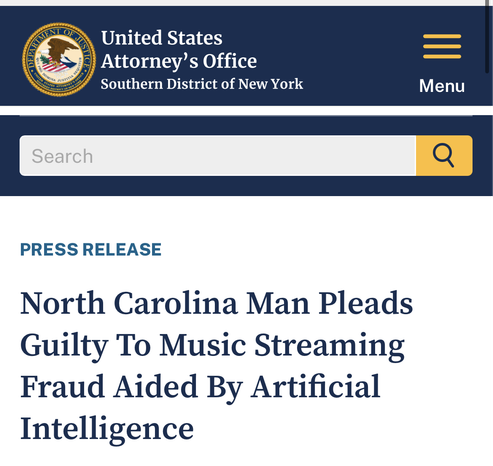
A man used LLMs to generate hundreds of thousands of "songs", then used bots to stream them billions of times, to collect $8m in royalties. https://www.justice.gov/usao-sdny/pr/north-carolina-man-pleads-guilty-music-streaming-fraud-aided-artificial-intelligence-0 Is there a better metaphor for late-stage capitalism than burning resources to make songs that are never listened to, then steaming them to robots that will never hear them, ad infinitum?
 Matt
Matt Reinald Kirchner
@matt @brucelawson like "pay per click" in the early times of ad-business in the Internet. Of course the system was to be exploited.
 Cassandrich
@brucelawson Dumbass. Probably would have gotten away with it if he'd kept it an order of magnitude or two smaller.
 No Way
@dalias @brucelawson I know at least two people that do this that make less than $50k a year. Not defrauded Spotify but defrauding their advertisers. Also not new from AI, they been doing it roughly about a decade. Bots aren't new. Making them at scale though, that now is so easy a caveman can do it instead of tech people aware that size can make you noticeable.
Pretty sure the internet is mostly dead now. I wouldn't pay for any advertising unless your targets are bots
 WilliamBob
@nowayeast - once upon the last millennium some porn sites could be made to click every ad. Good fun. Until... expensive lawyers fron that dirty valley of L.A. Made credible threats. Seeing as it was them, metallic and more suing and winning compliance wasn't hard😬But some were!
 Ashwin Dixit
Money is not the point. Art is. 😃
 Gary
Gary 
@brucelawson it's more than a little bit Devil's Advocate, but I'm struggling to see how this is fraud other than that it cost Spotify $8m
The money certainly didn't get diverted away from other more deserving artists. (*edit* apparently it does, as Spotify no longer pays artists per stream, but as a percentage of overall streams). It's only Spotify that's out of pocket because someone gamed their broken business model.
Fuck 'em 😒
(But of course we all know who the US courts will side with)
 Alessandro Corazza 🇨🇦
Yeah, same - at worst this seems a violation of Spotify ToS for siccing fake listeners on their servers. Nothing was taken from other artists, and Spotify allowed him to upload the deluge of AI slop tracks in the first place.
 Tor Iver Wilhelmsen
@alessandro @WiteWulf @brucelawson The court, obviously, disagreed with your whitewashing of the fraud.
The Court siding with corporate interests doesn't mean this was an accurate interpretation of the law. I'd like to see their rationale.
If the issue is fraudulent streams taking money from the pooled money given to human artists who publish on Spotify, then this same criticism could be leveled at all AI music on Spotify, which means this is all Spotify's fault - but many AI tracks have already hit big numbers on their platform.
 Adrian Riskin
@alessandro @toriver @WiteWulf @brucelawson
Here's the most recent superceding indictment, which has the government's reasoning. In federal court the judge must determine that there's a factual basis for a guilty plea before accepting it, so there actually was a judge's ruling in this case. [1]
https://storage.courtlistener.com/recap/gov.uscourts.nysd.627522/gov.uscourts.nysd.627522.44.0.pdf
[1] Per Rule 11(b)(3) of the federal rules of criminal procedure. https://www.law.cornell.edu/rules/frcrmp/rule_11
 John
John@AdrianRiskin @alessandro @toriver @WiteWulf @brucelawson I wish the same judge wrote up https://www.headphonesty.com/2025/01/spotify-ghost-artists-cut-royalty-payments-musicians/ with the same style and gravitas.
 johnny anhedonic
@alessandro @toriver @WiteWulf @brucelawson yeah this is what ai is for, this is spotify’s long term business model. the reason they are suing him is because he got on their turf
@toriver @alessandro @WiteWulf @brucelawson I like how you start by assuming that it's fraud, and then attack the person who you are responding to for going against your assumption!
care to support your assertion that it is fraud? it certainly MIGHT be! but you're definitely wrong about what "the court" said - he pled guilty, there was no court ruling in this case.
@Amoshias @toriver @alessandro @brucelawson the justice.gov website literally calls it “music streaming fraud”. There was no assumption made.
Yeah, I'm not adamant that it wasn't fraud, but I wonder how listener bots are fraudulent (assuming "fraud" here is taking money from the royalties pool) but AI music isn't - especially when AI music is not labeled as such and pretends to be a real artist. The only difference I can see is that the latter doesn't harm Spotify - only human artists, so Spotify DGAF.
@WiteWulf @toriver @alessandro @brucelawson so the people accusing him said it was fraud
and your response to that is "case closed, it's fraud."
I hope you are never accused of a crime.
@Amoshias @toriver @alessandro @brucelawson no, my initial argument in this thread (if you read allllllll the way back) was “I’m struggling to see how this is fraud”. Someone else then had a go about making assumptions that it was fraud. There is no assumption, it’s a fraud case, justice.gov says so. That doesn’t mean I suddenly agree that it *is* fraud, just that I didn’t make an assumption that the accusation was fraud when I said I was struggling with it.
Read, the, thread
*sigh*
@WiteWulf @toriver @alessandro @brucelawson you realize that I wasn't initially responding to you, right?
The way you're quoting posts makes it unclear who you're talking to. I suggest adding a line break like I did here, so that we can see who you're talking to and leaving he others CCed at the bottom. I'd also suggest being less aggressive - we're just having a friendly conversation here.
thank you for the formatting advice!
as for the tone advice I'm just responding in the tone of who I'm responding to:-)
@Amoshias @WiteWulf @alessandro @brucelawson THE COURT SAID IT WAS. Why do you assume the corporation runs the court? What is your alternative to courts? Spotify is a shitty company but why defend this asshole just because the target was this company? What if the target was a small company instead?
@toriver @WiteWulf @alessandro @brucelawson saying it in all caps doesn't make it true.
the court did not say this. if you believe I am incorrect, please provide a citation.
@Amoshias @WiteWulf @alessandro @brucelawson The crime he was convicted for was "wire fraud". Which is usually used when someone commits fraud online. Seriously, are you angry the «business model» of siphoning what little Spotify gives artists into the fraudster’s pocket failed?
okay, I think I understand what you're getting wrong. you aren't American, are you? you are fundamentally misunderstanding some things about our legal system. if you are interested, I will explain to you what you're getting wrong. if not, feel free to continue thinking you are right when you aren't :-)
@Amoshias @WiteWulf @alessandro @brucelawson No, I think you are worthy of a mute instead. You are basically trying to refute what the statement linked in the first post says. Trying to argue semantics when what he did is detailed there.
I asked you a very simple question, which was to actually support what you're saying with a citation. Because you're clearly not actually reading it. the linked page is a press release from the department of justice, not a court document. No court ruling was made in this case. the defendant pled guilty.
but instead of trying to understand where you are wrong or be less wrong, you're getting angry and blocking someone who is making you feel bad.
 WesDym
@Amoshias @toriver @alessandro @WiteWulf @brucelawson
The court had to rule that there was a factual basis for the plea before accepting it per Rule 11(b)(3) of the federal rules of criminal procedure. https://www.law.cornell.edu/rules/frcrmp/rule_11
@AdrianRiskin This thread got a lot quieter and more civil once I blocked that jerk.
@WiteWulf @brucelawson haven’t courts ruled that “AI” slop can’t be copyrighted? Licensing music you don’t own the rights to sounds like fraud.
The part I don’t get is if he acted alone why was he charged with conspiracy?
 arrbee
@ShadSterling @WiteWulf @brucelawson
Because its much more difficult to defend against "conspiring" rather than "doing" - it effectively reverses the burden of proof.
Because its much more difficult to defend against "conspiring" rather than "doing" - it effectively reverses the burden of proof.
 Charles A-M
@ShadSterling @WiteWulf @brucelawson
I can imagine a scenario — in today's bizarro tech bro world where workers aren't "employees", drivers for hire aren't "taxis", and purchasing doesn't mean "owning" — where the terms of service of a Spotify type service treats their relationship with the content uploader as something other than "licensing" for tech bro technicality reasons.
Otherwise yeah, you can't license a work without holding its copyright, and this slop definitely wasn't copyrightable.
@ShadSterling @WiteWulf @brucelawson Here's the actual indictment, which describes his dealings with co-conspirators to pull off the scheme: https://www.justice.gov/usao-sdny/media/1366241/dl
It also makes it clear that the fraud is essentially violating the streaming services' terms of service where he agreed (by accepting the terms of service) not to artificially boost streams of the music he uploaded. Whether the work is copyrighted, or copyrightable, doesn't seem to be a factor in the case.
 Otte Homan - remember Geordie
 Sette (they/them)
@WiteWulf @brucelawson I wish that were the case, but artists on Spotify are not paid per stream, but according to their achieved percentage of total streams.
@basil @brucelawson oh, I didn’t know they changed to that hellish method. That’s *awful* 😳
@WiteWulf Spotify used to be the first (?) legally allowed streaming service that claimed to "enable independent artists to publish their work outside of the corset of the music publishing industry". That was a long time ago. It's now just about taking in as many dollars for their shareholders as possible. @basil @brucelawson
 ⊥ᵒᵚ Cᵸᵎᶺᵋᶫ∸ᵒᵘ ☑️
 Kim Possible
@brucelawson That's infuriating. Also, predictable.
And influencers are using AI to add to their stories with a musical style of their choosing and their own lyrics. Where does this leave real musicians and singers?!?
 Alex@rtnVFRmedia Suffolk UK
somehow this reminds me of "butchers pigs" (ceramic ornaments of pigs in a butchers uniform and apron smiling and wielding meat cleavers, which were often on display in butchers here in England)
@kimlockhartga @brucelawson musicians should leave spotify and use bandcamp.
@Reinald you probably missed the memo that Bandcamp has been enshittified as well. @kimlockhartga @brucelawson
@otte_homan @kimlockhartga @brucelawson as shitty as spotify? Maybe it is time, to start an fediverse flavoured thing for a music streaming network.
 Marion 🦋☀️
@brucelawson
I'd say he's got the rules of the system down pat.
And if it weren't such an abominable waste of ressources, it would be quite funny, I think.
But being the way it is, it is just irresponsible waste and greed. And I'm soo tired of these greedy irresponsible man-children...
So, not funny - and no pity.
edit
 Alwin Schoemaker
@brucelawson I wouldn’t be surprised if similar things are happening on YouTube..
@schmkr or Napster or Deezer or .... (it's a long list) @brucelawson
 ReverendD
@brucelawson It's been my single biggest "I guess I don't understand humans" moment. Internet ads being successful.
So you're going to take the word of a company that designs their own metrics and monitors everything behind closed doors. You owe them X amount of money because they reached X amount of people.
Maybe 5% of what you paid for reached customers. Less than 1% cared. 95% of it was people getting spammed trying to read the news or kids downloading minecraft mods these days.
 Urzl
Urzl@brucelawson I hate paying the cost of what he did but I don't know in the larger perspective whether his conduct is "one guy not recycling" or "StarLink destroying the atmosphere" anymore.
 david
david@brucelawson also : why is it a fraud.
 Orb 2069
...I guess this is what courts are for, but don't expect anything more solid than "because our terms and conditions say so!"
 stony kark
@brucelawson @Em0nM4stodon this specific crime is a core part of spotify's business plan
 Joe Brockmeier
@brucelawson Don't forget effectively stealing royalties from other artists who actually deserve them...
 Eggs now in different baskets.
@jzb @brucelawson How companies such as Spotity choose to pay out "royalties", which algorithms they use are at best opaque.
In a recent article in Klassekampen a Spotify user who has had a paid subscription for 16 years discovered that his favourite artists had benefited to the tune of 262 Norwegian Crowns (around EUR 23) IN TOTAL during that 16 year period.
Paywall article
https://klassekampen.no/utgave/2026-03-12/avslorer-hva-artister-tjener-pa-din-lytting
 Humphrey Archer
@brucelawson
Easter Island comes to mind, but this is just faster and a bigger scale.
Cutting down forests to create more and more effigies eventually doomed the culture, but it took centuries and only killed off that one settlement. Generating artificial songs by the million to be paid for because a million robots watched, is just a less durable and faster way of social suicide.
On the plus side, some future anthropologist will write her PhD on this
 derptron
@brucelawson Yes. Any metaphor is a better metaphor than reality. You can't have a thing and then point at it and call it a metaphor for the thing that it is, silly.