 Cavedale Rhônes
Came across a Velvet Ant today. Cute little bug that is not an ant, but a wingless wasp with a serious sting. It is nicknamed “Cow Killer”, so you don’t want to mess with them! #Insects
 AI6YR Ben
@ai6yr You can test it if you want 🤣🫣. According to my 8 year old grandson, the African version which has red fur, is the real Cow Killer. He is a student of dangerous stuff in the world. 😉
 W6KME
W6KME@CavedaleRhones @ai6yr good thing they are such chill things, because they're everywhere here.
@W6KME @CavedaleRhones We have Tarantula Hawks, which I steer clear of. They have a reputation for dispensing immense pain.
@W6KME @silentLurker @CavedaleRhones
HAHAHAHA someone actually got stung by every single one of these insects for this.
https://en.wikipedia.org/wiki/Schmidt_sting_pain_index
h/t @emily

 kolya
kolya Pete's Mom 🍉 🇺🇦 ☮️
@kolya @ai6yr @W6KME @silentLurker @CavedaleRhones @emily @toxy
The analogies are worth the read 😂
"He also described the sting of the honeybee as a similar feeling to "The oven mitt had a hole in it when you pulled the cookies out of the oven.""
The analogies are worth the read 😂
"He also described the sting of the honeybee as a similar feeling to "The oven mitt had a hole in it when you pulled the cookies out of the oven.""
@ai6yr @silentLurker @CavedaleRhones @emily Schmidt has always sounded like the sort of lunatic you'd really want to hang out with. He's funny as hell also.
 NilaJones
@ai6yr @W6KME @silentLurker @CavedaleRhones @emily
The descriptions are amazing!
But also, this guy has the least reaction to stings that I have ever heard of
For him, the pain is incredibly brief. And he can't even tell the difference, it sounds like, between bees and yellow jackets, in pain level
'Schmidt set the sting of the Western honey bee at a pain level of 2 to be the anchoring value, basing his categorization of all other stings on it. He has categorized a variety of wasps, bees, and ants into pain level 2, including yellowjackets, the Asiatic honey bee, the trap-jaw ant, and the bald-faced hornet. The duration of the pain of the stings in this level is generally between five and ten minutes long'
For me, those guys are more like his description of the worst ever insect: "Paraponera clavata stings induced immediate, excruciating pain and numbness to pencil-point pressure, as well as trembling in the form of a totally uncontrollable urge to shake the affected part."In a later work, he described the sting as "pure, intense, brilliant pain...like walking over flaming charcoal with a three-inch nail embedded in your heel."
And for me, the intense pain from bees and yellow jackets lasts about 3 days. Then there's another week or so of itching
(I did forget the little wild bees on my list last night. They aren't too bad)
@NilaJones @ai6yr @silentLurker @CavedaleRhones @emily That's always been my impression too, ain't no way a bee sting can be compared to a loving nip on the ear lobe.
@W6KME @ai6yr @silentLurker @CavedaleRhones @emily
People do vary a lot in their reactivity. I was working construction with a guy one time who got a yellow jacket inside the back of his shirt. He had like four stings on his back
I was like omg, do you want to go home for the day?! But he said he was fine. And the stings looked like mosquito bites look on me. Red about an inch across
On me, each one would be as big as the palm of your hand
 there is beauty in simplicity
@NilaJones @W6KME @ai6yr @silentLurker @CavedaleRhones @emily and the guy who sought out stings to document them is obviously into it
 ater
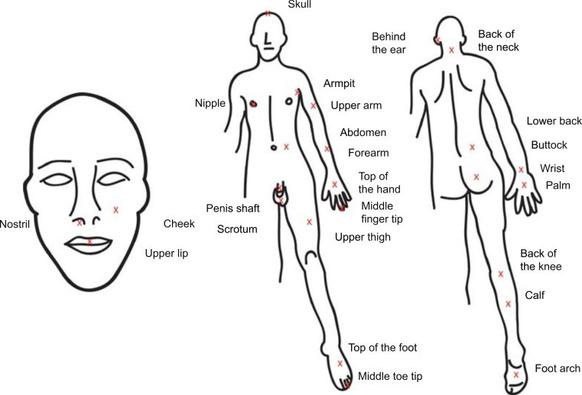
ater@ai6yr @W6KME @silentLurker @CavedaleRhones @emily He also had a protege who got himself stung all over by a honey bee to figure out where it would hurt the worst, giving us this lovely scientific diagram.
(Spoiler: the three most painful locations were the nostril, upper lip, and penis shaft )
 Jonathan
So ... Hundreds of bees were killed in the making of this picture? 😬
Anyway, it does reaffirm my life advice to people which is always to head butt bees.
"The three least painful locations were the skull, middle toe tip, and upper arm (all scoring a 2.3)."
@jmcrookston Beekeeper's tip: bees will head butt you as a warning BEFORE stinging.
Is that true? I'd believe it because they do warn many times before they sting. The stinging is always the last resort of course
@jmcrookston As a beekeeper, definitely true. if a bee hits you in the head, run and cover your face with your shirt so they don't get you... usually once you're past about 10-20 feet from the hive you're good, unless they are a hot hive, in which case keep going and jump inside a building or a car.
I believe this. I've just never looked up how they warn that they're upset. I figured flybys but smacking into you without stinging also makes sense.
 Violet Madder
I've heard angry bees smell like bananas. Not sure how close you have to be to pick that up, though.
(happy bees smell of lemongrass)
@violetmadder @jmcrookston Yes, yes they do. Most specifically, fake banana (i.e. the smell of banana runts). If you smell that around a beehive, RUN. (I am a beekeeper, and I have smelled that, and I do not like it one bit. I can't eat or go near anything fake banana flavored, it makes me ill lol... it's a sign of things having gone very wrong).
I came very close to starting some hives of my own and have watched MANY MANY videos on the subject.
It's totally wild to me, how some beekeepers can take a CHAINSAW to a hive in a log, and then just reach in with their bare hands to pull stuff out-- oh here's the queen, yoink-- and the bees are like fine whatevs.
I just walked up to look at a tree that had a hive in the base of it, and got stung on the scalp for being within 10' of the thing and I didn't touch nothin!
(tried to tempt a swarm that came out of that one later but they eschewed the box)
Perhaps you were just dealing with a hive that was good at ...
... thinking outside the box.
(•_•)
( •_•)>⌐■-■
(⌐■_■)
 Faraiwe
 James Gilbert
@ater @ai6yr @W6KME @silentLurker @CavedaleRhones @emily I was stung on my lower lip by a bee which lodged in the corner of my open mouth while cycling. It was certainly painful!
I seem to recall that the Australian bullet ant is supposed to have the most painful sting.
@ater @ai6yr @W6KME @silentLurker @CavedaleRhones @emily Oh yes, Paraponera clavata is there on the list at a 4, but it is South American, not Australian. https://en.wikipedia.org/wiki/Paraponera_clavata

 🏴🏳⚧🏴☠
🏴🏳⚧🏴☠ Mike Sheward
@ater @ai6yr @W6KME @silentLurker @CavedaleRhones @emily no perineum representation? what an oversight - repeat the experiment
@SecureOwl @ater @ai6yr @W6KME @silentLurker @CavedaleRhones @emily
It's wild to me the number of body parts that were skipped, in favor of going for the genitals.
 NosirrahSec 🏴☠️ guillotine enthusiast
@violetmadder @SecureOwl @ater @ai6yr @W6KME @silentLurker @CavedaleRhones @emily the fuck did I just read through?
A wonderful little jaunt through learning about this new animal I live near and juuuuuuuust talked about, then it's penis torture via honey bee. (I've managed to never be stung by bees.)
 Viss
Viss@NosirrahSec @violetmadder @SecureOwl @ater @ai6yr @W6KME @silentLurker @CavedaleRhones @emily does getting stung on the junk for science constitute junk science? :D
@violetmadder @ater @ai6yr @W6KME @silentLurker @CavedaleRhones @emily if i had a nickel for every time i’d received that feedback
@violetmadder @SecureOwl @ater @ai6yr @W6KME @silentLurker @CavedaleRhones @emily
I got stung on a tear duct by a yellowjacket a couple summers ago
It was bad. I was tearing thru the medicine cabinet, slathering anything and everything on it
In addition to the pain for days, I had severe fatigue for 6 weeks after
Much worse than the honeybee I did not see in my smoothie, whose little feet I can still feel curling around my bottom lip, to position its stinger
@NilaJones @SecureOwl @ater @ai6yr @W6KME @silentLurker @CavedaleRhones @emily
Damn!
I got stung all over the legs by yellow jackets as a kid, that was bad enough. Can't imagine getting it in the EYE. I don't remember after effects though, just the initial stings.
@violetmadder @SecureOwl @ater @ai6yr @W6KME @silentLurker @CavedaleRhones @emily
Only time I have had the fatigue thing. I guess an extreme mast cell reaction?
@violetmadder @SecureOwl @ater @ai6yr @W6KME @silentLurker @CavedaleRhones @emily
That's what she said
 ozeng
ozeng@violetmadder @SecureOwl @ater @ai6yr @W6KME @silentLurker @CavedaleRhones @emily some people like a lot of foreplay, others are keen for the main event
 Robert Burgholzer
@violetmadder wasn't this an episode of Jackass?
 Bytebro 🇬🇧 🇺🇦 🇬🇱
Oh Goddess, I'm sure I've read about, might have been a tribe, or a local native population, within which some older adolescents would deliberately get their willies stung by bees bcs allegedly it would make their willies 'bigger'. In my world I'd be going "Nah, yer alright mate - yours is bigger, OK?"
 bk
bk Hari Seldon's dead hand
@ater @ai6yr @W6KME @silentLurker @CavedaleRhones @emily
I'm reminded of Bill Murray as the dental patient in the 1986 Little Shop of Horror.
"Oh, yeah. Ooooh, yeah!"
I'm reminded of Bill Murray as the dental patient in the 1986 Little Shop of Horror.
"Oh, yeah. Ooooh, yeah!"
 tlariv
 Ho Ho Ho Like The Slur
@ai6yr @W6KME @silentLurker @CavedaleRhones @emily
Fun interview with a scientist on a similar mission...
What The Duck?!: Stinging Science
Episode webpage: https://www.abc.net.au/listen/programs/what-the-duck/stingingscience/13990790
Media file: https://abcmedia.akamaized.net/rn/podcast/2022/07/wtd_20220730.mp3

@ai6yr @W6KME @silentLurker @CavedaleRhones @emily
"Schmidt described the sting of an urban digger bee, categorized into pain level 1, as "almost pleasant, a lover just bit your earlobe a little too hard."[3] Also rated into pain level 1, Schmidt has described the sting of a sweat bee as "light, ephemeral, almost fruity. A tiny spark has singed a single hair on your arm."[3]"
Thank heavens for geeks with bizarre hobbies.
 PhilSalkie
@violetmadder @ai6yr @W6KME @silentLurker @CavedaleRhones @emily
Somewhere I have a photo of a really cool looking black and bright red ant-looking bug that I found in a park in Maryland and let it walk on my hand for a better photo op. I set it down again, we went our merry ways.
Later was told that it was a Cow Killer Ant (actually a parasitic wasp) - its sting (on a scale of 1-10) is said to be about a 27.
Sometimes I wonder about me...
@PhilSalkie @ai6yr @W6KME @silentLurker @CavedaleRhones @emily
They're pretty chill though, and you didn't make it mad so it's all good.
(I'd probably pick one up myself, even knowing what it was)
 neville park
@ai6yr @W6KME @silentLurker @CavedaleRhones @emily He sadly passed away in recent years (from Parkinson's, not being stung). In one of his last published papers, on giant red velvet mites and what eats them (https://doi.org/10.1636/JoA-S-21-019  ), he described taste-testing one:
> Our own species is a generalist predator that eats a wide variety of animals as food. For this reason, and to grasp an idea of how a mite might taste to other generalists, one of us (JOS) sampled a Willcox mite. After biting the mite with my front incisors, an immediate, overwhelmingly bitter, astringent, and spicy taste exploded throughout my mouth. Within seconds, I spit out the mite and its juices. The chewing never progressed back of my front teeth and the tip of my tongue; nevertheless, the bitterness was detected nearly instantly in the very back of my tongue and lingered for about an hour. To cross-check for bitterness using another species of giant velvet mite, I sampled a fresh mite from Limpopo province of the Republic of South Africa (23°39′51″S; 27°48′35″E; 840 m) – the taste was identical to that of the Willcox mite.
A real one to the end.

Big, bad, and red: Giant velvet mite defenses and life strategies (Trombidiformes: Trombidiidae: Dinothrombium)
Giant velvet mites, the largest living mites, are a familiar sight when they are present above ground, usually after the first summer rains, in warm arid areas. Despite their often-conspicuous presence in enormous numbers, little is known about their basic biology, life history strategies, or predators. The emergence of Dinothrombium magnificum (LeConte, 1852) in southern Arizona, USA usually occurs after the first summer rain that exceeds 1 cm. Of the 17 species of vertebrate predators offered velvet mites, only those that quickly engulf their prey intact (horned lizards and toads) successfully preyed upon the mites. Even those ate only one or few before rejecting subsequent mites. Of the 12 species of insect predators and 11 species of other arthropod predators offered mites, only the larvae of antlions were possibly meaningful predators. Nevertheless, antlion larvae only rarely succeeded in puncturing the rubbery integument of a mite and killing it. When sampled by an author, a velvet mite produced an exceedingly bitter, astringent, and spicy taste that endured in the mouth for about an hour. Overall, velvet mites appear to have no meaningful predators, likely because of their enormous suite of highly effective defensives: red aposematic coloration, aposematic odor, a tough puncture-resistant integument, unpleasant tasting chemicals on the integument, and exceedingly distasteful internal compounds.
 Sam Levine
@ai6yr @W6KME @silentLurker @CavedaleRhones @emily Neither an insect nor venomous! Just simply so gross-tasting that nothing eats it.
edit: because mites are arachnids, not insects; and venom is generally considered to be a toxin that is specially injected (as opposed to something that is toxic when ingested or touched); and if you read the paper, injecting it into a mouse produced no effects. I doubt it is actually "toxic" in any real sense, just bad-tasting.
@nev @ai6yr @W6KME @silentLurker @CavedaleRhones @emily
Excellent writer, and hella brave!
I have to say though, there's mounting evidence that Parkinson's is caused by toxins, long long after exposure