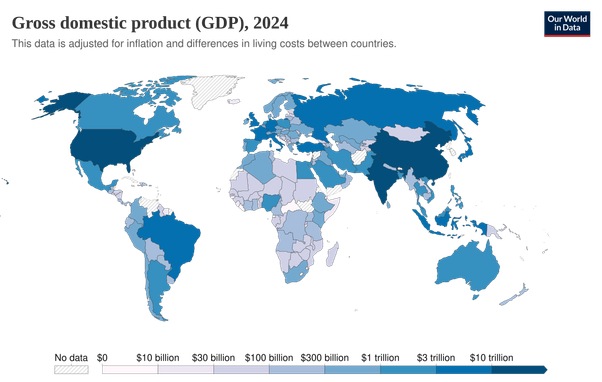
Zack Polanski (Green Party of England & Wales) argues that GDP should be downgraded as a measure of political economic success; he is 'much more interested in growing people’s mental health, growing our public services, growing cohesion of our communities'....

While possibly a quixotic aim given the continuing centrality of GDP measure to political discourse, it *does* play to people's distrust of GDP as a plausible measure of their own economic experience(s).

#economics #politics
h/t FT

@ChrisMayLA6 GDP is the economic equivalent of BMI. We use it because it’s the only thing we can measure, not because it’s meaningful.
@ChrisMayLA6 That's because GDP no longer reflects the experience of the vast majority since wealth is too concentrated. Yes, many people need risk and insentive, but more and more just can't keep up, and feel more and more left out
@ChrisMayLA6 I remember Julian Tudor Hart telling me that he’d never contributed to GDP as publicly funded services are counted as costs. His work on blood pressure saved, and is still saving, millions of lives. Marilyn Waring’s 1995 documentary gives an excellent critique of this method of accounting. Also, remember when our nationalised services gave much better service than we have now, and produced generations of youngsters with apprenticeships? Not counted in GDP. I’m with Polanski
@Jeffrey @ChrisMayLA6 You make a good point about the apprentices. A point I have frequently made myself. I worked in one of the nationalised industries and apprentices were taken on in several trades each year. Many of them will have eventually left for other industries where they arrived ready qualified. Too often private industries don’t want to invest in apprenticeships- they have to be subsidised by govt.

@Jeffrey @ChrisMayLA6

Publicly provided goods and services - as distinct from transfers such as welfare payments - have counted as part of the production measure of GDP ( not to mention expenditure and income ) for as long I have been familiar with the subject - well over half a century. Where there was a problem was with conventions for measuring them - which often led to undervaluation though never nil value - and for including them where appropriate in measures of personal consumption.

@ChrisMayLA6 But what is "Gross Domestic Product"? Is it actually a meaningful number, or is it, as I suspect, an estimate of turnover added to an estimate of turnover added to an estimate of turnover...

@RussCheshire @ChrisMayLA6 The big issue with GDP isn't the figure itself, or how it is calculated.

The problem is that as a metric, it doesn't tell you very much, other than "the total of X is Y". There is no relation between GDP and the amount of tax raised. Or the welfare of the state or its residents.

If tomorrow Musk and Bezos decide to move their business to the UK, the GDP would go up enormously. While nobody would be a penny better off...

@ChrisMayLA6 Nicola Sturgeon did the same but she was not praised in the press for doing so.
Very few people want to vote for somebody who might make them poorer. Even if they do make them feel better about being poor!

@peterbrown

Of course the issue is whether a stagnating GDP necessarily means people get poorer? The dominance of GDP makes such a Q.seem non-sensical but rather is the heart of the problem...

@ChrisMayLA6 a reducing GDP with better distribution of wealth will not make most people poorer. But politically it’s a very hard sell.

@peterbrown @ChrisMayLA6

Raise GDP. Build schools and hospitals we need. Build wind farms, solar fields, desalination plants, cafes and skate parks. Build bicycles and music venues, housing omgosh let's build dome housing, let's spoil some views.

Let's spoil a LOT of views.

@ChrisMayLA6 it’s not whether people get poorer or not. It’s whether the tabloid press will believe it.

Because if they don’t believe it, they will crucify the party that promotes it

@peterbrown

But, of course, the right wing press' interest in the population's economic wellbeing is entirely contingent - when they like the party in power, the talk up general prosperity, when they feel themselves in 'opposition' then they talk it down....

@ChrisMayLA6
Whenever the topic of GDP comes up, I'm reminded of Robert F. Kennedy's dismantling of GDP as a metric in 1968 with the summation of his speech: "it measures everything in short, except that which makes life worthwhile." increasingly economic activity appears to have a somewhat tenuous relationship with the well-being of society as a whole,many of whose members have seen incomes stagnate while rent seeking entities take an ever larger portion of that already stretched income.

@tompearce49

yes, I used to have that quote on a powerpoint slide early on in my lecture on how to measure economic activity....

@ChrisMayLA6
Sadly R. F. K Jnr. is cut from very different cloth.
@ChrisMayLA6 @tompearce49
Julian Huppert (ex MP for Cambridge) used to point out that demolishing and rebuilding hospitals would massively increase GDP whilst improving absolutely nothing for anybody.

@KimSJ @tompearce49

Although in Keynesian terms not really completely true - the multiplier effect of the money spent first on demolition & then the following funds spent on rebuilding would all flow outwards into the economy - hence Keynes notion that counter-cyclic economic policy might be just dig big holes & fill them in, provided it was paid employees doing it - the multiplier produces economic effects beyond the actual practical action beef paid for....

@ChrisMayLA6 @tompearce49
True, of course, though I wonder what the negative effects of not having the hospital available for maybe a decade would be. No employment for doctors and nurses, worse health outcomes locally, etc. 🤷‍♂️
In fact you could also increase GDP by demolishing and *not* rebuilding hospitals. 🤦‍♂️
Conclusion: we definitely need to include the value of national infrastructure in whatever measure replaces GDP, just as all businesses account for the value of their assets.

@KimSJ @tompearce49

Indeed; the activity itself is not neutral in effect (as you rightly point out), but the multiplier does mean to some extent the cost(s) are nitrated more widely, but yes the valuing if infrastructure is key, which (to be fair to Rachel Reeves) is what the new version of the fiscal rules is approaching as a logic

@ChrisMayLA6 I'm with Bobby Kennedy when it comes to GDP, it measures everything except that which is of real value. It is at least 10% fiction as well, so hardly an objective measure.

@epistatacadam @ChrisMayLA6
On the first clause, yes (but it measures what it measures).
On the second, it is a basic principle of #measurement that #accuracy and #precision should each be known and reckoned with, but that large departures from perfection in either or both do not prevent useful measurements being made.

(When the fiction is reduced the instrument needs recalibrating.)

@ChrisMayLA6 "people's distrust of GDP" - is it not actually objective experience, that for many people GPD does not measure their own circumstances due to increased inequality, which GDP takes no account of? That is to say, the issue is not that people don't trust GDP, it is that GDP is untrustworthy.

@robparsons

No' I'd disagree; GDP is trust-worthy inasmuch as any economic metric can be trusted... the problem is how the data point is politically deployed.

The concept has clear rules about it should be calculated, it allows comparisons to be made... but its focus is quite narrow in social terms, but politicians & the media never allow for that & so it is criticised for something it couldn't be - which is why alternative measure may be better.

@ChrisMayLA6 I was going to leave this because I feared we'd get into a morass of linguistic philosophy, but I couldn't help myself, so... While there is clearly a technical meaning in which the term "GDP" can be deemed trustworthy, that meaning is very rarely deployed. In common commentary the dominant meaning is GPD-has-gone-up-therefore-everybody-is-better-off, and that is so at odds with people's actual experience 1/2
@ChrisMayLA6 2/2 (not their feelings about it, but their actual reality) that it is useless as a concept. You can argue whether "trust" is the right word to use; my point is that the benefits of growth in GDP are so unequally distributed that for most people it is a meaningless measure.

@robparsons

Yes, I think we agree; as it is used in popular political discourse & media commentary, you are aright it bears little connection with loved experience - GDP per capita is a little better, but even then doesn't take distributional issues into account - so while we are expressing the argument in different ways I think we are *essentially* agreeing.