 Greenpeace International
“You cannot blow up the sun. It is incredibly difficult to disable a decentralized network of millions of rooftop solar panels. Distributed energy is inherently more resilient to sabotage than a handful of massive, vulnerable thermal plants.”
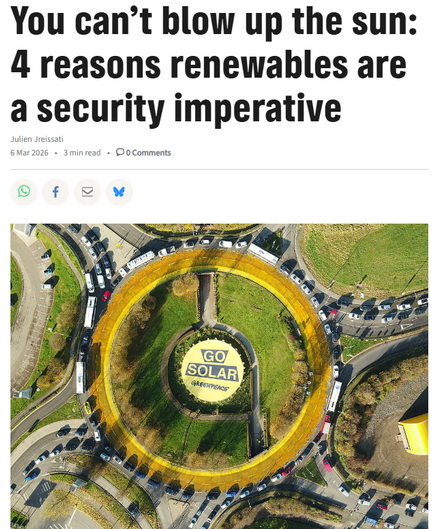
“You cannot blow up the sun. It is incredibly difficult to disable a decentralized network of millions of rooftop solar panels. Distributed energy is inherently more resilient to sabotage than a handful of massive, vulnerable thermal plants.”
@greenpeace one problem with this... and i am all about renewable...
Solar panels make big, shiny targets unless distributed.
Centralized could be bad for security.
Federated networks would count as good.
That distinction is important.
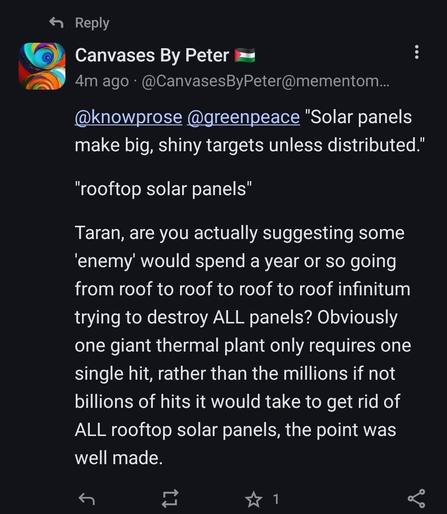
@knowprose @greenpeace "Solar panels make big, shiny targets unless distributed."
"rooftop solar panels"
Taran, are you actually suggesting some 'enemy' would spend a year or so going from roof to roof to roof to roof infinitum trying to destroy ALL panels? Obviously one giant thermal plant only requires one single hit, rather than the millions if not billions of hits it would take to get rid of ALL rooftop solar panels, the point was well made.
@greenpeace it appears someone was confused when I wrote 'federated'. Distributed might be the easier term for people.
One person appears confused. And they chose to block me. Just as well.
@cyberspice
When the global economy is dependent on a centralised, combustible resource, missiles do more than just cut off power or disrupt shipping. They rock the very foundation of global stability.
The current crisis is a tragic, undeniable argument for why we must accelerate the transition to Renewable Energy.
This isn’t just about carbon emissions or climate targets. It’s about resilience, security, and survival.
@cyberspice @greenpeace yup.
Where it's legal.
Back in the 1970s, people were getting paid for adding to the grid in Wisconsin.
Really.
Lobbies on government have kept solar from being used that way all over. Kind of sad.
This is a strange criticism to make of a technology that is regularly stuck on a bunch of existing roofs.
It's amazing how many people don't understand the difference between a solar farm and on rooftops.
Solar farms are a thing.
Federated = distributed.
Come on, do better.
@Jude_theone479001 @gbargoud @greenpeace
And another, apparently. But my point stands.
It's a simple matter of reading comprehension. And Peter who? The guy who posted a comment and blocked immediately? 🤣
@greenpeace I agree!
Just hope no billionaires figure out how to block sunlight and make access a paid subscription. If they could, they would.
This demonstrates the true values of the Government of Alberta which has stopped development of small scale wind and solar: centralization is riskier in every way, but easier to gate-keep and pull unearned profit from.
@greenpeace this could be right if we weren't massively supplying all our solar panels to the same provider, and happily making them smart as in "we delegate operations to some China based IP".
Supply chain is complicated, and we even managed to make git spof-centralized.
Time for floss firmware and interoperable, open protocole ? Then yes, we can talk about resilience.
Plus the #1 arg about "strengthening the grid" really miss the way energy grid are sync, see the recent Spain blackout - partly due to failing solar farms, and bad response, and missing pilotable electricity generator and inertia buffers
@fanf42 @greenpeace every inverter I know can work offline, I don't get how it's not giving you autonomy.
An installed panel is no longer a dependency to the provider unlike fossil or nuclear fuel.
And regarding Spain, the blackout was mostly due to fossil electricity plants not respecting the contract they have with the grid operator.
@matthieu @greenpeace for Spain, it's not what I read in the mostly final report. Iirc, two solar plants want if grid for unknown reason. Then there was a sequence of bad decision about cutting branches of the grid, which ultimately lead to major resonance what could be absorbed because the grid buffer ratio is very low (ie, Spain miss a lot of stabilizers like inertia rotator, which are by construct available in gaz based turbine). Then they asked France for more power to stabilize the grid which was shutting down, and everything blew up with huge unwanted signal, and France cut down the link to avoid propagation to other part of eu.
For the solar panel / inverters, until you can look into them, you're not sure. Plus, it's not because things start ok that convenience and laziness doesn't make them horrible. Smart (connected) inverters provide nice online services that you don't need to manage yourself. The village of my wife just made a common, pooled solar project where inhabitants can install panels and share prod. The whole thing (witch is really nice) uses a local provider which uses turn-key China solution, SaaS plateforme for the management included.
@fanf42 I read once again about Spain and it seems to me that solar was part of the problem, but it probably accounts for a small part only.
The french wikipedia article seems to concur with what I read here https://bsky.app/profile/aukehoekstra.bsky.social/post/3lrsvpse6ns2i last year.
And about "being sure China does not control your inverter", well, no network means no control I guess.
But we could drift to our dependency to foreign technology for IT, and then I'm not sure any other part of the grid is safe, don't you think?

The official report on the blackout in Spain and Portugal was just released. I'll give a quick summary of findings and provide some additional info. TL;DR conventional power plants didn't control the voltage as planned over-voltage caused renewables to turn off as required
@matthieu the solar is the trigger (it could have been something else) but also the systemic enabler : solar (and wind) don't provide inertia buffer by construction like turbines, so you have to add them to the grid explicitly, which is not done because it's extremely costly and complexe and breaks the narrative about easy, clean energy and simpler grid.
(Edit : it's relevant in the context of that thread because my point was that the quoted article was misunderstanding how electricity grid behaves, and that the benefits quoted are wishful thinking, and that we have existing case of what actually happen at system level for massively solard grid : more instability, not more resilience).
For China and inverter and no Internet connection: well, perhaps, but the main stream is not going there, it's going toward "smart", managed systems. You personnaly might remain secure, but it will more and more means fighting mainstream (like linux circa 2000). And if you are in a quasi monopolistic system, the provider decide (like windows for supported hardware/bios behavior).
And for the global supply chain : yes of course, but the fact that our politician and decideurs can't understand supply chain risk for SaaS is more an argument for "they won't understand it for solar" than against
@fanf42 @matthieu my SMA solar inverter is from Germany. Solar edge is from Israel both are large providers. So there are alternatives
With that said, yes there is a risk that a large inverter operator (or hackers taking control) launches a coordinated shutdown during a time of peak production. IIRC this would crash the European electric grid as the available redundancy are not enough and couldn't be brought online fast enough.
I also agree we need more open hardware, locally operated systems
 Taran Rampersad
 Canvases By Peter 🇵🇸
 Cyberspice
 Alexa Fontanilla
 George B
 oracle bones
 Ms. Que Banh
 jackcole
 Ron Bowes
 Howard Gees
 Howard Chu @ Symas
 Jeff C
 Kim Possible
 Pink Cyberdragon
 David Mitchell
 ZephyrXero
 WideEyedCurious 🇺🇸 💙 🇺🇦 & 🇨🇦
 joat
joat rpgwaiter
 ZenHeathen
 fanf42
 Matthieu Baechler
 Jean Helou ⌨️
 AlisonW ♿🏳️🌈♾️