 blastmaster :vim:
 Erik McClure
It's either very funny or very depressing to watch executives trip over themselves to prove who has the worst understanding of what software development actually entails.

@cloudhop
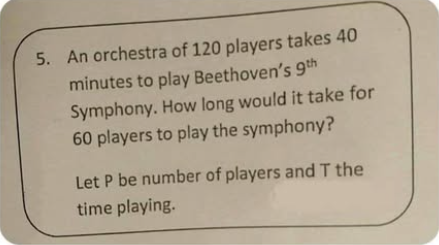
From the quoted screenshot:
@interru @cloudhop Once again they don't understand that the purpose of a programming language is to allow unambiguous expression of intent.
But then, that's how ruling classes work. They don't do the hard work and they don't understand the hard work. Which takes more knowledge, growing crops with your own labor, or ordering soldiers to collect the grain at spear-point?
Nice to see the Sony vs Philips CD capacity conflict mentioned.
@bencourtice @coolcalmcollected @bangskij @cloudhop
I always suspected software developers were holding back human progress by being slow typists...
...they even talk to rubber duckies to infuriate C-execs!
@coolcalmcollected @bangskij @cloudhop
Everyone knows Beethoven's 9th Symphony takes 24 hours to perform.
@monicarooney @bangskij @cloudhop
excellent point. I wonder if the extra credit question was "which musicians, men or women, played faster and why?"
@sabrinaweb71 @cloudhop No, no. They don't know anything. We're not seeing true consciousness here, just an (admittedly surprisingly convincing) example of mimicry.
And then there are the LLMs…
@cloudhop
I mean it's a pretty accurate understanding of programming measurements as 'lines of code' without ever once considering 'that compiles', and somehow people have used THAT as a metric!
(which is to say, this is hilariously awful, but they've made a lot of really dumb decisions before now too!)
@gilesgoat @cloudhop my cube was outside the VP of Engineering's office. For weeks I saw him quietly fuming as he walked past. Often I'd be sketching ideas on a whiteboard, or sitting back staring at it with my feet up on a filing cabinet. Four o'clock each afternoon I disappeared off to the war room to chat with the other three system architects.
Sometimes he saw me actually typing into a code editor. "How's it going?"
"Pretty good - I've got the data structures locked down, most of the function headers in place, just working on the state machine now."
"So no code yet?"
"Not yet."
The code worked the first time it was flashed into the fpga prototype, reading and writing data to a RAM disk. In three months from the start of the project, we were booting Windows from that prototype.
For comparison, the previous ground-up firmware project took 18 months to get to the same point. Code-first only *feels* faster.
@gilesgoat @cloudhop absolutely - especially when adapting or extending existing code. My process is very much the same as yours.
The scary part of that big project was that it was the frontend processor tightly bound to a hugely complex SAS interface hardware block - I tested what I could by simulation, but that was only about 10%!
@gilesgoat @cloudhop I was frustrated by test-driven design purists who seemed to want to continually test whether the processor could add two numbers!
I tended not to write test programs - except where running the real program could corrupt real persistent data. Then I separated out all the "doing the work" code from the "writing the results" code, and made a parallel data-safe test version of the program.
Other than that, Debug builds of the code that added sanity checking on function parameters seemed to catch most errors.
RE: https://equestria.social/@cloudhop/116077882659405785
@cloudhop Equally funny (or depressing) to watch CEOs not seeing how "20-30% Microsoft code now written by AI" at the same time we see "security leak in Notepad" and "Windows 11 performance drop after last update" is not a recommendation for AI...
So can we tap the sign "when a measure becomes the goal, it stops being a measure" a few more times? One day they'll get it. One day...
 interru
 Mistake not ...
 FoolishOwl
 Krazov
 Truffles
 Schneckbert 🐌
 Bruno Nicoletti
 Pare
Pare Manni
Manni Alien software, human hardware
 Jernej Simončič �
 Matthew Walton
 Matt Hardy 3.11 for Workgroups
 Captain of the SS El Faro
 🏴🏳⚧🏴☠
🏴🏳⚧🏴☠
 Jordan
 Henk Langeveld
 bencourtice
 Wulfy—Speaker to the machines
 Cat!
Cat! Monica Rooney
 mathew
 Sabrina Web
  📎
📎 ersatzmaus
 Twenty Twenty Sixhorns
 DressToKILT
 refraction
 James 🦉 #FBPE 🇪🇺
 Loke Mani
 🇨🇦🇩🇪🇨🇳张殿李🇨🇳🇩🇪🇨🇦
 rustedivan
 Barry Rowlingson
 Tim Ward ⭐🇪🇺🔶 #FBPE
 Oggie
Oggie Mad Engineering
 Abram Kedge🏴🇨🇦
 Giles Goat
 Matt Lacey
 Jules 🍺
 🇺🇦 haxadecimal 🚫👑
 Timothy Wolodzko
 Ryan Harter
 scott
scott Exit Code 1
 Joris Meys