 Kenneth Russell
 wslack
Terry Pratchett was wise
We And They
- Rudyard Kipling
Father, Mother, and Me,
Sister and Auntie say
All the people like us are We,
And every one else is They.
And They live over the sea,
While We live over the way,
But would you believe it?
They look upon We
As only a sort of They!
We eat port and beef
With cow-horn-handled knives,
They who gobble Their rice off a loaf,
Are horrified out of Their lives;
While They who live up a tree,
And feast on grubs and clay,
(Isn’t it scandalous?) look upon We
As a simply disgusting They!
We shoot birds with a gun.
They stick lions with spears.
Their full-dress is un-.
We dress up to Our ears.
They like Their friends for tea,
We like Our friends to stay;
And, after all that,
They look upon We
As an utterly ignorant They!
We eat kitcheny food.
We have doors that latch.
They drink milk or blood,
Under an open thatch.
We have doctors to fee.
They have Wizards to pay.
And (impudent heathen!)
They look upon We
As a quite impossible They!
All good people agree,
And all good people say,
All nice people, like Us, are We
And every one else is They:
But if you cross over the sea,
Instead of over the way,
You may end by (think of it!)
Looking on We
As only a sort of They!
alt-text to above pic:
Terry Pratchett, Jingo, pp. 205f
@wslack oh yes! It is so much easier to blame others rather than seeing what you can do differently.
#terrypratchett was indeed a very wise man!
Casting yourself as the eternal victim leaves you up a certain creek without a certain rowing instrument. Grab the paddle, take control of where you go.
10%/90% rule: 10% is 💩 happens, 90% is what you do about it.
@neil_h I'm not sure that's the point of the passage. This is about who does the wrongs and who can do wrongs. All of us can harm others.
People can be victims of history/disease/accident etc AND take control with what they have. Those aren't contradictions.
@wslack no, of course they're not contradictions.
However, too often people blame "Them" for a situation and continue to complain without doing anything.
I have a friend who continually complains about her spouse's disinterest in her and their children. But never does anything even to try and change herself or the situation.
My conclusion: her satisfaction at being the victim is greater than her distress.
My reaction: I change the subject as soon as she gets started. My canoe, my paddle.
@wslack but thanks to you, as well.
Got me thinking.
And that's possibly part of the point of the passage.
The error is, most certainly, the mindset that blame can be placed on just one person/entity/group.
They absolutely do plot behind cigars and brandy. They bastardize every good system we create for common good. They undermine the collective will.
Billionaires should not exist. They do Very Bad Things to exist. They are rightly due Their blame, for sure. But we own blame as well, for we have yet to eat them.
@owlchemist @your_huckleberry I would respectfully still say you are generalizing. There are different ways to make a lot of money and founding a company that becomes quite valuable gets it done, even if the holder of the equity has done no scheming and has little liquid money (and sometimes their companies are worth that much even while running at a loss).
I would grant that all billionaires are subject to poor incentives to use their money in harmful ways, but that doesn't make someone inherently bad.
@wslack @owlchemist @your_huckleberry
There is no way to legitimately make a billion dollars. No company is legitimately worth a billion dollars, they're made that way by manipulation of the stock market. When you look under the covers (or into the books) there is abuse of the workers, tax evasion, buying off gov't officials, etc.
There shouldn't be billionaires because there is no way to legitimately make a billion dollars.
@switch I don't think people are bad because they didn't solve every problem for every person they ever had contact with, or for the world entire.
Toilet cleaners at Microsoft make $21/hr. I suppose you could argue that $21/hr is what minimum wage should be if it had risen to keep pace with the overall economy.
It is already in the text: "No-one ever thinks of themselves as one of Them."
Yes, conversations here on Mastodon with people, looking at themselves and not at others, are VERY rare.
But be the one, who is not joining them. Don't talk about those people. Don't ask such kind of questions.
Talk about patterns, you think you recognized.
Explain ideas.
"Great minds discuss ideas; average minds discuss events; small minds discuss people."
Eleanor Roosevelt
Be the one, discussing ideas.
Yesterday I was commenting on an event. I immediately had "average" replies. - My fault! Should not have started at all. Or talk about the idea behind it.
@wslack More complete picture description/text:
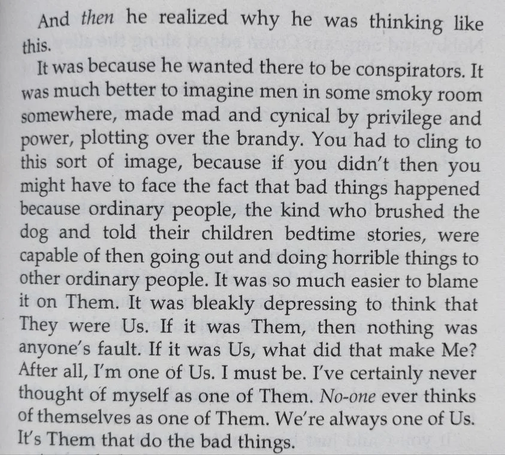
Photograph of two paragraphs from Terry Pratchett's Jingo. The text reads:
And *then *he realized why he was thinking like this.
It was because he wanted there to be conspirators. It was much better to imagine men in some smoky room somewhere, made mad and cynical by privilege and power, plotting over the brandy. You had to cling to this sort of image, because if you didn’t then you might have to face the fact that bad things happened because ordinary people, the kind who brushed the dog and told their children bedtime stories, were capable of then going out and doing horrible things to other ordinary people. It was so much easier to blame it on Them. It was bleakly depressing to think that They were Us. If it was Them, then nothing was anyone’s fault. If it was Us, what did that make Me? After all, I’m one of Us. I must be. I’ve certainly never thought of myself as one of Them. *No one *ever thinks of themselves as one of Them. We’re always one of Us. It’s Them that do the bad things.
"And then he realized why he was thinking like this.
"It was because he wanted there to be conspirators. It was much better to imagine men in some smoky room somewhere, made mad and cynical by privilege and power, plotting over the brandy.
@wslack #alttext4you "And then he realized why he was thinking like this.
It was because he wanted there to be conspirators. It was much better to imagine men in some smoky room somewhere, made mad and cynical by privilege and power, plotting over the brandy. You had to cling to this sort of image, because if you didn't then you might have to face the fact that bad things happened because ordinary people, the kind who brushed the dog and told their children bedtime stories, were capable of then going out and doing horrible things to other ordinary people. It was so much easier to blame it on Them. It was bleakly depressing to think that They were Us. If it was Them, then nothing was anyone's fault. If it was Us, what did that make Me? After all, I'm one of Us. I must be. I've certainly never thought of myself as one of Them. No-one ever thinks of themselves as one of Them. We're always one of Us. It's Them that do the bad things."
@wslack All of us who lived under the Communism remembers this very well: Them are Us! And it is the most sobering and humbling discovery I’ve made.
1. Be very decisive in rejecting evil in our lives. It is very easy to slide from being Us to being Them. Something like the baptism renewal vows: “Do you reject Satan, all his works, and all his empty promises?”
2. Be very careful in judging others. Everybody has their own story, and yes some people are truly evil and they did it for horrible reasons, but many did not. “The line dividing good and evil cuts through the heart of every human being.” (Solzhenitsyn)
 heine
heine Nick
Nick ArneBab
 Octorine
 Stoneface Vimes
 Dgar
Dgar kauer
kauer Toni
Toni 
 Jaddy
Jaddy
 Neil
Neil Shadow
 Volker
 sbi
sbi Icarosity
 your_huckleberry
 The OwlChemist
 DB Schwein
 Bytebro 🇬🇧 🇺🇦 🇬🇱
 Claude
 AdeptVeritatis
 lj·rk
lj·rk raptor
 NIST Standard Reference Boy
 Bill Minarik
 Von Xylofon
 Laura G, Sassy 70’s
 dasgrueneblatt
 Primo
Primo Jack Jackson
 Liminal Fiction
 Matěj Cepl 🇪🇺 🇨🇿 🇺🇦
 Paul H 🏴🇪🇺
 Leipoa ocellata
 Esme Ciredutemps