 Jens Greifenhagen
 nixCraft 🐧
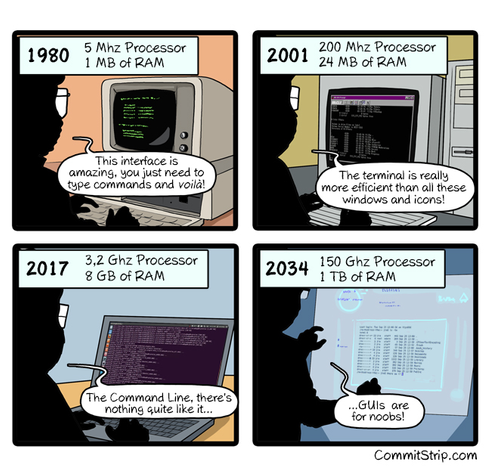
Terminal forever <3 https://www.commitstrip.com/en/2016/12/22/terminal-forever/? #unix #linux #macos #freebsd
@flup 1970 would be 0, the 2038 bug is a signed 32-bit integer rollover so it'll become maximally negative.
2106 would be the unsigned 32-bit integer limit, but I'm not sure how much that's used.
@flup And 32-bit programs running on 64-bit systems. Like some manager was told they need to upgrade to 64-bit so they just replace the hardware and OS, but continue running their proprietary 32-bit software. It probably won't be as impactful as Crowdstrike's f-up, but it'll be a lot harder to get what is impacted up and running again.
Oh crap, and what about 32-bit protocols? Like the system that lets airlines rebook passengers on another airline. Sorry, you're 135 years late for your flight.
@nixCraft Didn't we hit 1GHz around 2001? I remember it being a big party. Everyone* were completely blown away by it.
* Me and my one friend.
@uecker @nixCraft To be fair, many CLI programs have _horrible_ UX, especially the ones that have been around for decades.
But, as you say, they never change so copy-pasting from ten-year-old posts usually works out fine.
Shell completion on options/flags is an absolute must, as it adds discoverability to otherwise arcane commands.
@nixCraft Years a little off methinks…
1980: 1MB would have been loads of RAM. IBM PC XT had 128~640kB in 1983. Maybe closer to 1990 (286+).
2001: you would have been laughed at with 24MB RAM… budget PCs with 256MB were common by then. 16~32MB would have been common circa 1996 or so.
Still… the point is valid… I pretty much live in the CLI. Always have.
One of the first great inventions was curses, which allowed simple windowing on terminals. I didn't hashtag that, because there are too many witches around. :)
Look at Mr. Moneybags here with 1MB of RAM in 1980.

@SeanWelsby @nixCraft Your argument is weakened by the existence of the apropos command, and that most commands have -h/--help arguments.
Eg. More important than being an expert in writing pcap filters for tshark is knowing that that tools exist to analyze network traffic, and they can be looked for.

 garrytansucks.55 on Signal
 Karl Pettersson
 StarkRG
 Ian Chard
 ElectroFetish
 Virginicus
 The Gym Nerd
 S.T. Veje
 0x10f/kalle/qalle
 Benjamin E.
 thorsummoner
 RejZoR
 Ash_Crow
 Trit’
Trit’ josejuan
 markymarrow
 Claude Lavoie
 Tim Ward ⭐🇪🇺🔶 #FBPE
 Martin Uecker
 Raphael
 Ciencia Al Poder
 oceaniceternity
 h0nza 🌄 🏊🚴
 Stuart Longland (VK4MSL)
 SirWumpus 👾🍁
 AzureArmageddon
 Bonkers
 Blue Ridge Black Hat
 Dan Neuman 🇨🇦
 Leif Samuelsson
 lemgandi
 Killab33z
 Dave Wilburn
 Juankz
 Rene 🄲🄰🅅🄰🄲 Schickbauer
 Linky~
 http
http Wintermute_BBS
 Jabberwock
 Capywarist
 Chloé Raccoon