 Patricia Aas
https://social.vivaldi.net/@Patricia/112719504676456386
Patricia Aas (@[email protected])
When you quote me I hope you pick the best quotes: “And I posit that the NOK is weak because the planet is fucked and everybody knows it.” https://social.vivaldi.net/@Patricia/112719497998588756
https://en.wikipedia.org/wiki/Bretton_Woods_system

75/ Chapter 5: “‘Winning’ at trade” is interesting, but doesn’t really go into the depth I’d like (but I guess after reading 4 Econ books in a row I’m not the target readership). The chapter is very “political” and idealistic rather than descriptive, but that was a tendency we saw earlier too. The basic idea is that a trade deficit isn’t a bad thing. She goes on to envisage a world economy that is more… equitable? It argues for developing countries to focus more inward, and diversifying their economies, perhaps making them less vulnerable to the global markets. It argues against losing control over one’s own currency (its MMT, so obviously). It makes clear that the dollar gives the US an outsized influence and leverage over the rest of the world.
She criticizes both democrats and republicans, but seems to have a soft spot for Bernie Sanders. He hired her to work at the Capitol, so I guess that makes sense.
The MMT premise seems to be that you don’t have to “have the money” to fund guaranteed full employment or “entitlement programs”, because the control over the currency means that the government always “has the money” to pay.
76/ The “winning vs losing” at trade is explicitly directed at Donald Trump. But she spends a lot of time emphasizing that American workers have lost jobs (“well paid union jobs” comes up several times) when production moved offshore.
It feels to me like she is arguing for a midpoint, a more protectionist approach, but not measuring in trade deficit/surplus, but instead in… standard of living?
She gets slightly into the topics of “The Shock Doctrine” in that the international trade organizations and the world bank became dominated by extremist (my word) capitalist forces.
1. She is clear that the challenges that face us in the years to come are global, and that we have to work together to solve them, as partners instead of competitors.
2. She is not proposing some sort of bloody global revolution.
3. She is slowly selling me on the idea that guaranteed employment, benefits and entitlement programs are a safeguard against radicalization. I have mostly thought of these things as the “right thing to do” rather than a way to maintain peace.
4. The ideology is inclusive instead of divisive, and therefore doesn’t rest on the boogeyman approach of both the fundamentalist left and right. She doesn’t use immigrants or poorly veiled antisemitic tropes (the evil rich man of various formats) to paint some other group as the enemy.
79/ But the book is supposed to not just be a work of ideology, but provide a way through this mess we’re in, in the aftermath 🤞of a global economy dominated by extremist capitalism.
And that premise is based on this currency “trick”, and there I am not yet convinced tbh.
That train of thought reminded me of this Norwegian song
https://youtu.be/9QxGKTTtYgM?si=G9in1FTPPu2q49_a

Noen å hate
“Han der er ikke sånn som deg
Fort deg bort og ta han
Det er like godt som sex
Å banke en stakkars faen
Er det ikke deilig å ha noen å hate?
Føles det ikke godt å ha noen å hate?
Er det ikke herlig å slå dem flate?
Er det ikke deilig å ha noen å hate?
Hør lyden av nakker som knekker
Hør lyden av kjøtt som sprekker
Det er bare å følge fingeren som peker
Dit hvor de voksne leker
Er det ikke deilig å ha noen å hate?
Føles det ikke godt å ha noen å hate?
Er det ikke herlig å slå dem flate?
Er det ikke deilig å ha noen å hate?
Han der er ikke sånn som deg
Fort deg bort og ta han
Det er like godt som sex
Å banke gørra ut av en stakkars faen
Er det ikke deilig å ha noen å hate?
Føles det ikke godt å ha noen å hate?
Er det ikke herlig å slå dem flate?
Er det ikke deilig å ha noen å hate?
Er det ikke deilig å ha noen å hate?
Føles det ikke godt å ha noen å hate?
Er det ikke herlig å slå dem flate?
Er det ikke deilig å ha noen å hate?”
“He's not like you
Hurry over and get him
It's as good as sex
To beat a poor bastard
Isn't it nice to have someone to hate?
Doesn't it feel good to have someone to hate?
Isn't it great to knock them flat?
Isn't it nice to have someone to hate?
Hear the sound of necks snapping
Hear the sound of meat cracking
You just have to follow the pointing finger
Where the adults play
Isn't it nice to have someone to hate?
Doesn't it feel good to have someone to hate?
Isn't it great to knock them flat?
Isn't it nice to have someone to hate?
He's not like you
Hurry over and take him
It's as good as sex
Beating the crap out of a poor bastard
Isn't it nice to have someone to hate?
Doesn't it feel good to have someone to hate?
Isn't it great to knock them flat?
Isn't it nice to have someone to hate?
Isn't it nice to have someone to hate?
Doesn't it feel good to have someone to hate?
Isn't it great to knock them flat?
Isn't it nice to have someone to hate?”
84/ Ok, chapter 4 “Their red ink, is our black ink”. I think it was Keen in one of his podcast episodes who said something that I hadn’t considered. From memory: as a country’s economy grows, whatever that means, the money supply would need to grow too.
Looking at population growth alone that makes sense to me. And that means that my mental model of a fixed “amount of money we have” isn’t correct. It would, at least over longer periods of time, need to be elastic in some way. And I can’t see how that could be a global zero sum game either, since many countries that were poor a century ago, and are still poor today, often still have a “bigger” economy than they did a century earlier.
“Cases 5 and 6 underscore the lack of a causal relationship between rapid M2 growth [growth in money supply] and high inflation, because when we increase the threshold of nominal M2 growth to from 60 percent in five years to 200 percent in five years, it is followed by high inflation even less frequently than in Cases 3 and 4. This is, of course, the opposite of what one would expect if high M2 growth causes high inflation.”
(h/t @igimenezblb) https://www.ineteconomics.org/perspectives/blog/rapid-money-supply-growth-does-not-cause-inflation

https://youtu.be/wuonrlKefRM?si=7TUvGs-JeUI2AWW5

The Paradox of Debt | Richard Vague | TEDxCapeMay
92/ As some folks have alluded at (where does the new money actually go) and based on something she says earlier in the book (that deficits have actually been too low) I started wondering. Imagine I have a truck full of dirt and I tell you I’m going to pour it out, you’d think it would create a pile of dirt, right? But what if I pour it into a hole. We don’t get a pile, we lose a hole…
The thing that I think MMT are arguing is that “debt” isn’t “debt” if it’s monopoly money you made up. To you as the money machine it behaves differently. And debt isn’t debt. It’s potentially pothole filling. But that means something is absorbing money, and don’t just say “rich people” because that is lazy. Are there holes? Where are they? What would be the effect of filling them? I’m assuming that filling different holes would have different effects. And maybe that’s MMTs thing: to fill the unemployment/underemployment hole? And from there achieve an effect?
94/ Still in chapter 4. She was discussing another economist, Wynne Godley, and so I had to look him up and that opened another line on economic models: equilibrium models (the “mainstream economics” models) and a set of models referred to as “accounting models”.
Steve Keen, who a lot of folks have brought up (the guy with the podcast “Debunking Economics”) seems to be one of the people who are proponents of “accounting models”.
And it seems to me that MMT draws from the work of economists in this area.
Wynne Godley was credited for predicting the financial crisis based on his model.
This paper looks very interesting because it seems to contrast the two approaches. Which tends to be illuminating in my experience.
“No one saw this coming. Understanding financial crisis through accounting models”.
https://pure.rug.nl/ws/portalfiles/portal/2646456/09002_Bezemer.pdf
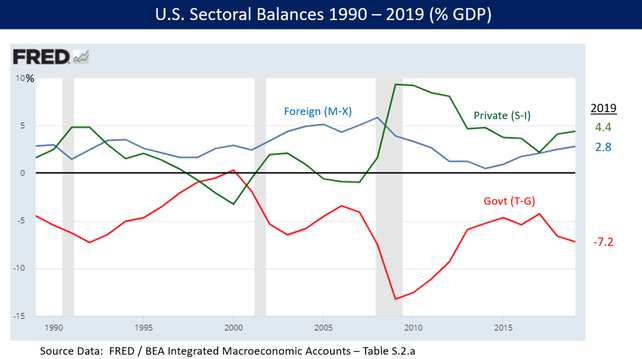
95/ so far my (quite shallow) understanding is that these “accounting models” model flows of money. With the basic premise that money has to come from somewhere and go somewhere. Or more accounting-wise that a subtraction one place has to lead to an addition of equal size (possibly the sum of multiple additions) somewhere else.
This relates to the idea that MMT presents, which Wynne Godley also seems to have supported and Richard Vague (above article and TED talk), that a deficit for the state necessitates a surplus somewhere else. Found this graph from Godley using his “sectoral financial balances” framework, depicting the US economy. This graph is very similar (perhaps identical?) to what Vague shows in his TED talk. They both show what seems to be an inverse relationship between a public deficit and a private surplus.
Which funnily enough is called “Anchoring effect” and features prominently in “behavioral economics”
https://en.wikipedia.org/wiki/Anchoring_effect
100/ but hold up… I just argued that the size of the money supply was not fixed… but I guess that fits… because the public side can create money to cover it’s deficit, but private sector doesn’t have that option. So under austerity we create a zero sum game.
Am I even making sense anymore ?
https://www.nytimes.com/2019/02/25/opinion/running-on-mmt-wonkish.html

103/ seems to me from reading this and some of the references that the disagreement seems to be “technical”. Krugman seems to agree that the fear of deficits is overblown, but seems to argue that interest rates are another tool to manage possible inflation. Tbh I haven’t gotten the opposite impression yet from the book, but maybe I missed it.
One thing I do wonder about is that if the deficit is in the form of bonds, won’t higher interest rates affect the cost of the accumulated deficit? Wouldn’t the public side now also have to pay more for the accumulated deficit? How does that work?
Maybe I don’t know how any of this works
105/ she is describing a model for interest rate that I think she is going to argue against. In it there seems to be a mechanism where one imagines that the private sector and public sector compete for loans in the same fixed sized market. And so the public sector deficits are in this model financed by loans in this market. And therefore the increased deficit would then be a significant increase in demand on a finite supply of money. And therefore drive the interest rate up.
But… that’s not how it works? In the real world? The banks increased their interest rates when the central bank did. So this model doesn’t make sense at all to me.
https://youtu.be/ZuXzvjBYW8A?si=g_1Z9XfgsTpioq2G
(h/t @Di4na)

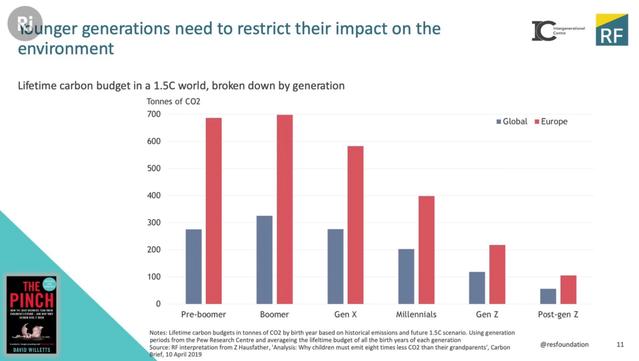
Have the Boomers Pinched Their Children’s Futures? - with Lord David Willetts


https://social.vivaldi.net/@Patricia/112704863073553929
Patricia Aas (@[email protected])
4/ “Capital in the Twenty-First Century” by Thomas Piketty https://social.vivaldi.net/@Patricia/112681938811222913
 modulux
@Patricia There certainly are reasons to believe so. Schäuble seemed to essentially set the post-2008 policy. It's also indicative that while procedures against countries for failing to fulfil the stability criteria (debt, deficit...) were initiated against Greece, Portugal, Italy, etc, France and Germany violated stability criteria before 2008 without this happening to them.
https://www.theguardian.com/business/2003/nov/25/theeuro.politics
And there's still similar asymmetries going on: https://www.bruegel.org/analysis/fixing-germanys-fixes-european-commissions-fiscal-governance-proposal

 Iker
Ikerhttps://vimeo.com/ondemand/eyeofthestormenglish

In The Eye Of The Storm — The Political Odyssey Of Yanis Varoufakis
 Jose Raya
https://www.ecb.europa.eu/press/key/date/2024/html/ecb.sp240626~0cdeaedbb1.en.html

114/ And here from the Congressional Research Service
Deficit Financing, the Debt,
and “Modern Monetary Theory”
https://sgp.fas.org/crs/misc/R45976.pdf
 Lars Ivar
For us as Norwegians it was mildly absurd, but I guess we just assumed it was “an American thing”.
116/ But one thing I haven’t read much about is this inflation they’re currently fighting with interest rates globally. What do they think caused that? The EU guy didn’t seem to think it had anything to do with the financial measures during the pandemic, but rather fallout from the supply chain breakdown? I really need to read that speech more closely.
For Norway imo imported inflation of 2-3 percent doesn’t really matter when exchange rates mean that imports are 25(?) % higher than a couple of years ago. And I’ve realized that people aren’t distinguishing the two much in the media. But the interest rate hike that they are apparently doing to fight the insignificant inflation is killing households who are struggling with food prices due to the weak NOK.
For real. I don’t get the interest rate hike at all, it seems purely destructive for no reason. It clearly has zero effect on the value of the NOK.
117/ For real, how does this make any sense? Companies costs are increasing because the NOK is historically weak and interest rates shot up, so costs are way up and demand is way down. So their answer is to continue to beat Norwegian households into “submission” because they are already lying on the ground?
“There is uncertainty about the further development of the Norwegian economy. If companies' costs continue to rise rapidly or the krone becomes weaker than forecast, price inflation may remain high for longer than we currently envision. Then the committee is prepared to raise the interest rate again.” (Google translation)
https://www.norges-bank.no/kort-forklart/inflasjon/
I am no economist, but I think one idea is that higher interest rates ought to help with the weak NOK by increasing demand.
A higher interest rate means that just holding NOK in the bank gains more interest, and so it is more attractive for investors to buy NOK.
Of course, this is just an armchair view of how people ought to behave, which seems to be how economics works 🤷♂️
But anyway, investors seem to shy away from the NOK whatever the interest rate, so I'm not claiming it works.
 Mario Trost
@Patricia One story I find convincing: Trigger was a supply chain shock because of COVID (per e.g. Paul Krugman or Claudia Sahm), hence world wide inflation.
Then other factors prolonged it, like Ukraine war.
Also: corporations feeling confident consumers will pay more.
Pretty sure I very much butchered that last argument but the Odd Lots podcast episodes with Isabelle Weber were great about that
[]
Earlier this year, Odd Lots talked about the idea of companies taking advantage of bottlenecks and other disruptions to raise their prices. Since then, the notion of this type of corporate-led inflation has burst into the public discourse with central bankers and politicians all taking a closer look. But how does this type of inflation differ from more traditional economic interpretations of prices, and what are the implications for monetary and economic policy? In this episode, we talk once again to Isabella Weber, the University of Massachusetts Amherst economics professor who dubbed this phenomenon "sellers' inflation" in a paper published earlier this year. She talks about how the way we think about inflation is changing and her own experience of seeing public attitudes shift in real time.
https://www.project-syndicate.org/commentary/sellers-inflation-diagnosis-accepted-but-old-interest-rate-policies-remain-by-isabella-m-weber-2023-07

https://youtu.be/fjoDjv1R3to?si=0jJNF-sEFAdFC8rR

Sellers Inflation [Isabella Weber]
https://youtu.be/RyIeC21XeLs?si=O7YOGfZd_ETpc8vR

Jon Stewart Forces Economist To Admit Capitalism Screws Us All
 Thomas Depierre
@Patricia actually... The term of "inflation" itself is... Problematic.
Inflation of *what*. Typically car price, especially second hand, and housing cost have shot up significantly. Noone knows exactly why but I have some ideas.
The other elements of CPI are usually down or stable.
So looking at it as a single "inflation" term is... Dangerous.
@Patricia for a look into the complexity of inflation, this is a good start.
Once again, not an endorsement of everything, just another brush of paint on the canvas
https://economicsfromthetopdown.com/2021/11/24/the-truth-about-inflation/

@Patricia my personal take at inflation is simpler.
People are retiring, which is heavily unbalancing the flow of money, wealth, salaries and demands.
The vast majority of Western economy is moving to support wealthy (comparatively, in average) Boomers pensioners. That means a lot of bad pay job (home mobility and nursing) that are highly dangerous, from a generation of renters (landlord being boomers) who work for corps which profit pay the pensions.
What we are seeing is the impact of that
121/ Finished chapter 7 and 8 and it is pretty clear to me that this is mainly aimed at the US, and seems to be intended as an economic lever to shift the US in a more social democratic direction.
This is her summary of MMT
123/ I have been trying to find someone saying what is causing this inflation. And it's weird how little there is to find on this. But I found a page on the national statistical institute of Norway (SSB) talking about inflation in 2023. And it is really funny how they even point out the same feedback loops I've talked about in this thread (plus some more):
- rents are up (increased interest rates are probably a factor)
- imported goods are up (weak NOK is probably a factor)
Other things they brought up was that energy prices had been very high and that those losses were probably also being priced in.
The thing is... That means that we are turning up interest rates partially because we turned up interest rates and partially because our currency is weak and that energy prices were high a year ago. And turning up interest rates is not made to fix any of that.
It is made to cool down an overheated (too much money, too much spending) economy.
But that isn't what the economy looks like. But since they have reduced the entire state of the economy into one number (plus some including this, excluding that numbers), all context is gone and they pull out the same hammer that is part of the reason we got in this mess.
https://www.ssb.no/priser-og-prisindekser/konsumpriser/statistikk/konsumprisindeksen/artikler/kraftig-prisvekst-i-2023

Kraftig prisvekst i 2023
Året vi har lagt bak oss var nok et spesielt år når det gjelder prisvekst. I et historisk perspektiv steg prisene uvanlig mye. I motsetning til året før, da prisveksten økte kraftig for de fleste varer og tjenester som husholdningene kjøper, var bildet litt mer sammensatt i 2023.
124/ Their whole model is based on the assumption that when prices go up it is because demand is up. But sometimes prices go up because costs are up. And... that is not fucking supported.
I don't know what to say.
 Simon Frankau
@Patricia Maybe it's what you're alluding to, but the big case of inflation without demand increase was '70s stagflation from the oil shock.
Conventional wisdom is that this was brought under control by high interest rates, despite the economy being weak (very painful). I'm sure you can find more subtle takes.
The lesson about avoiding stagflation is to maintain military supremacy over oil producers. ;)
 Peter Van Eynde
@pvaneynd @Patricia Sorry, I don't have anything non-economist on it. My knowledge comes from reading undergrad economics texts.
I took a look at Wikipedia, https://en.wikipedia.org/wiki/Stagflation#Responses covers the "escape through high interest rate" part of it, but the whole page makes it sound like "it's complicated" - for example, the trigger being more than oil prices, and many, many different models competing to explain it.
Inflation, being partly based on expectations, is very "complex adaptive systems".
https://no.wikipedia.org/wiki/Norges_statsgjeld

 🐈⬛David Sommerseth
@Patricia That's fairly close to my understanding.
There's more about that here: https://www.norges-bank.no/en/topics/Government-debt/
 Simon Cropp
 Alper Çuğun-Gscheidel
 RAOF
RAOF
https://youtu.be/0G6obeUKWmw?si=-rW1dPklrdytZCMz
