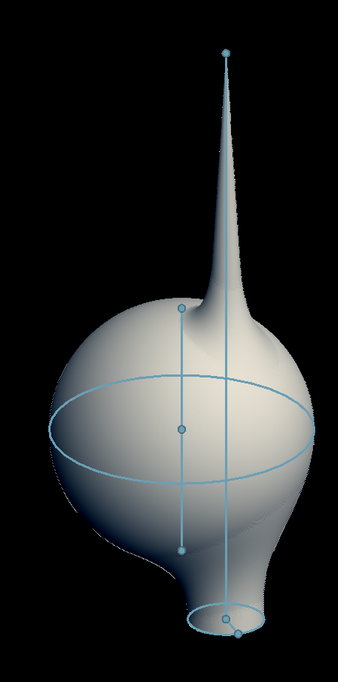
Oh and there is a CAD program called Antimony that looks an awful lot like #codeCAD but with graphical interaction:

https://www.mattkeeter.com/projects/antimony/3/

🧵 A short thread of me looking at #AntimonyCAD and comparing it to #sdfCAD 👇

Antimony

Wow this #AntimonyCAD thing looks quite promising! Logic in the form of a graph in one window, an interactive (!) render in another window and the nodes seem to be #Python code under the hood! Apparently it's also based on #SDF's, so potentially smoothing might be possible!

Yep, it's #SDF based and probably just uses marching cubes as #ImplicitCAD and #sdfCAD as we have shitty edges folks! 😅

UPDATE: Ah, but one can enable 'feature detection' which gets rid of the edges, nice!

#antimonyCAD

#AntimonyCAD is well operatable with a touchpad, so that's a plus! 👌 #SolveSpace without a middle-mouse-button-drag is pretty much unusable unfortunately.

#AntimonyCAD does not have STL import either, like #sdfCAD currently, so that's uncool.
https://github.com/mkeeter/antimony/issues/153

[Feature request] STL import · Issue #153 · mkeeter/antimony

A very neat feature would be the ability to import STL model as a node in Antimony. Example of use case : I'm currently designing a casing that will contain many PCBs (of various sizes). Kicad can ...

GitHub
Although #AntimonyCAD is SDF-based, I can't seem to find a way to do boolean operations smoothly like in #sdfCAD. This is a trivial thing with SDFs and one of its selling points so I'm not quite sure why this isn't available. 🤔
Okay so #AntimonyCAD can do a smooth union, but apparently calls it 'blend'. No chamfer joining or smooth intersections and differences though, so here #sdfCAD definitely wins.
Under the hood, #AntimonyCAD seems to use C++ with Python bindings. Code is thus more complicated than #sdfCAD.
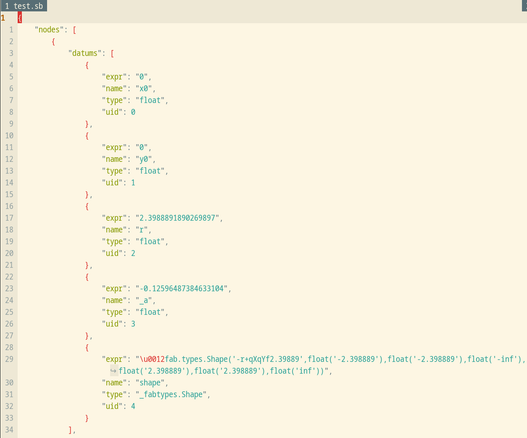
#AntimonyCAD's file format seems to be a rather compact JSON with mostly embedded Python code and parameters, so quite version-controllable, nice!