When I got to San Francisco in 2010, I really wanted to do it all

Build a startup, create change through technology.

But the more I learned of the culture, the less I wanted to succeed according to its rubric. The turning point for me was Airbnb

Around 2011, Airbnb was REALLY taking off. All the benefits of a software business, none of the drawbacks of a real estate business. The best of all worlds.

Except…

The primary externality Airbnb generated was RISK

This exploded into public awareness when a host found her apartment absolutely destroyed by a guest

Which, you know, of course: a system like that is bound to fail spectacularly on occasion.

But what shocked me was how unprepared Airbnb was to make their host whole again. They were dodging accountability and only public shame, orchestrated by the host’s desperate PR campaign, could make the difference

It drove me bonkers.

These guys were getting absolutely rich off the backs of the communities that hosted them.

And they couldn’t take care of someone when things went wrong?

It was such a breach of the basic, reciprocal, implied social contract we should all adhere to.

And what I was learning was that all of Silicon Valley business culture was premised on that kind of breach. Move fast and break society if it earns you a better valuation next round

I didn’t like that at all.

Man, Steve Huffman tried to open the door for me, too.

Sometimes I look back and wonder if I fucked up. He’d invite me to hang at the beach with his YC buds.

But I just couldn’t get excited about them and their world. I couldn’t play the game the way they all expected. It wasn’t for me.

We haven’t talked in years. I got pretty mad at him and Alexis, after they returned to Reddit. I felt they had a greater responsibility to community health.

At the time, Steve… disagreed.

Today all those guys are RICH

I mean, beyond fuck-you money, this is fuck-everyone money. And powerful, in that they can do more or less what they want any given year, and have access to anyone else they need to meet or influence.

Meanwhile, I’m not rich.

It feels like I could have been, if I’d made different choices. But I couldn’t do that any more than I could have sprouted wings.

It’s one of the enduring heartbreaks of my life that I found the Valley so inimical to my values.

So now I live in the woods, almost as far from San Francisco as you can get and still be in the US.

I’ve got a fiber connection and half a prayer everything I know about software and technology strategy can still matter, can still pay some bills.

It’s hard to spend a lifetime really learning something, knowing it down to your bones, only to find the Mecca of its practice so hostile to the vision of the future you hold dear.

It’s been quite a walk through the desert.

@danilo it feels like threads from my heart are woven into the fabric of your story 🫶

Thanks for telling it so well.

@toolbear thanks for reading <3

@danilo @toolbear

Don't worry. The #LongTail of what you want to do for a business will gift you with the correct pitch deck, eventually, that fits your values. 👍📌

@danilo

Don't worry that you took a bad path for your field: every field is now like this. If you'd become a medical doctor, a civil engineer, a worker in retail, or whatever, you would have gone through the same thing.

@RichPuchalsky @danilo the fraction of people who slog through a medical degree in order to rip people off is much lower than in software.

@naught101

Not many people in any real field go into it in order to rip people off, but that is what most of them end up doing in our society. For doctors, they slog through a medical degree, then they rip people off for insurance companies by seeing them for too short a time and not trying procedures that are too expensive, and for pharmaceutical companies by prescribing their meds whether they are the best ones or not, and if they rise in the hierarchy they learn to rip off more and more people.

@RichPuchalsky

What you're describing is very different from inventing new and cleverly obfuscated ways of ripping people off en mass which is the driving foce behind the SF Bay Area VC startup culture.

@naught101

@ericjmorey @naught101

Eh, that's kind of part of the self importance of techies to think that VC startup culture is uniquely bad. The people who figured out how charge megabucks for ambulance rides whether the patient had insurance or not have killed a lot more people than VCs have.

@RichPuchalsky

Sure. But that's not what's being pumped out of medical schools and recruited for. That's more of a VC and insurance industry culture thing.

@naught101

@ericjmorey @naught101

The original post included: "When I got to San Francisco in 2010, I really wanted to do it all / Build a startup, create change through technology." In tech, that is pretty much the attitude of people going to school, and presumably getting initially recruited. Not too many people are both sociopathic and on the ball enough to realize "Hey, if I go to school in tech, I could get rich ripping people off."

The reason I keep going with these comments is because people tend to think that their own fields are bad and don't realize that other fields are. Doctors didn't go to med school to end people's lives. But if they go up the hierarchy at all, that's what they do. Same with anything: people in retail just want a job, but as soon as they go up to assistant manager they find themselves telling people with Covid that they have to come in to work without a mask or get fired.

@RichPuchalsky

That's fair. There's no perfect or pure industry to work in. And it's hard to have perspective on things outside of your life experiences.

@naught101

@danilo I am in this picture and I do not like it.

I still live in the area, I haven’t had that big falling out with anyone personally, but the dawning realization that the engine of “tech” was just breaking existing laws with technobabble obfuscation (a partial list: illegal cab company, illegal hotel, illegal parking garage, illegal rocket launches, wildcat bank, mass art theft) and it only works because law enforcement is perpetually asleep at the wheel … makes it hard to maintain enthusiasm

@glyph yeah

WAY too much of the last cycle’s “innovation” was software outrunning sleeping regulation

It’s depressing stuff

@danilo @glyph And finding ever more ways to erode workers' rights!

@danilo I obviously think the crime-doers doing the crimes are to blame here.

But the sleeping regulators are also an important part of the problem.

If you are an executive who is not comfortable with rampant criminal behavior, but you’re also not an incorruptible paragon of righteousness (as most of us are not), there’s only so long you can watch the rest of the industry do a bunch of crimes before you can start wondering “wait, are these actually crimes or is it just acceptable CODB?”

@danilo If everyone is willing to externalize their costs but you, you get out-competed and replaced by someone else who is willing to do that externalizing. The incentives make the environment more than the personalities do.

@glyph this is real as hell and especially visible with the self driving car fiasco

The shit is out there running people over and it takes how long to shut it down? It’s pathetic

@danilo @glyph

Yep -- as I was reading @danilo's original thread, and that anecdote of realizing the Airbnb founders were happy to let their users/community bear the costs of entirely-foreseeable problems caused by Airbnb existing, my first thought was that one trend that unified the big Silicon Valley firms that emerged in the late 00s was ...

... "shrugging off externalities" as a business plan

A venerable strategy in business, bien sur

But rediscovered with exuberance by those guys

@danilo @glyph

One of the most interesting things to me has been watching the rare times when regulators actually do clearly see the potentially-malign externalities that are outgassing off a tech business model ...

... and pass regulations to account for them

I'm thinking of how many US cities began more-tightly regulating electric-scooter firms, and even (eventually) Airbnb

This regulatory action has, a far as I can tell, mostly been at the local or state level ...

@danilo @glyph

... possibly because "local" is where government is most responsive to actual citizen needs (I say "most" not to say "it's super great and totes responsive", but to distinguish it from the federal level, which can be sclerotic) ..

.... and also because all the ill effects of those tech business models were highly *visible*, and perhaps more importantly *physically* palpable, on a local level:

Scooters lying askew on the streets; housing taken off the rental market

@clive @danilo @glyph

AirBnB triggered an explosion in home prices & rents, capital gains tax evasion, foreign money laundering into residential real estate, and the commodification of residential housing by private equity Wall Streeters like Blackrock.

As global anti-democracy movements grow, a flight of capital out of repressive regimes like China & Iran accelerated housing unaffordability

Homelessness blew up because housing became treated like commercial real estate.

@Npars01 @clive @danilo it’s a *little* unfair to put that all on AirBnB. They were one accelerant among many, on a market with some pretty bad fundamentals

@glyph @clive @danilo

It's not all on AirBnB, but buying multiple homes for short-term rentals became a gold-rush amongst the tax-evasion crowd.

@Npars01 @clive @danilo no disagreement there.

@glyph @Npars01 @danilo

Yep yep

These grimy little ploys all played a part

The failure of (far too many, most) countries worldwide to build enough housing is such a crapshow, and one with lots of blame to go around

@Npars01 @glyph @clive @danilo
New York City real estate seems to be driven primarily by tax-evasion and money laundering, everything bought and sold from one LLC to another.
For example, this last sold in 2018 for $1.16M. No other reasons I can think of why it would.
https://flic.kr/p/24fnmDX
248 Stratford Road, 2018-03-29

Flickr

@xris @glyph @clive @danilo

Several cities have experienced the same carpet bagging influx.

London. Atlanta. Austin. San Francisco. Miami. Los Angeles. Vancouver. Seattle. Madrid. Rome.

@Npars01

I'm surprised short term rentals don't fall victim to arson the instant they hit the market. That's what a sane renting population would do. Sane populations rectify existential threats.

@clive @danilo @glyph

@noyes @clive @danilo @glyph

AirBnB's tend to overstay their welcome.

Residents being accosted in the elevator by inebriated party-goers, tends to trigger fines by the condo association

Complaints to municipal business licensing agencies trigger tax investigations.

Anonymous narcing to the IRS triggers tax audits.

AirBnB's who steal property, let their pets urinate in hallways, & leave suspicious packages behind for later pickup by scary dudes, it tends to disincentivize repeat business

@clive @danilo @glyph "shrugging off externalities". - I recall discussions with a VC guy, who was busily and regularly asserting that we shouldn't ignore the positive externalities. #sheesh

@PaulWermer @danilo @glyph

True enough

In the early days of the first e-scooter-for-hire boom, I spoke to a CEO for one of them, who was an exuberant 20something dude

"You know, Clive," he told me, "what I'm realizing is that sidewalks are the hot new platform"

That comment ... has stuck with me

@clive @danilo @glyph indeed. And with a balance- impaired space, that sidewalk action is scary. We've experienced it. And we are not alone; there is an aging population, and the sidewalk e- scooters are are a threat.

@clive @danilo @glyph though, to be fair, we were out one day and met a young couple riding e-scooters on the San Francisco sidewalk. All of us waiting at a loooong light. Nice people. Why were they on the sidewalk? Well, they tried the street ( the label says not to ride on the sidewalk (giggle)). And the drivers terrified them. So, onto the sidewalk. And guess what? They hated the e-scooter experience, would never do it again. (Speaking as one who bicycle commuted through a Chicago winter, I stopped bicycling because of safety concerns/ bad drivers.)

Think of how much better it would be, if instead of thinking of the sidewalk as a hot new property to squat on, the brilliant tech mind had actively engaged with the city to develop good protected lanes for bikes & scooters? They'd be heroes. And their political clout would have accelerated development of a safe, fast travel network.

#BikeTooter #bikelanes #micromobility #VultureCapital

@PaulWermer @danilo @glyph

Agreed on all these points

And in truth, the interesting thing about cities taking a regulatory interest in these scooter-on-demand firms ...

... and reining them in from their early-years model of "just dump a bunch of scooters on the roads and wait for the city to sue us" ...

... is some of the scooter companies got a bit wiser, and have been actively participating in the push for more bike lanes

Since that's what scooters need

@PaulWermer @clive @danilo @glyph

> the brilliant tech mind had actively engaged with the city to develop good protected lanes for bikes & scooters?

What's the (alleged) business model? The e-scooter and bike rental startups are in the game to sell their stock, not to improve the world.

@artemesia @clive @danilo @glyph simple business case: more demand from potential riders who would ride if not forced into auto lanes & congestion., and won't ride on sidewalks because in many cases they are either too badly maintained, or they don't want to risk pedestrian traffic, or even no sidewalks .

@PaulWermer @clive @danilo @glyph

That's not a business model. How do you make money?

@artemesia @PaulWermer @clive @danilo not sure what you are getting at here. You make money in this case by renting scooters. The “model” is just rental; these are strategies to boost demand. Most businesses do have a productive economic activity underlying them, even if it is buried under a pile of perverse economic incentives and crenellations of weird anticompetitive behavior

@glyph @PaulWermer @clive @danilo

No, a simple shop makes money by renting scooters. A company distributing 2500 scooters across a city (and abusing public infrastructure by doing things like tying up every bike rack near popular attractions with truck-moved scooters at 7AM) is in the business of selling stock.

My question to the OP is, how are these tech geniuses supposed to make money by "the brilliant tech mind had actively engaged with the city to develop good protected lanes for bikes & scooters?"? There's no growth story, no greater fool to sell to, no elevator pitch, and as my largely rhetorical question pointed up, no business model.

@artemesia @glyph @PaulWermer @danilo

Oh, they certainly may be intending a greater-fool stock dump, and not a sustainable business

that's certainly the arc of most of these businesses

but in the interim they've been occasionally quite useful in making city councillors take a closer look at rolling out more bike lanes

@artemesia @clive @danilo @glyph ad I said in the first line, more attractive infrastructure (in this case, a good network of dedicated safe lanes) will increase demand for use of rentsl e-scooters/e-bikes. More demand = more rentals = $$$$

@PaulWermer @danilo @glyph

Yep -- particularly the ones from dockless on-demand firms that get left willy-nilly on the sidewalk, falling over and turning into obstacle courses

@clive @PaulWermer @danilo @glyph I’m amazed your eyes didn’t roll back into your brain and kill you instantly, congrats on surviving that.

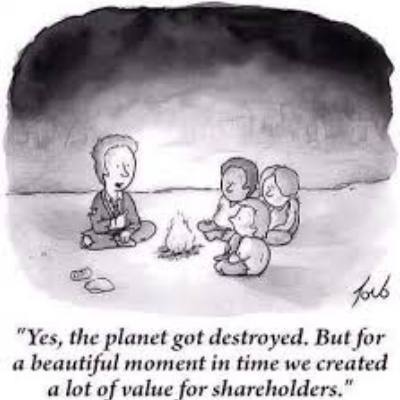
@clive @danilo @glyph Fundamentally, all of the large businesses that run the world now are built on socializing externalities and privatizing profits. Tech just provided them an opportunity to do the same without having to build any manufacturing capacity or maintain as much plant overhead.

Now they can get started to generate pollution, consume electricity, destroy communities and pervert the real estate market with a handful of code and a single download server.

@glyph @danilo That makes the responsible course of action, as someone with business expertise in the domain, being lobbying for regulation that will constrain both you and your competitors. Use your unique position to clearly inform lawmakers what your industry is up to.
@dalias @danilo unfortunately, as you probably already know, lawmakers,

@glyph @danilo

The regulators aren't asleep.

They've been bought.

@glyph @danilo
I spend some time working at a regulator, the biggest forces were:
-another small cut to our funding, like last year and the year before that, slowly nibbling away at the size of the organisation
-we made very decent money working for the regulator, but the great money was in building a network and transferring to the companies we were supposed to be monitoring.

That atmosphere of individual corruption did more damage than any funding-cut ever could.

@glyph @danilo The SV VC-backed tech scene would have you believe that it's the center of all information technology, as Hollywood does with popular culture.

I can imagine it seems that way to those who are there, but it's not objectively true at all.

Ignore the reality distortion field.

There's a whole world of other options out there for people innovating and building cool stuff.

This is true at every layer of the stack, and there are still layers yet to be conceived.

The world needs people who understand this stuff and who have a conscience to stay engaged, now more than ever.

@danilo Yet, as with Hollywood, there are few parts of the world it doesn't reach.
@marshray @danilo so, you’re not wrong, but there *is* — or should I say there was — a huge and vibrant engineering, dare I say it, “hacker” culture in the bay area. I feel like I watched it die. It’s hard to tease apart how much of this was just having a kid and less time for socializing, but there was a palpable shift in the culture here where meetup events shifted from “check out this cool gadget, I don’t know if it’s useful” to “here’s how to build your drop-shipping website in 3 clicks”
@marshray @danilo the shift is slow and subtle, and in some tiny ways I felt like I played a part in it. Not all of the shift to more commercialism is bad; having resources for cool fun projects is good. But eventually it all just got really same-y; no more demos of games, no more experimental computational art, just web frameworks and cloud infrastructure and eventually NFTs and ChatGPT demos.
@marshray @danilo in some sense this was inevitable. The reason that the bay area is a “tech capital” is specifically because of resource accumulation, and these sort of repeatable business-y things are exactly what the resource-accumulators want. The incidental joy and wonder and weirdness get optimized out. Hardly unique to this industry or this time, I know, but this is where I am.