 Wolfofthenyght
 Jen Gentleman
Loading bars explained:
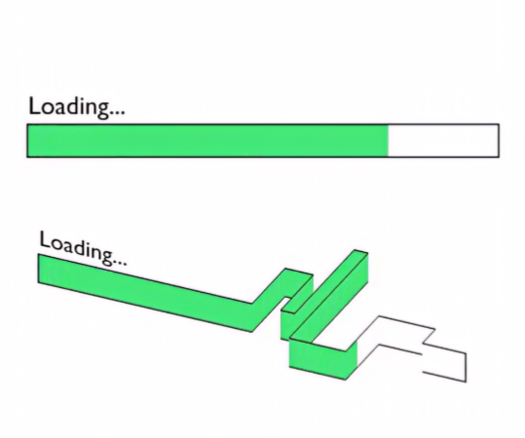
@jbiserkov @JenMsft The text is cut in to make it easy to print (no bridges, no tough overhangs) and easy to colour up in the slicer for multi-material prints.
Anyway, here's the link to the file: https://www.printables.com/model/559301-loading-demo
If you'd like the .f3d source to play with, let me know and I'll export it.
@JenMsft
"People assume time is a strict progression of cause to effect, but actually, from a non-linear, non-subjective viewpoint, it's more like a big ball of... wibbly wobbly... timey wimey... stuff."

~30 years ago, I recall Adobe Premiere going backwards;
15 secs out of 3 minutes
30 secs out of 8 minutes
1 min out of 15 minutes
2 mins out of 30 minutes
4 mins out of 60 minutes.
8 mins out of 80 minutes.
16 mins out of 90 minutes
It became a sport to see who could guess the total time the closest within the first minute or so.
@JenMsft
We should have a more detailed look in isometric at many things.
Would probably explain a lot.
@tnibert @JenMsft Yeah… it’s pretty much a special case of the halting problem.
I think the only way to get sympathy from non-programmers is to try to relate it to really complex projects and attempting to both have a very accurate estimate of the time needed and up to the minute status of all the work completed against that estimate. Then ask how many projects like that they’ve ever seen that actually completed on time with every project member pulling their own weight.
@JenMsft I watched a great video about how and why progress bars work the way they do, at least in some instances.

Having implemented and maintained a number of "progress bars" /under intense management supervision/, I can attest that a number of them do, in fact, behave *exactly* as shown in the diagram! By design! 😆
😢

@JenMsft having coded a few loading bars, this tracks perfectly with the program taking different loops, some of which are longer than others..
Then I discovered TQDM and stopped programming them myself 😅
 Medea Vanamonde🏳️⚧️ ♀
 BrooklynMan (in exile) 🏳️🌈
 Andres Jalinton
 Ursidinoj/The Bjornsdottirs
 Xiuwen
 Kneworldodor
 TeleviseFur 😺🦁🐰
 Andre
Andre Jordan Biserkov
 Momo
Momo Marco
Marco Radkolumne
 Jean Luc am Grimmsten
 Niclas Hedhman
 ThunderOwl
 llewelly
 Tim Ward ⭐🇪🇺🔶 #FBPE
 Calicosine
 derzeitreisende
 Timothy Nibert
 Eric Jennings
 Swift
Swift Xymon
Xymon Stefan
 Michael
 siegfried
 nytpu the wyvern
 korin 🔜 kodi
 Jeff Grigg
 Reiner Jung 🇬🇱 🇺🇦 🇪🇺
 Steven Toth
 Matt Singley
 Finnley Dolfin


 John Bell 🇺🇦🇪🇺🔸🕷️🏴
 MiggyMan
 Steven Roose
 Joshua Aspinall
 André Köhler
 Sushy
Sushy Siguza
 Tim Skywalker
 Urda
Urda Huh
Huh Nuki Raccoon: Fedi's Favorite Furry F***poster
 StuffyXP

 Martin Boller


 Stefan
 Nathanael Newton