 dafnis
 Craig S. Kaplan
How small can a set of aperiodic tiles be? The first aperiodic set had over 20000 tiles. Subsequent research lowered that number, to sets of size 92, then 6, and then 2 in the form of the famous Penrose tiles. https://youtu.be/48sCx-wBs34 1/6

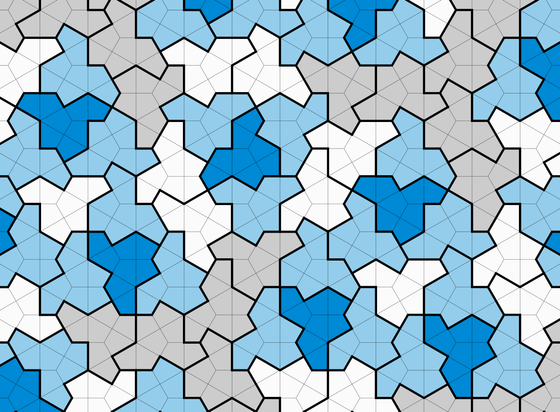

A longstanding open problem asks for an aperiodic monotile, also known as an "einstein": a shape that admits tilings of the plane, but never periodic tilings. We answer this problem for topological disk tiles by exhibiting a continuum of combinatorially equivalent aperiodic polygons. We first show that a representative example, the "hat" polykite, can form clusters called "metatiles", for which substitution rules can be defined. Because the metatiles admit tilings of the plane, so too does the hat. We then prove that generic members of our continuum of polygons are aperiodic, through a new kind of geometric incommensurability argument. Separately, we give a combinatorial, computer-assisted proof that the hat must form hierarchical -- and hence aperiodic -- tilings.

With the Penrose tiling, there are details encoded in the coordinates of the location where you are computing the tiling that will require more and more bits of precision to maintain accurately as you get farther away. I’ve never really tried to quantify this aspect of the tiling, though, and it is not an issue for the applet shown when run for, say, several hours. But in the infinite limit you would need ever more precision.
@tiotasram Some relatively (2021) recent examples exploring TRNGs in @bunnie's Precursor here:
https://www.bunniestudios.com/blog/?p=6094
Though if you look at the math break down here:
https://www.bunniestudios.com/blog/?p=6097
You'll see that NIST SP 800-90B section 4.4 has at least one logarithmic function.
There are some comments with other perspective in the second link that are food for thought.
AFAIK, not many people discuss these subjects too widely or openly, IMHO I think because most people aren't nerdy enough? ;)
@tiotasram @soulsource @csk The method is sometimes called "cut and project". Say you have 2d quadratic grid and you draw a stripe of some finite breadth and with irrational slope into the grid. Then projeting the gridpoints that come to fall within the stripe onto a say central line of the stripe you obtain a 1D quasi periodic/quasicrystalline pattern. Like the sequence of S and L in the penrose tiling.
The analog works for Dan Shechtmans real world 3D quasicrystalls, they can be described as an irrational intersection of a 3D slath with a 4D periodic (translational) tiling (pattern).
As far as I know it's open if there are quasi periodic patterns that cannot be described by "cut and project". In any case the basic idea can be used to compute fourier tranforms, i. e. the (electron) diffraction patterns of the quasiperiodic patterns that can be described like that.
Freeman Dyson wrote famously in "From Birds and Frogs" about the idea that the Riemann zeta zeros could be 1D quasicrystals in some sense and that a "complete understanding" of 1D quasicrystals might open a way to the RH.
@tiotasram @soulsource @csk Lagarias wrote on quasiperiodic sets (https://dept.math.lsa.umich.edu/~lagarias/doc/diffraction.pdf) and their diffraction patterns. He gives a general definition and if I understand correctly there should be both a finite upper and lower bound to the gaps between the points (sorry for my wild descriptions I am no mathematician) of a quasiperiodic lattice. This seems to be a valid generalization to me of what one can obtain from "cut and project".
I wonder about the gaps of the zeta zeros. As far as I know there are upper and lower bounds but they do depend on the zeros, I mean they are as far as I know no constants. If one can fix this somehow, say transform the zeta function such that these bounds become constants, I don't know.
@rjf_berger you've gone a bit beyond my math + physics level here, and web search isn't proving useful to figure out what a "quadratic grid" is since it also appears to name a teaching technique for polynomial multiplication. If you have a reference handy for "quadratic grid" I'd appreciate that, although I can keep searching more carefully on my own.
The idea of slicing an n+1 dimensional repeating grid at an irrational angle and projecting the included points down to n dimensions makes sense to me.
I saw some other papers referencing a Fibonacci grid, but I'll have to dig into that more, because they glossed over the definition of the Fibonacci grid and the paper they cited for that didn't have a full text I could access very easily.
But thanks for drawing additional connections!
@tj @csk "Aperiodic Monotile" for #LaserCutting, parametric layout in #CuttleXYZ
https://cuttle.xyz/@forresto/An-aperiodic-monotile-BgC9jiVONijH
(I vote that it's an untucked shirt over a hat, and think the cut could catch on.)
@csk Someone posted a link for more discussion at https://www.metafilter.com/198657/Coming-to-a-bathroom-floor-near-you-soon
This is a splashy result so I bet there will soon be many more links across the web to it.
Congratulations!
@csk If you want to print a few billions pieces for an empirical proof, you now can :)
I added a link to arXiv; if you prefer a different citation, please let me know. Once it's peer reviewed I will update links & citations.
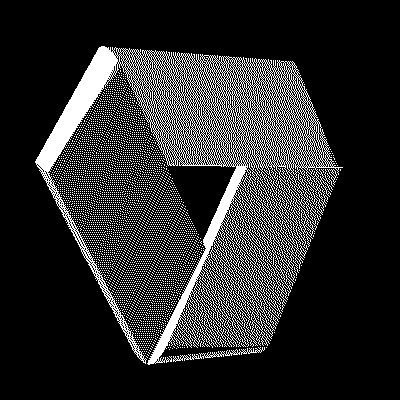
https://www.printables.com/model/430171-einstein-worlds-first-aperiodic-monotile
@csk This is amazing, and I have just ordered the materials to make a quilt based on tiling hats, so watch this space!
A question, inspired by figure 2.12 in the preprint: at large scale, can you always trace a path from one F metatile to any other F metatile through only F metatiles? Similarly, from one H/P metatile to any other H/P metatile through only H/P metatiles? My intuition is that at most only one of these can be yes, but they could both be no.
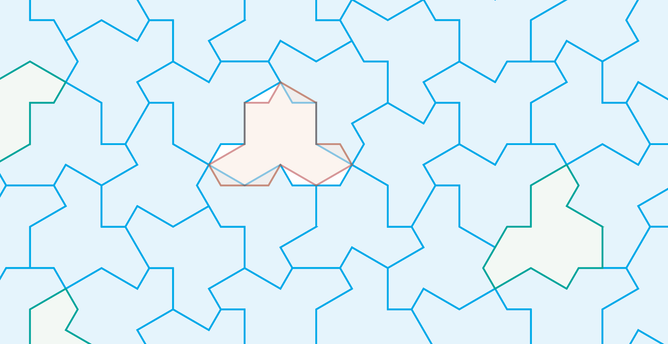
The periodic tiling conjecture asserts that any finite subset of a lattice $\mathbb{Z}^d$ which tiles that lattice by translations, in fact tiles periodically. In this work we disprove this conjecture for sufficiently large $d$, which also implies a disproof of the corresponding conjecture for Euclidean spaces $\mathbb{R}^d$. In fact, we also obtain a counterexample in a group of the form $\mathbb{Z}^2 \times G_0$ for some finite abelian $2$-group $G_0$. Our methods rely on encoding a "Sudoku puzzle" whose rows and other non-horizontal lines are constrained to lie in a certain class of "$2$-adically structured functions," in terms of certain functional equations that can be encoded in turn as a single tiling equation, and then demonstrating that solutions to this Sudoku puzzle exist, but are all non-periodic.

 Patrick Honner
 Tiota Sram
 Cassidy Curtis
 Greg Egan
 グレェ「grey」
 Andreas Grois
 rjf_berger
 tjhowse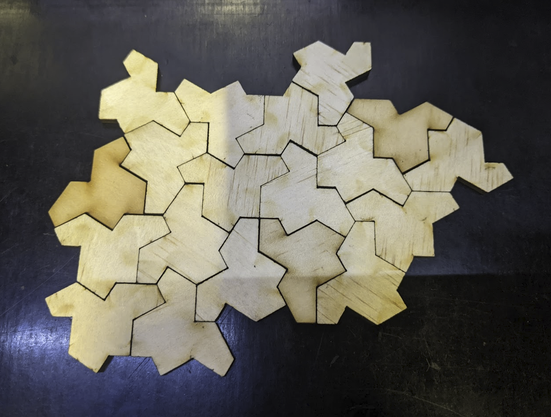
 forresto
 raboof
 Jesse Clark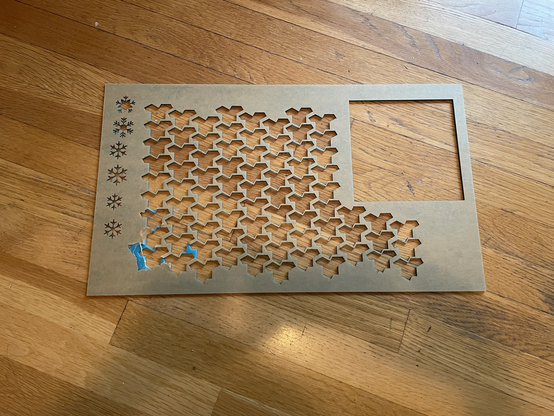
 nick
nick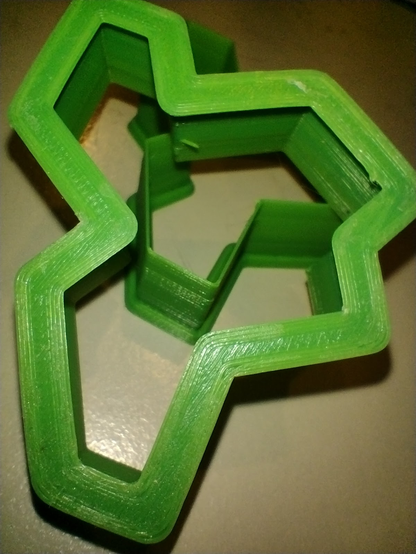

 0xDE
0xDE
 Stijn De Baerdemacker
 Bill Ricker
 Richard "RichiH" Hartmann
 Owen Maresh
 Globaltom
 Deborah Pickett
 SupposeNot
 S Bodzin, Real American 🇺🇸
 Ianagol
 Christian Lawson-Perfect
 Louis Evans
 LE Murphy
 That Dirk Guy
 me
me CurtAdams
 Bill Woodcock
 benjohn
 Joseph Myers