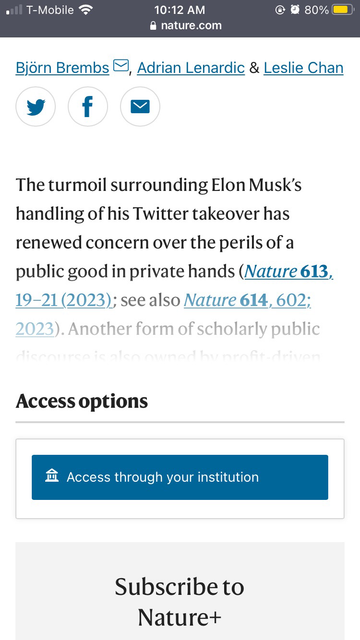
Many scholars are leaving Twitter for #Mastodon, a public, decentralized alternative, impervious to private take-over:

https://www.science.org/content/article/musk-reshapes-twitter-academics-ponder-taking-flight

Scholarly organizations are already supporting this migration:

https://www.nature.com/articles/d41586-023-00486-3

and

https://doi.org/10.5281/zenodo.7643817

There are analogous solutions for another public good in private hands: journals. There are even levers the scholarly community could pull to incentivize an analogous migration:

https://doi.org/10.5281/zenodo.5526634

What are we waiting for?

As Musk reshapes Twitter, academics ponder taking flight

Many researchers are setting up profiles on social media site Mastodon

@hnnng

The abstract may be paywalled, but the articles are not

https://doi.org/10.5281/zenodo.7643817

and

https://doi.org/10.5281/zenodo.5526634

Mastodon over Mammon - Towards publicly owned scholarly knowledge

Twitter is in turmoil and the scholarly community on the platform is once again starting to migrate. As with the early internet, scholarly organizations are at the forefront of developing and implementing a decentralized alternative to Twitter, Mastodon. Both historically and conceptually, this is not a new situation for the scholarly community. Historically, scholars were forced to leave social media platform FriendFeed after it was bought by Facebook in 2006. Conceptually, the problems associated with public scholarly discourse subjected to the whims of corporate owners are not unlike those of scholarly journals owned by monopolistic corporations: in both cases the perils associated with a public good in private hands are palpable. For both short form (Twitter/Mastodon) and longer form (journals) scholarly discourse, decentralized solutions exist, some of which are already enjoying some institutional support. Here we argue that scholarly organizations, in particular learned societies, are now facing a golden opportunity to rethink their hesitations towards such alternatives and support the migration of the scholarly community from Twitter to Mastodon by hosting Mastodon instances. Demonstrating that the scholarly community is capable of creating a truly public square for scholarly discourse, impervious to private takeover, might renew confidence and inspire the community to focus on analogous solutions for the remaining scholarly record – encompassing text, data and code – to safeguard all publicly owned scholarly knowledge.

Zenodo
@brembs "social media site Mastodon" Displaying the mainstream media's usual grasp of how the internet works 🙄
@brembs I think one of the next nice steps would be for Altmetric and PlumX (I don't know of other similar services) to count #Mastodon article mentions along with those on Twitter. Aside from mentions in the news, this is a kind of rough metric to measure the intensity of discussions related to a piece of research (and also nice for those who just like to see the numbers go up).

@lexolf

I agree! (and perhaps stop counting Twitter?)

@lexolf @brembs That would require search indexing of Mastodon services. And the whole topic of who has right to do it has been going on for years...

By default, most Mastodon instances allow search engines to collect the contents, but there is a difference between how much people are aware of the lacking technical restrictions. At the same time, it's more about question of what kind of a social contract there is (if any) between the search engines and community services. Power imbalances, etc.

@brembs (you know about scholar.social and the #SummerSchool conference, right?)

@nev

I know scholar.social, but what about the #summerschool conference?

@brembs You better knock on some wood after "impervious to private take-over".

Email is impervious to private take-over too, but try telling that to Gmail.

@LouisIngenthron

Good point (knocking on wood)!

But I'd describe GMail not as taking over, but rather captulating. Same sad effect, different actors (transitive vs. intransitive verbs).

@brembs Positive, indeed!
I've had cause to write to the UK TV provider #channel4 and asked why they don't have a presence on Mastodon, I hope they will in due course.
@mrjonno @brembs I’m rather certain Sunak and the torries will try to prevent them.

@mrjonno @brembs
UK TV (and radio) broadcaster BBC still has "you can find me on Twitter at _____" as part of almost every presenter's script, especially the TV rolling news channel.

That needs to stop.

The Beeb have been building out websites for decades, and a streaming platform more recently.

They run their own DNS servers, and they are their own LIR for their own range of IP addresses.

A Mastodon instance is not a huge undertaking.

@dec23k @brembs
Absolutely get this. Seems there's a great deal to unpack here with regards to the @BBCWorld ?
Maybe not today because this is a significant topic to do it justice.
Briefly, I am outraged that UK govt has sought to turn Aunty into Commercial TV and not the purpose of PSB. I listen to R4 and also dismayed - especially by Today. I still find some hope in WS and thanks for R3 and R6 as not sold out yet.
To have to pay a TV license for the mostly trash that is #Freeview , well...

@mrjonno @brembs

Is @BBCWorld (and @BBCBreaking ) just a 3rd party bot?
There seems to be a lot of them: @bbcnews (and some birdsite ones that I won't link).

Although @BBCNews has a 'tick' emoji after the name.

@mrjonno @brembs
A LIR is a Local Internet Registry, working closely with the appropriate Regional Internet Registry (RIR), in this case RIPE.

From Whois:

org-name: BBC
country: GB
org-type: LIR
nic-hdl: BBC-RIPE
mnt-by: BBC-MNT

@mrjonno @brembs
They should have set up a presence on an existing Mastodon instance years ago.
@brembs
The irony is not lost on me that when I click on the science.org article, I have to pay $32 to read it. Thankfully I have access through my university so I downloaded it and I post the screenshot of it here for others to read:
Mastodon over Mammon - Towards publicly owned scholarly knowledge

Twitter is in turmoil and the scholarly community on the platform is once again starting to migrate. As with the early internet, scholarly organizations are at the forefront of developing and implementing a decentralized alternative to Twitter, Mastodon. Both historically and conceptually, this is not a new situation for the scholarly community. Historically, scholars were forced to leave social media platform FriendFeed after it was bought by Facebook in 2006. Conceptually, the problems associated with public scholarly discourse subjected to the whims of corporate owners are not unlike those of scholarly journals owned by monopolistic corporations: in both cases the perils associated with a public good in private hands are palpable. For both short form (Twitter/Mastodon) and longer form (journals) scholarly discourse, decentralized solutions exist, some of which are already enjoying some institutional support. Here we argue that scholarly organizations, in particular learned societies, are now facing a golden opportunity to rethink their hesitations towards such alternatives and support the migration of the scholarly community from Twitter to Mastodon by hosting Mastodon instances. Demonstrating that the scholarly community is capable of creating a truly public square for scholarly discourse, impervious to private takeover, might renew confidence and inspire the community to focus on analogous solutions for the remaining scholarly record – encompassing text, data and code – to safeguard all publicly owned scholarly knowledge.

Zenodo
@nathaliaassaad @brembs thanks for posting Maybe repost the #Amazonia #keepitintheground piece again with a headline?
@brembs lol the irony

@phurd

The abstract may be paywalled, but the articles are not

https://doi.org/10.5281/zenodo.7643817

and

https://doi.org/10.5281/zenodo.5526634

Mastodon over Mammon - Towards publicly owned scholarly knowledge

Twitter is in turmoil and the scholarly community on the platform is once again starting to migrate. As with the early internet, scholarly organizations are at the forefront of developing and implementing a decentralized alternative to Twitter, Mastodon. Both historically and conceptually, this is not a new situation for the scholarly community. Historically, scholars were forced to leave social media platform FriendFeed after it was bought by Facebook in 2006. Conceptually, the problems associated with public scholarly discourse subjected to the whims of corporate owners are not unlike those of scholarly journals owned by monopolistic corporations: in both cases the perils associated with a public good in private hands are palpable. For both short form (Twitter/Mastodon) and longer form (journals) scholarly discourse, decentralized solutions exist, some of which are already enjoying some institutional support. Here we argue that scholarly organizations, in particular learned societies, are now facing a golden opportunity to rethink their hesitations towards such alternatives and support the migration of the scholarly community from Twitter to Mastodon by hosting Mastodon instances. Demonstrating that the scholarly community is capable of creating a truly public square for scholarly discourse, impervious to private takeover, might renew confidence and inspire the community to focus on analogous solutions for the remaining scholarly record – encompassing text, data and code – to safeguard all publicly owned scholarly knowledge.

Zenodo
@brembs I get way more interaction on Mastodon than I ever got on Twitter.

@britishtechguru

Ditto here.

@brembs And so far it has generally been higher quality interaction. I mostly post tech stuff. Going off topic gets a bit too dicey. Anything I say in support of LGBT immediately gets twisted as though I made a full frontal assault so I don't even bother with subjects like that.

@brembs

Great, isn’t it! Out of the claws of murky algorithms trying to sell you more and more screentime and ads, mixed with fake news adepts taking your time in pointless discussions.

@brembs Elon is a colossal narcissist, dangerously fragile ego, heel turn complete. Or, he was just always planning to screw over the progressives that helped him build his brand. Leaving the bird app was the best move. Mastodon feels quite a bit less intuitive, but the amount of BS I’m subjected to has decreased by 99%. Still learning how to shape my feed.

@Sinnistergrin

Yup, I'm also having a great time here and if twitter were gone tomorrow, I wouldn't miss it one bit.

@brembs I think most people " #Mastodon, a public, decentralized alternative, impervious to private take-over" without giving it any real thought. While It's sort of true, if you join the wrong instance, it's not true. Any instance administrator can sell their instance, or even worse get depressed fighting an avalanche of hate speech and just shut the instance down. Here are a few thoughts on the topic.

https://markcathcart.com/2023/01/26/mastodon-enter-at-your-own-risk/

Mastodon: Enter At Your Own Risk!

When twitter started its impending collapse right after Elon Musk took over, I like many jumped over to Mastodon, or more specifically to the mstdn.social(( server. By now, anyone even vaguely inte…

Life, Technology and more...

@4mc

Cirrect in principle, yes. In practice, it's like email and that has been around long enough, I hope, for people to understand the meaning here. Moreover, it's about scholarly societies implementing instances, another hurdle.

@brembs The evidence so far among academics and journalists with tens or even hundreds of thousands of followers is that they will never, ever leave Twitter. Having a voice that reaches that many people is too much power, and too intoxicating to let go of.
@brembs very good points - I've enjoyed reading it.
Are there further ideas developed on #peerReview?
At the moment that's a major lock-in from my perspective, especially in emerging scientific communities (such as the built environment). What journals ideally offer there is an organised review of a paper that then (again ideally) is improved and then published. How would quality control look like without journals / editors organising it?

@kerstinsailer

There have been many journal-independent peer review services over the last 10-15 years. Any of these could be implemented. ONe of the most recent ones is "Peer Community In":

https://peercommunityin.org/

So once we have control, there would be lots to choose from. But I don't think editor-led peer-review will die out completely. It has its uses. It'll probably just be more focused.

Peer Community In - free peer review & validation of preprints of articles

PCI is a non-profit open science organization of scientists to evaluate, recommend and publish research preprints in free open access

Peer Community In
@brembs I think Mastodon and the Fediverse should absolutely be everyone's solution for social media. Any way we can keep government and corporate interests out of our communications is a good thing.
@brembs no, I don't plan to leave twitter, I just wanna try something similar.
@brembs so glad to hear it.
@brembs they’re waiting for quote boosts. Mastodon needs it and needs it now.
@brembs Nature’s article on “Mastodon: a move to publicly owned scholarly knowledge” costs $32. Ironic.
Mastodon over Mammon - Towards publicly owned scholarly knowledge

Twitter is in turmoil and the scholarly community on the platform is once again starting to migrate. As with the early internet, scholarly organizations are at the forefront of developing and implementing a decentralized alternative to Twitter, Mastodon. Both historically and conceptually, this is not a new situation for the scholarly community. Historically, scholars were forced to leave social media platform FriendFeed after it was bought by Facebook in 2006. Conceptually, the problems associated with public scholarly discourse subjected to the whims of corporate owners are not unlike those of scholarly journals owned by monopolistic corporations: in both cases the perils associated with a public good in private hands are palpable. For both short form (Twitter/Mastodon) and longer form (journals) scholarly discourse, decentralized solutions exist, some of which are already enjoying some institutional support. Here we argue that scholarly organizations, in particular learned societies, are now facing a golden opportunity to rethink their hesitations towards such alternatives and support the migration of the scholarly community from Twitter to Mastodon by hosting Mastodon instances. Demonstrating that the scholarly community is capable of creating a truly public square for scholarly discourse, impervious to private takeover, might renew confidence and inspire the community to focus on analogous solutions for the remaining scholarly record – encompassing text, data and code – to safeguard all publicly owned scholarly knowledge.

Zenodo

@brembs

Legacy social media and private academic publishing have common features: they're both software-based information capture systems that sell information back to the creators of that information at one form of cost or another.

Ransomware, in other words.

In common with less accepted varieties, these too are installed via various sneaky means advertised as something else, promoted as benefical choices. "Click here to get [benefit]." In haste, without thinking ahead being key to all.

@brembs But *we* have not waited. We are here.
@brembs Hi Björn, congrats to the article! Next to some of the German research orgs mentioned in your paper for their respective ActivityPub activities, there's Leibniz. We, @tibhannover, are one of Leibniz' member institutes, featuring multiple Mastodon / ActivityPub related activities, e.g. VIVO profile verification (since 2022). https://blogs.tib.eu/wp/tib/2022/11/23/verification-of-scholarly-social-media-accounts-in-the-fediverse/ Please consider mentioning us in forthcoming pieces. See you e.g. on one of Leibniz' #OpenScience barcamps where we sometimes meet anyway. 😉
Verification of scholarly social media accounts in the Fediverse - TIB-Blog

At TIB, we use the open source research information system VIVO for research profiles. We have extended it with the feature to add Mastodon IDs and thus verify their Mastodon profiles.

TIB-Blog
@brembs Indont believe Musk wants scientists on his RW platform. It’s more for Kanye West and other Nazi apologists/slavery deniers. And before someone says “oh Kanye is banned” I’ll caveat with “for how long until his good buddy reinstated him?”
@brembs yes, do it! Science should have its own server
@brembs I guess that Elon Musk buying Elsevier would be a game changer

@vigji

At least one could hope he'll destroy it like Twitter 🤣

@brembs meanwhile... ESA, NASA, JAXA, DLR, CNES, ESO, national agencies, still dragging their feet... at least we know that ESO seriously considers it, but no news from other agencies.

@brembs What's the point of the article if none of the publications have added a "Follow us on Mastodon" link?

Just gawkers filling some column inches

#medlibs I have shared the academia-moves-to-mastodon links curated by @brembs, above, with the (surprisingly large) communications team at the school where I'm liaison librarian. Maybe you should too ;)
STEM & Medical Mastodon Instances

servers instance,description,users (1,000),posts (1,000),admin name,admin handle,email,additional info <a href="http://fediscience.org/">FediScience.org</a>,research scientists w/ publications,5.34,60.8,Frank Sonntag,@FrankSonntag SciComm.xyz,science communicators & enthusiasts, scientists,1.28,...

Google Docs
@brembs Thanks for your work on this!
@brembs
This this THIS!!! Who even has the thousands of dollars/Euro/EFFING SWISS FRANCS in order to publish work that THEY produced, often without financing?! The old system only favors publishing monopolies and unequal access for researchers in poorer countries (and the “low-income country” APCs are a joke.