@JessTheUnstill @[email protected]

While true, this commonplace #Green thinking ignores the needs of the many handicapped or frail elderly people or stressed-out parents with several younger kids who already feel guilty about spending too little time with their family.
Using public transport in off-peak times often doubles or triples travelling times + involves quite some walking.
Furthermore, in rural areas, #PublicTransport is mostly too rare and often too expensive due to low population density.

@HistoPol @JessTheUnstill @[email protected] Handicapped people can use buses far more easily than they can use cars. Buses squat to curb level to allow wheelchairs to board, cars do not. Wheelchairs can roll into buses far more easily than they can roll into cars, even vans with lifts. And for visually impaired people who cannot drive, buses are a fundamental lifeline along with taxis. Cars are oppressive to the handicapped.
@HistoPol @JessTheUnstill @[email protected] And in rural areas public transit is already available for the handicapped due to Federal funding. My aunt drove a van for the local handicapped transit contractor to help the handicapped get to their doctors' appointments and grocery store trips. Only non-handicapped don't get public transit there.
@HistoPol @JessTheUnstill @[email protected] In short, your observations about the handicapped and public transit are totally divorced from the reality. Public transit is the most friendly form of transit for the handicapped, and that has been true for decades.

@badtux @JessTheUnstill @[email protected]

Interesting observation.

A longer time ago, I was managing a driving service for the handicapped. All of our clients would not have shared your opinion. In particular, as almost all would not have made it even to the next bus stop half a mile away by themselves.

The ones that might have made it would still mostly have preferred a cab/taxi.

Most of the people I know aged up to 80/85 who are not nursing-home residents still manage to drive...
1/2

@badtux @JessTheUnstill @[email protected]

2/3
...however, many would not manage more than walking to a bus station and back 600m/half a mile (and back) and then still go shopping downtown.

Also, someone merely having an injured foot would not make it out of the unfathomable undergrounds in the #CityOfLondon when the #escalators are out of order.
...

@badtux @JessTheUnstill @[email protected]
3/3
...Oh, and if you are not #CrocodileDundee, taking an underground train in metropolises like #MexicoCity might prove too much adventure, in particular at night. πŸ˜‰

So, all I am saying is that while #PublicTransport might be the best, often only solution in urban areas, it is not for a significant number of people.

Also, an e-bike, for many, is an even faster solution for short and medium distances if there are bike lanes.

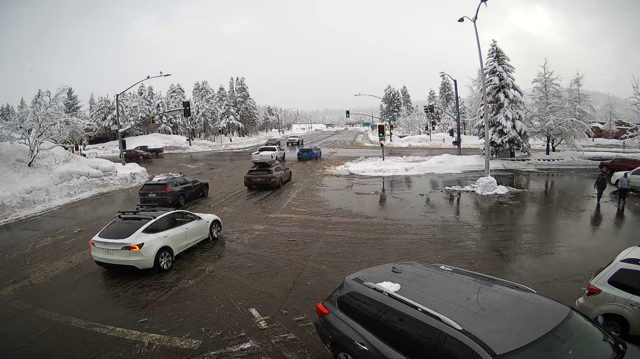
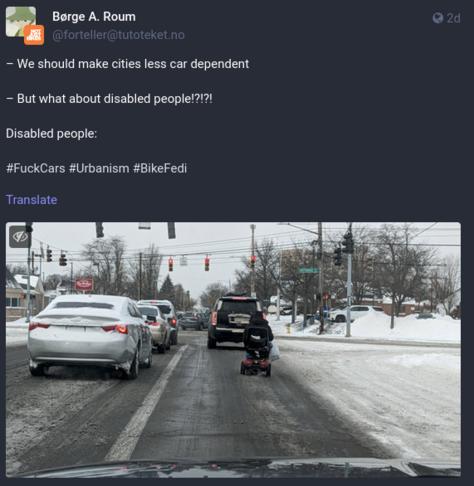
@HistoPol @JessTheUnstill @[email protected] An e-bike is useless to my mobility-impaired mother and visually-impaired brother. Furthermore your person riding an e-bike is not going to handle snow and ice very well, which is over 25% of the population of the United States during the winter. Here, tell me how well an eBike is going to do in this weather:

@badtux @JessTheUnstill @[email protected]

Abysmally, in general, though I have an acquaintance using #Spikes, prohibited for cars im most countries. πŸ˜‰

Many countries and #US regions do not experience snow on the ground.

But this is not really the point.
A well-designed #PublicTransport system will provide oeople with alternative means of transport infrastructure, too, like bike lanes and rental bikes/cars.

Buses and metro trains/subways will not be the panacea for all people/regions/climates.

@HistoPol @JessTheUnstill @[email protected] The fact that a third world nation has an unsafe mass transit system is of supreme disinterest to me. The fact that the United States lacks a functional mass transit system in 99% of its cities -- by functional, I mean any address no more than 2 blocks from a stop, and buses/trains run every 15 minutes -- makes life excruciatingly difficult for those who can't drive cars for whatever reason.

@badtux @JessTheUnstill @[email protected] @badtux @JessTheUnstill @[email protected]

(1/n)

Agreed.
I was trying to have an international perspective.

People complain about public transport in most places.
In fact, my feeling is that it is one of the goods where demand is by far greater than supply almost anywhere.

As I heard on the radio today, the richest one percent have accumulared two thirds of wealth-gains since before the Pandemic (e.g...

@badtux @JessTheUnstill @[email protected]

(2/n)
...the #food and #energy sectors).

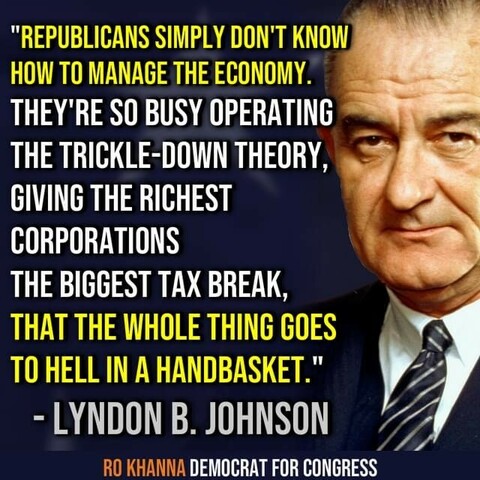
As trickle-down clearly could never work, it is high time to finally level the playing field for the people.

A #WealthTax, a steep #CarbonTax, in particular for private trips to space, and an #ExcessProfitsTax / #WindfallProfitTax / #WindfallTax of at least 50% would go a long way to pay for a state-of-the-art #PublicTransport and #HealthSystem...

@badtux @JessTheUnstill @[email protected]

(3/n)
...
A #WindfallProfitTax / #ExcessProfitTax / #WindfallTax has been introduced in several countries, including #Britain.

Cheap #PublicTransport would have a asymmetrically benefitial impact on low-income households. They would lower inner-city rents, as much more workers would be able to live in more distant suburbs (like in #SanFrancisco and #NYC).
The wealth of big home real-estate owners would be adversely affected, as prices would drop there...

@badtux @JessTheUnstill @[email protected]

(4/n)
...The effect on #GlobalWarming would be significant, too.

In the #US, however I fear that this will not happen in the next decade. Government, in particular #Congress and #SCOTUS have mutated into a #plutocracy ever since that fatal decision #CitizensUnitedVsFEC in 2010. What is even worse, it is not just #US #DarkMoney from national industry but increasingly from antagonistic,...

@badtux @JessTheUnstill @[email protected]

(5/6)
...#autocratic foreign countries like #Russia and #SaudiArabia that is skewing the US' and other western democracies (e.g. #UK, #France, #Hungary). At the beginning of this year, for instance, it turned out that #Qatar had bought the vice-president of the #EuropeanParliament.

I would like to have a more optimistic outlook, but I don’t. #VoterSupressionLaws including...

beSpacific (@[email protected])

A 5% tax on the world's multimillionaires could lift 2 billion people out of poverty The richest 1% have captured twice as much wealth as the rest of the world combined since 2020, according to a new Oxfam report. The world’s richest people have gained $1.5 trillion in the past three years. In fact, Oxfam’s findings show that the ultra rich have captured half of all new wealth created in the past decade. https://qz.com/oxfam-richest-people-pay-tax-poverty-hunger-wef-davos-1849986155 #Oxfam #Wealth #economy #billionaires #UltraRich #poverty

Newsie
@HistoPol @JessTheUnstill @[email protected] The fact that the EU does not have handicapped-access laws is not my problem here in the United States. The lack of any functional mass transit at all in most US cities is my problem. There's basically only two cities in the United States where you can easily live without a car -- New York City and San Francisco. That's pathetic.

@badtux @JessTheUnstill @[email protected]

Yes, the #US has been too focused on the #CarIndustry since #WWII.

But wheelchair accessibility is a problem in most countries, also in the #US:

"A 2011 report from Amtrak's Office of Inspector General found that 48 of the stations used by the railroad met the requirements set by the Americans with Disabilities Act, while 434 did not."

Even if there R willingness + laws, the funding must B there as well. Upgrading platforms + bus stops is very expensive.

After $25,000 fee, wheelchair users wait for better Amtrak stations, trains

Amtrak has been slow to make progress on improving accessibility of its stations and trains 30 years after the Americans with Disabilities Act passed.

USA TODAY

@HistoPol @JessTheUnstill @doppelgrau Here's the timetable for the Sydney Metro. Trains run every 10 minutes off-peak, including on weekends and public holidays (it runs every four minutes during the weekday peak). That's 5am to after 11pm, on Sundays and public holidays.

https://transportnsw.info/documents/timetables/93-M-Sydney-Metro-North-West-20201221.pdf

Being a modern metro, all stations and trains are wheelchair accessible, including level boarding with the platform (with no stairs). It features platform screen doors (that keep kids off the tracks), and the trains themselves are automated and driverless.

It runs through tunnels or on viaducts for most of its 36 km (22 mile) length.

There's no red lights, no traffic jams, no looking for parking.

It stops right in front of several major shopping centres (including Castle Towers, Rouse Hill, and Macquarie Centre), the main campus of Macquarie University, and numerous office parks.

There's also a number of excellent restaurants in the actual station building itself at Chatswood.

Compared to taking the Metro, driving (even off-peak) involves red lights, traffic, and parking, which often doubles or triples travelling times.

This means, compared to the Metro, cars are no good for stressed-out parents with several younger kids who already feel guilty about spending too little time with their family.

Cars also don't account for frail elderly people or people with disabilities (such as severe visual impairments) who can't drive.

#Urbanism #UrbanPlanning #MassTransit #trains

@HistoPol @JessTheUnstill @doppelgrau Unfortunately, I think too many people in the US have never lived in a city with even decent public transport, and so have no point of reference to compare to.

So their comparison doesn't end up being driving compared to a modern metro service, it's instead driving a car vs. the local hourly bus service/Amtrak.

@ajsadauskas @JessTheUnstill @[email protected]

This was my point, too.

And even in big cities, many bus stops and train stations for metropolitan trains are not (yet) suited for wheelchairs, in particular at suburbs.
Furthermore, it is not just wheelchairs. Anyone who has broken a leg once knows how exhausting it is to walk just a couple of hundred feet/meters to a bus stop. Also, if youvhave strongly impaired vision, just as 2 more examples.

Oh, and try the former with a shopping bag... πŸ˜‰

@HistoPol @JessTheUnstill @doppelgrau I wheeled a 20+ kilogram suitcase on Sydney trains and it wasn't much of a hassle. Many thousands of people do similarly each day.

The problem seems to be that most US cities don't have a decent public transport system like Sydney, let alone a world-class system like Singapore, Paris, Tokyo, or Hong Kong.

As for taking the Metro vs driving in northwestern Sydney, the difference is 1 hour 15 minutes to drive from Rouse Hill to Macquarie Park at 7am on a weekday, compared to just 35 minutes by Metro.

If you're a stressed-out parent with several younger kids who already feels guilty about spending too little time with the family, why would you bother driving? The Metro is just so much quicker.

@HistoPol @JessTheUnstill @[email protected]

Some persons with disabilities cannot use cars and are actually marginalized by the car centric city. Public transit times are longer because we design them that way: not bothering the cars too much, not creating fast lanes for them to avoid removing parking spots etc. So they stay stuck in traffic. Or we don't invest to much in them, so the frequency is low. Therefore, as they are slow, people take their cars, making them even slower.

@StephaneHuart @JessTheUnstill @[email protected]

Of course, people with disabilities are not a homogenous group. Some just might need assistance getting on and off a bus while others need a chauffeur and an assistanton top.

Also: bikes weighing more than 50kg/100 pounds do not belong on normal bike lanes, as well as any motorbikes and e-bikes that go faster than 35 km/h / 20 mph. They are a tremendous accidents hazard for standard bikers.