1/6
😲 Two recent studies from China look at the truly wide diversity of RNA viruses found in ticks.

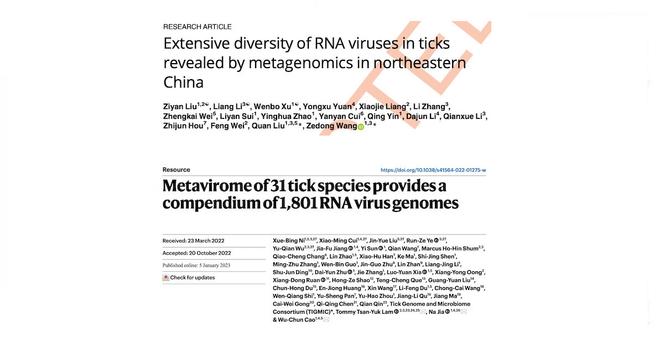
"Extensive diversity of RNA viruses in ticks revealed by meta #genomics in northeastern China"
https://doi.org/10.1371/journal.pntd.0011017

"Metavirome of 31 tick species provides a compendium of 1,801 RNA virus genomes"
https://www.nature.com/articles/s41564-022-01275-w

A lot of insights in these two studies, so I'll just point out a few things that I personally found interesting.
#virology @virology #RNA #virus #virome #InfectiousDisease

Extensive diversity of RNA viruses in ticks revealed by metagenomics in northeastern China

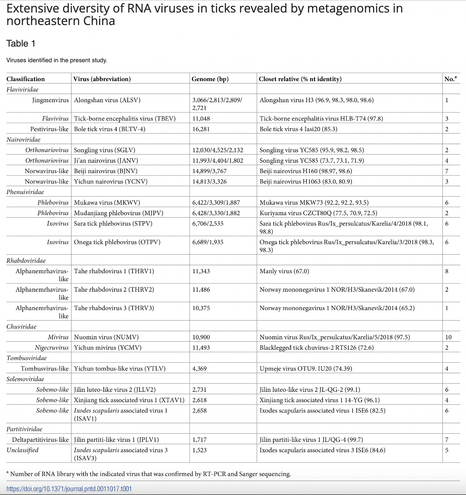
Author summary Ticks are important vectors to transmit many infectious agents. In recent years, many novel tick-borne viruses associated with human illness, including Alongshan virus, Songling virus, and Beiji nairovirus, have been identified in northeastern China. It is necessary to conduct routine surveillance of tick-borne viruses in ticks, however, little is known about the tick virome in northeastern China. In this study, we used metatranscriptomics to investigate the virome diversity in four tick species collected from northeastern China. In total, we identified 22 RNA viruses belonging to eight virus families (exclude an unclassified virus). Of these, five members were established human pathogens, eight viruses were of novel species, and six viruses had close relationship with pathogenic tick-borne viruses with potential public health threats. Moreover, we found that the viromes were significantly affected by the tick species and geographical location in the study. These findings revealed an extensive diversity of RNA viruses in ticks in northeastern China, which will lay the foundation for the prevention and control of emerging tick-borne diseases.
2/6
In the first study, from a collaboration of researchers in northeastern China, 22 RNA viruses were identified from four tick species. 8 were novel and 1 was unclassified.

5 were known human pathogens that included Alongshan Virus, part of a group of segmented flaviviruses first identified in 2014. Robert Gifford explains more:
https://twitter.com/Paleovirologist/status/1494030027679223808

But the range of Alongshan Virus is much wider than just East Asia, as it has recently been detected in Switzerland:
http://doi.org/10.5281/zenodo.7403328

Robert Gifford on Twitter

“Short #Jingmenvirus primer - medium thread. Jingmenvirus is a recently identified group of segmented RNA viruses that are phylogenetically linked to unsegmented flaviviruses. They appear to infect a wide range of animal hosts, including humans.”

Twitter

3/6
The first study also detected Tick Borne Encephalitis Virus (TBEV) among the 5 known human pathogens.

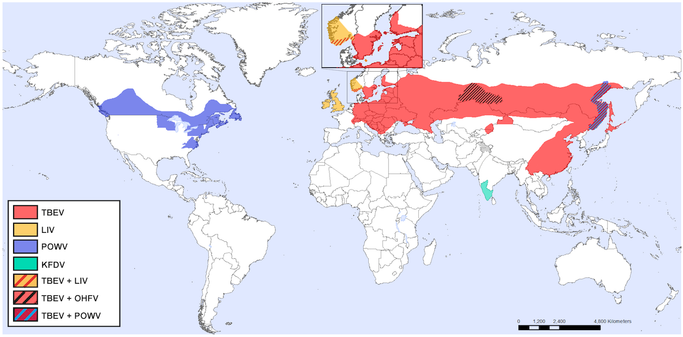
TBEV is a flavivirus that is found in northern latitudes across Eurasia, from England to Siberia.

The Siberian subtype seems particularly virulent, leading to a progressive brain infection that can cause death many years after infection.

4/6
In North America, the TBEV variants are known as Deer Tick Virus or Powassan Virus. The geographical range of these variants seems to be expanding southward, with infections reported as far south as Virginia, US.

The fact that these variants are transmitted by the same ticks that transmit #Lyme disease, as well as the fact that the symptoms are mostly identical to untreated Lyme disease, means that many human infections are undoubtedly misdiagnosed as Lyme disease.

5/6
In the second study, from a collaboration of researchers across China, 724 RNA viruses were identified from 31 tick species. Interestingly, they found that "more viral pathogens were detected in ticks from northeastern China compared with other areas."

The authors found that "41.5% of the viruses were +ssRNA viruses, 28.5% were −ssRNA viruses, 1.6% were dsRNA and 28.3% were unclassified viruses, suggesting the specific preference for +ssRNA in the tick virome."

6/6
The authors of the second study found differences in the virome of hard ticks vs. soft ticks, and investigated multiple factors that might explain the differences in tick viromes.

They also found similarities between the viral families found in ticks and the viral families found in other arthropods.

Using their findings, they develop theories on the historical evolution of the tick virome.

7/6
🦠 RNA Viruses in Ticks — Ticks that Feed on Bats! 🦇

In addition to the above studies ☝️, a new study looked at the #RNA #virome of ticks— specifically ticks that feed on bats in Sweden.

• Found 16 viruses from 11 #virus families, of which 15 were novel!
• Authors suggest that such surveillance might help identify potential zoonoses.

"Substantial viral and bacterial diversity at the bat–tick interface"
https://doi.org/10.1099/mgen.0.000942
#virology @virology #epidemiology #InfectiousDisease @eddieholmes

Substantial viral and bacterial diversity at the bat–tick interface | Microbiology Society

Ticks harbour a high diversity of viruses, bacteria and protozoa. The soft tick Carios vespertilionis (Argasidae) is a common ectoparasite of bats in the Palearctic region and is suspected to be vector and reservoir of viruses and other microbial species in bat populations, some of which may act as zoonotic agents for human disease. The Soprano pipistrelle (Pipistrellus pygmaeus, Vespertilionidae) is widely distributed in Europe, where it can be found inside or close to human habitation. We used meta-transcriptomic sequencing to determine the RNA virome and common microbiota in blood-fed C. vespertilionis ticks collected from a Soprano pipistrelle bat roosting site in south-central Sweden. Our analyses identified 16 viruses from 11 virus families, of which 15 viruses were novel. For the first time in Sweden we identified Issuk-Kul virus, a zoonotic arthropod-borne virus previously associated with outbreaks of acute febrile illness in humans. Probable bat-associated and tick-borne viruses were classified within the families Nairoviridae, Caliciviridae and Hepeviridae, while other invertebrate-associated viruses included members of the Dicistroviridae, Iflaviridae, Nodaviridae, Partitiviridae, Permutotetraviridae, Polycipiviridae and Solemoviridae. Similarly, we found abundant bacteria in C. vespertilionis, including genera with known tick-borne bacteria, such as Coxiella spp. and Rickettsia spp. These findings demonstrate the remarkable diversity of RNA viruses and bacteria present in C. vespertilionis and highlight the importance of bat-associated ectoparasite surveillance as an effective and non-invasive means to track viruses and bacteria circulating in bats and ticks.

8/6
🦠 #RNA Viruses in Ticks that Feed on Farm Animals 🐮

In addition to the above studies ☝️, another one looked at the #virome of ticks that feed on livestock in Uganda.

• Analyzed 2,754 ticks from 31 farms.
• Used semi-agnostic sequencing to detect all known #virus families.
• Found 22 viruses from 9 families, of which 5 were novel!
• Orthonairoviruses were notable, including Crimean-Congo Fever virus & a novel one.

https://doi.org/10.1101/2023.03.10.532017
#virology @virology #epidemiology #InfectiousDisease

@pyrrhus Thanks for sharing. especially, the metavirome study made me bite my nails. 😨

@MerveTepe
I know, right?!

I used to absolutely love hiking in the woods and across grasslands.

But these days you'll only find me hiking in deserts! 😅

@pyrrhus Yeah, I never thought I would have said that but at least in summer, I'll be on my treadmill only. No more outdoor walks. 😅
@MerveTepe Can you explain to a non-Virologist, why that is? I do not understand the implications of that second study. @pyrrhus

Hello @levampyre. In general terms, when we consider the ever-increasing interaction of human beings with wildlife, we are more likely to contact with the microbes in nature. Even worse, with the adverse affect of climate change, microbes (viruses, bacteria, fungi) broaden their distribution (remember the viral disease seen in Europe caused by flies which are normally seen in Southern Hemisphere) and due to glacier melting, microbes buried under the ice are also likely to arise++

@pyrrhus

@levampyre @pyrrhus ++In such circumstance, it's more important than ever to know the genetic pool of microbes. This gives scientists chances to predict, control and intervene current and/or future spillovers in local and global scale. You know, when we encounter a novel disease, it is a race against time to find a treatment and/or a vaccine for this disease. This is what these scientists were trying to do. They were trying to clarify the viral genetic pool of ticks to keep them under control.
@MerveTepe @pyrrhus But that's generally a good thing and not concerning, is it not!? (Apart from climate change that might make zoonoses more likely.) But what was the concerning thing they discovered about the tick genome?
@levampyre @pyrrhus Yeah, as long as we know the risks and take necessary precautions, there's nothing to worry about. The stupendous part of this research is ticks carry much more viruses than we might imagine. Before I forget, ticks also cause bacterial diseases (Lyme disease is the well-known one).
@MerveTepe Ok, thanks for explaining. That's about what I took away from that study, too. I thought I had missed something more essential. @pyrrhus
@levampyre @pyrrhus you're very welcome. Have a lovely day 🙋‍♀️😊
@pyrrhus - that cutoff at the western border btw Canada and US looks sus.

@axel_hartmann
I noticed this, too. I suspect reporting habits or statistics.

When I look at Germany, then the map supports this theory. To my knowledge mostly in the south-eastern part of Germany (Bavaria, Baden-Würtemberg, Thuringia, Saxonia) TBEV is endemic. It is moving north and west.

My numbers are at least three years old, so it might be the whole of Germany already.

@pyrrhus

@pyrrhus The fact that Lyme’s disease is often misdiagnosed as other ailments is bad enough. Had that experience & personally know of other similar cases (n=5). Increased education for PCPs, improved diagnostics, & vaccine R&D in the US are public health priorities. Unfortunately, these are dismissed by PH authorities, insurance agencies & funding partners. Cases & chronic illness from tick-borne pathogens will escalate rapidly & this country is ill-prepared. (As usual)