1/6
😲 Two recent studies from China look at the truly wide diversity of RNA viruses found in ticks.

"Extensive diversity of RNA viruses in ticks revealed by meta #genomics in northeastern China"
https://doi.org/10.1371/journal.pntd.0011017

"Metavirome of 31 tick species provides a compendium of 1,801 RNA virus genomes"
https://www.nature.com/articles/s41564-022-01275-w

A lot of insights in these two studies, so I'll just point out a few things that I personally found interesting.

#virology @virology #RNA #virus #virome #InfectiousDisease

Extensive diversity of RNA viruses in ticks revealed by metagenomics in northeastern China

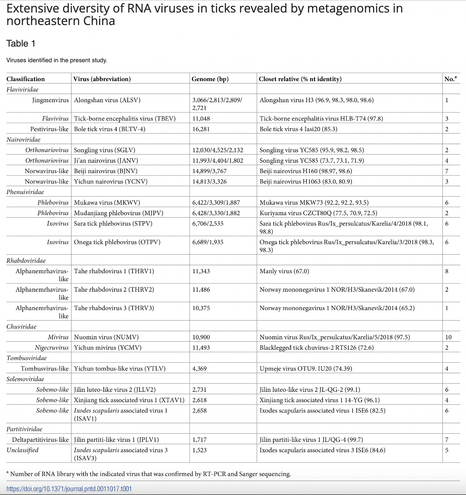
Author summary Ticks are important vectors to transmit many infectious agents. In recent years, many novel tick-borne viruses associated with human illness, including Alongshan virus, Songling virus, and Beiji nairovirus, have been identified in northeastern China. It is necessary to conduct routine surveillance of tick-borne viruses in ticks, however, little is known about the tick virome in northeastern China. In this study, we used metatranscriptomics to investigate the virome diversity in four tick species collected from northeastern China. In total, we identified 22 RNA viruses belonging to eight virus families (exclude an unclassified virus). Of these, five members were established human pathogens, eight viruses were of novel species, and six viruses had close relationship with pathogenic tick-borne viruses with potential public health threats. Moreover, we found that the viromes were significantly affected by the tick species and geographical location in the study. These findings revealed an extensive diversity of RNA viruses in ticks in northeastern China, which will lay the foundation for the prevention and control of emerging tick-borne diseases.
2/6
In the first study, from a collaboration of researchers in northeastern China, 22 RNA viruses were identified from four tick species. 8 were novel and 1 was unclassified.

5 were known human pathogens that included Alongshan Virus, part of a group of segmented flaviviruses first identified in 2014. Robert Gifford explains more:
https://twitter.com/Paleovirologist/status/1494030027679223808

But the range of Alongshan Virus is much wider than just East Asia, as it has recently been detected in Switzerland:
http://doi.org/10.5281/zenodo.7403328

Robert Gifford on Twitter

“Short #Jingmenvirus primer - medium thread. Jingmenvirus is a recently identified group of segmented RNA viruses that are phylogenetically linked to unsegmented flaviviruses. They appear to infect a wide range of animal hosts, including humans.”

Twitter

3/6
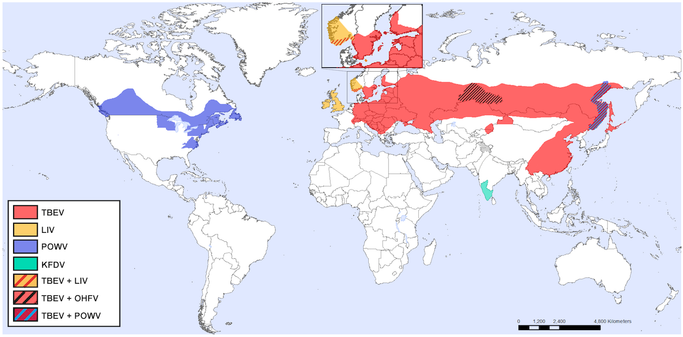
The first study also detected Tick Borne Encephalitis Virus (TBEV) among the 5 known human pathogens.

TBEV is a flavivirus that is found in northern latitudes across Eurasia, from England to Siberia.

The Siberian subtype seems particularly virulent, leading to a progressive brain infection that can cause death many years after infection.

4/6
In North America, the TBEV variants are known as Deer Tick Virus or Powassan Virus. The geographical range of these variants seems to be expanding southward, with infections reported as far south as Virginia, US.

The fact that these variants are transmitted by the same ticks that transmit #Lyme disease, as well as the fact that the symptoms are mostly identical to untreated Lyme disease, means that many human infections are undoubtedly misdiagnosed as Lyme disease.

@pyrrhus - that cutoff at the western border btw Canada and US looks sus.

@axel_hartmann
I noticed this, too. I suspect reporting habits or statistics.

When I look at Germany, then the map supports this theory. To my knowledge mostly in the south-eastern part of Germany (Bavaria, Baden-Würtemberg, Thuringia, Saxonia) TBEV is endemic. It is moving north and west.

My numbers are at least three years old, so it might be the whole of Germany already.

@pyrrhus