
Merve Tepe, PhD

335 Followers
573 Following
1.2K Posts

Microbiologist, Bacterial biomineralization, Antimicrobial resistance, Biofilms and so on. Bacillus aficionado, Alum @Hacettepe1967 // Defend science, resist ignorance

Ankara/New York/Tel Aviv

https://twitter.com/mervetepePhD
https://post.news/@/mervetepephd

Twitterhttps://twitter.com/mervetepePhD
Post.Newshttps://post.news/mervetepephd

A Fungus that Reduces Methane Emissions

Noteworthy — We face unprecedented rising global temperatures, a crisis driven largely by the burning of fossil fuels. But other sectors, like the livestock industry, also contribute by producing large amounts of greenhouse gases.

Read more > https://schaechter.asmblog.org/schaechter/2025/03/a-fungus-that-reduces-methane-emissions.html
#microbiology

In the US there is a flu epidemic as well. Fortunately, with low COVID-19 and RSV.

It is comparable with some of the heavy flu epidemics, such as 2010 and 2017/18, it is one that seems to happen around every decade. Vaccination levels unfortunately low.

This is seasonal flu, not the new birdflu.

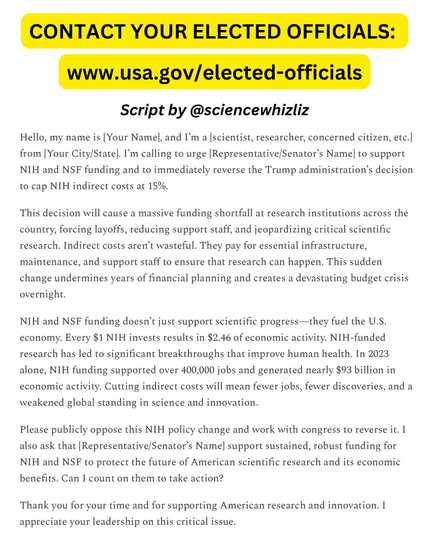
If you are upset about the devastating cuts to science, remember to call your elected officials and let them know about it.

Regardless of if they are red or blue, supportive of science or not, they all track calls. Calls matter. Do it!

Find your elected officials: www.usa.gov/elected-officials

How to Respond to Misinformation From the Anti-Vaccine Movement

Vaccines are one of the most crucial life-saving medical interventions. Perplexingly, they court more public controversy than their objectively excellent safety profile warrants.

https://journals.sagepub.com/doi/10.1177/00469580231155723
1/10

Add another name to the list of mammal species infected with #H5N1 #avianflu: alpacas.
It’s not surprising at this point but it certainly isn’t reassuring either that this virus just keeps spreading farther and wider…

https://www.aphis.usda.gov/livestock-poultry-disease/avian/avian-influenza/hpai-detections/mammals/highly-pathogenic-avian

Highly Pathogenic Avian Influenza (HPAI) H5N1 Detections in Alpacas | Animal and Plant Health Inspection Service

'The emerging sewage crisis is only one of many disasters we can expect as the planet continues to warm, and nowhere near the top of the list. But it seems to me to offer an especially graphic illustration of two points. First, the damage from climate change is likely to be more severe than even pessimists have tended to believe. Second, mitigation and adjustment — which are going to be necessary, because we’d still be headed for major effects of climate change even if we took immediate action to greatly reduce greenhouse gas emissions — will probably be far more difficult, as a political matter, than it should be.'
https://www.nytimes.com/2024/05/27/opinion/climate-change.html
Opinion | The Stench of Climate Change Denial

What overflowing septic tanks tell us about the future.

The New York Times

Histological and Ultrastructural Changes in Lungs One
Year Post Asymptomatic or Mild SARS-CoV-2 Infection:
Evaluating the Potential for Active Virus Presence

It is tiresome, these low impact papers being abused to make exaggerated claims.

http://www.intjmorphol.com/wp-content/uploads/2024/05/Art_23_423_2024.pdf
1/3

"Masks don't work"
"Vaccines don't work"
"Distancing doesn't work"

(They do. Just imperfectly).

I've heard so many of these types of comments over the past 3 years, I thought it was time to write a bit about how one big aspect of infection is a numbers game. /1

/2 When we think of it that way--what is the number of microbes needed to cause an infection?--we can think about how masks, vaccines, distancing, ventilation, hand hygiene, and more can collectively reduce our exposure.
/3 In the best cases, these interventions reduce the dose of the microbe to a number too low to cause infection. This is the basis of the "swiss cheese" layering defense that was touted early on, and is still important today. My article @ Quanta discusses this. https://www.quantamagazine.org/how-many-microbes-does-it-take-to-make-you-sick-20230927/
How Many Microbes Does It Take to Make You Sick? | Quanta Magazine

Exposure to a virus isn’t an all-or-nothing proposition. The concept of “infectious dose” suggests ways to keep ourselves safer from harm.

Quanta Magazine