A recent FT article has prompted discussion on birdsite as to why the idea that you become "more conservative as you age" seems to be breaking down.

As I've talked about before, this has ALWAYS misunderstood what happens. Which is that people become more conservative when they feel part of (or the opportunity to be part of) the status quo and want to preserve it.

And Xennials/below don't have that.

Here's a thread to explain. 🧵

Home ownership, good healthcare, pensions, free education etc. are all key pillars of being part of the status quo. They're also all pillars that Xennials/ Millennials and below increasingly don't have access to.

You can't expect Millennials and below to defend the status quo when the Boomers (speaking generally) pulled up the ladder that would allow future generations to be part of it, once they were in charge of the country.

Ironically, given her 'hero' status in the current Conservative Party, Thatcher did more than anyone to lock in that long-term drift away from conservatism.

It was the Council House sell-off, with no effort made to replace the lost housing stock.

Short term win. Long term fail.

Obviously I'm talking in UK terms here, but the absolute same thing applies in the US too, with some quirks of its own.

If you want everyone to believe in 'the American Dream' you have to let at least a few people, each generation, achieve it.

Also, as I've mentioned, the real pivot point in the attraction of the status quo slices right down the middle of Gen X.

Early Gen X got houses, pensions, free education. Late stage Gen X either didn't, or found them much harder to access/weakened.

Which is why you get more 50 somethings screaming about wokeness than 40 somethings. And why despite the Boomers ageing out of power, gradually, the situation hasn't really improved.

Because we're now in Early Gen X power period.

And why making old people pay for their own care is a MASSIVE time bomb for UK conservatism.

People are cashing in on their home value to do that. So the 'inherit your way into the status quo' path is permanently weakened now.

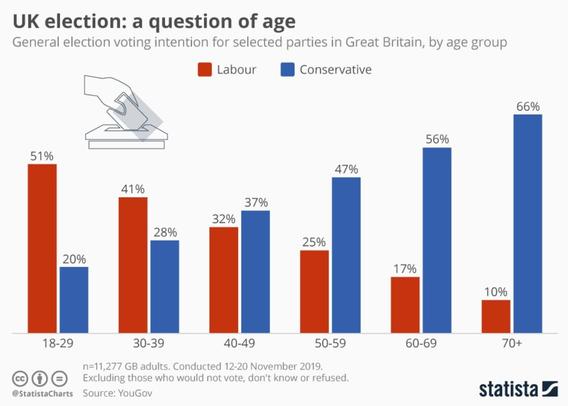
But yeah, if you look at this YouGov voting intention survey from 2019, you can really see that it's the middle of Gen X where the pivot away from the Conservative party comes. Not the Boomer/Gen X split, or the Gen X/Millennial split.

I really, really, wish they'd done that survey in five year, not ten year, increments.

Because I'd love to see how that 40-49 block split between 40-44 and 45-49.

That's the "beat the UK housing apocalypse" point.

Essentially if you're born in the UK after 1975, your first opportunity to buy a house hit right at the point where you needed a massive deposit and a many-times-value mortgage. If you've managed it all.

And born after 1978ish you had to pay for university in some way.

So the Xennial (i.e. late Gen X) experience is far more similar to the Millennial one than a lot of people realise. If you got on the housing ladder, it was a horrific and costly experience. And you likely either still have, or had to pay off, student loans.

So it's wrong to map age (and, indirectly, generation) to a shift to conservatism, especially in the UK.

It's all about "screw you, got mine."

And few people under 45 feel like they got theirs.

Indeed you could argue it's only people born 1937ish - 1975ish that ever 'got theirs' in the UK.

That's the only group that ever legit got the full benefits of the welfare state and a wave of national, future-focused infra/housing development.

Ironically all the Conservative Party needed to do in order to remain eternally relevant/powerful was maintain the welfare state and housing.

That had created a MASSIVE, natural pipeline of fresh blood into the status quo.

And they screwed up. Hard.

Finally, it's worth remembering that the "Boomers are deliberately selfish" thing isn't really true either.

But admitting you pulled up all the ladders is hard. And there is an ENTIRE RIGHT WING MEDIA INDUSTRY (Daily Mail etc) dedicated to convincing them they didn't.

This is why it's always about Millennials 'choosing' Netfix, or avocadoes over housing. Or about how it's immigrants that are the problem. Or 'wokeness'. Or 'waste' within vital services.

Or the EU stealing money from the NHS.

All of that has one main purpose:

To convince those who are part of the status quo that the ONLY reason those outside it don't have access to it is because they are too lazy, or because of foreigners.

It's absolutely NOT because of their own actions or voting pattern. Honest.

And that's another reason why that shift to conservatism breaks down so hard the further you push through Gen X.

Because the personal experience of being part of it weakens, and there's less of a desire to be convinced it wasn't their fault. Because it wasn't.

And by the time you hit Xennial, you're (mostly) looking at voters who feel that whatever part of the status quo they've managed to obtain was at great cost and/or luck, and can see the inequalities get worse for everyone after them.

Because ultimately this is all about participation and opportunity.

What matters isn't just being PART of the status quo. It's feeling like the OPPORTUNITY to be part of it, for oneself or for others, isn't closed off.

That's what's different for everyone born after 1975.

And not just for them. For some people older than that the issue has always been obvious. For others, as they've grown older and seen children struggle, it's BECOME obvious.

You can remove access to parts of the status quo and get away with it. But the more parts you remove, the more obvious the lack of opportunity becomes until you can't persuade people they have that opportunity, or make people feel like they obtained it fairly if they got it. /END
@garius Born in '74 and yeah, you're not wrong.
Deeply lucky to get the free education and to be pushed (by parents) into buying a house while they were still affordable.
But close enough to see how hard it becomes almost immediately afterwards which, in this case, keeps me leftwing because it's clear how precarious is my position.
Would also love to see the split at 45 as I suspect those without the uni costs might have taken a few more years to see it.
@munchkinstein @garius I was born in 1980, and only avoided uni fees because I'm Scottish and got good Highers, so I got in in '97, just before grants were abolished entirely. I think pensions matter too in this discussion - at what age do today's 40-somethings expect to retire?
Because to me it looks like the ever-receding carrot.
@munchkinstein @garius Pensions might be a gendered perspective because of the whole WASPI thing, and I guess also because of the scale of the age increases for women.

@Jobob @munchkinstein @garius

"...at what age do today's 40-somethings expect to retire?"

They don't.

Capital formation has *ceased* in the UK economy: either you inherit wealth, or you will never, never accumulate it through employment.

@hairyears @munchkinstein @garius Exactly. Coupled with mortgages so high that repayment seems unlikely, we're just not accumulating wealth or security at all.
@hairyears @Jobob @garius I'll not lie, my default mental position on pensions is I will put in but I don't actually expect to get anything worth speaking of back out. Certainly not anything I could live on.
@hairyears @Jobob @munchkinstein @garius Exactly this. Listening to my kids chat through their unhappy lot in life is one the worst things in our lives. They range from 24 - 31. I am life long left in my political views. What’s happening in the UK right now is totally depressing.
@hairyears @Jobob @munchkinstein @garius
'Capital formation has *ceased* in the UK economy'
Is that an opinion, or evidence-based? I'm asking because I know of counter-examples, but they may be atypical.
@munchkinstein @garius Also born '74, got the free uni education, bought a place in 2000-ish *but* poor financial decisions and selling with a hostile co-owning ex means I'm now ~9 years later finally a homeowner again with a big mortgage having stumped up a massive deposit. (Though even when I owned first time I was still massively left-wing, probably thanks to my mum)

@garius

Also worth pointing out the stupid first past the post electoral system which elects a Government with a massive majority with a minority of voters. The last 12 years have shown the frailties of that system. And the whole Govt finances are just like home finances schtick that has led to cut after cut to public services. Needless to say I'm no fan of the Tories

@Sc0tty agreed. It's not fit for purpose anymore.
@garius - an excellent thread, and one I’ve suspected for some time. I was terrified that I’d get more conservative as I aged, and instead I find myself more liberal and reactionary. The short term thinking of the Tories has torpedoed their chances, and they’ve done considerable damage to the country along the way.
@garius
I was born in 73, but as a Londoner the housing market had long gone for me.
Maybe that’s why London is a Labour city, and has been for a long time.
@garius it’d be interesting to see graphed the 45 and under vote for “none of the above” or the drift away from the Tories but not to Labour- Starmer’s labour. Thomas Ferguson’s investment theory of party competition, makes a lot of sense in the UK post Blair and feeds into how social democratic amelioration in Corbyn was ludicrously besmirched. If not also the funding behind brexit to both sides. https://en.m.wikipedia.org/wiki/Investment_theory_of_party_competition
Investment theory of party competition - Wikipedia

@garius great thread. Born in 74, free Uni but had to work full time at the same time to live. Also suspect regional divides are big factors here too. Seeing what happened across the North under Thatcher probably pushes the split closer to true gen X if you witnessed our cities/towns gutted and left to rot. But so much of the thread resonates.

@garius I'd like to add that from an American perspective, there are a lot of factors that feed into what we consider to be the mass sociopathy of the boomer generation, and it goes a bit beyond just the class divide. The namesake of the generation, the post war boom, and unique factors of prosperity and American exceptionalism that were the hallmark of the time led to a massive takeover of the political machine by people who were given everything for nothing, and demanded as much as part of their own status quo. They invented whole industries to funnel wealth from past and future to themselves, and wholesale committed to neoliberal policies to entrench that system of power. That consolidation of political power is what is allowing that shrinking minority of the propertied class to continue to shut out everyone else despite the growing disillusionment of the younger generations of serfs.

That divide of propertied vs unpropertied people is what now forms the basis for opportunity vs none, as upward mobility has diminished to the point where only the most privileged and ruthless children of aristocrats need apply.

@earthshine which is, to a certain extent, what at least the last 12 years have felt like in the UK. Arguably the last 25.

We just needed an economic boom before they could start doing the same thing. It's been an accelerated adventure in the consolidation of wealth and power!

@garius early Gen X here, but working class - no affinity with Boomers, not part of their 'normal', loads of affinity with Millennials onwards

@garius interesting analysis, but it begs the question, if the welfare state is part of how boomers "pulled up the ladder" for millenials, how is them voting more left (= more welfare state) going to help them?

Sounds like an alcoholic voting for more booze if you ask me.

@garius @ligma

I think you may have misread. The failure to replace sold-off public housing was a withdrawal of the welfare state, as has been the move to make people use their lifetime-acquired wealth to pay for end-of-life care rather than to pass it on to the next generation.

@valoisdubins @garius that seems like an oddly specific thing to nail what appears to be a systemic failure on.

@garius @ligma

A sharp curtailment in the ability to accumulate wealth over a lifetime and invest it in one’s children seems pretty significant in terms of how much one wants to preserve the system.

Look, for example, at the horrible impact of redlining in the US on the intergenerational wealth of African Americans.

@valoisdubins @garius that’s presuming boomers *wanted* to invest in their kids all along, when the evidence mostly shows otherwise.

Remember, THEY voted for the people who instituted such practices. And the fact that they never protested against or recalled their elected representatives for doing so shows at least tacit agreement with all of it.

@garius @ligma

Boomers benefitted from welfare state support for housing. The argument is that they like previous generations, became conservative as they aged because they were able to get on the property ladder. That conveyor belt broke down halfway through Gen x. So half of gen x and millennials are not moving right like older generations did because they have a lot less invested in the status quo.

I really think it would be worth reading the thread again.

@valoisdubins @garius it’s not the boomer’s fault that the welfare state is failing, it’s their fault for not getting rid of it sooner because they wanted to keep enjoying the benefits while they could.

The welfare state was doomed to begin with, it’s a Ponzi scheme that pays people today with money borrowed from the future. It’s nothing but a vote buying program for unscrupulous politicians.

@ligma @garius I think you may have misread the thread? The Boomers pulled the ladder up by dismantling¹ the welfare state; repairing the welfare state would be lowering the ladder again.

¹: incidentally, it's kinda weird how, for my entire lifetime, “Conservatives” have consistently persued a utopian project to radically reshape the economy.

@RAOF @garius but the welfare state hasn’t been dismantled. In fact, welfare spending has been on a consistent uptrend ever since it was instituted, yet the results in terms of poverty and inequality appear to be getting worse every year.

It’s high time that millenials realize that the welfare state is the PROBLEM. It was never the solution.

@ligma @garius so, there's a lot implicit in your toot, but I'll start with: you're making a subtly, but significantly, different argument. That graph is a graph of social spending, not social programs. That graph is just as compatible with the hypothesis “shifting social spending to individual grants rather than community infrastructure is inefficient”. You're spending more, and not even getting free college out of it 😉

Unless society is willing to let people starve/freeze/die of easily treated diseases/be illiterate/etc you have to have a bunch of social spending.

I wonder the extent to which this is a broader version of the US' health care debacle, where (for example) the federal government spends about the same per capita as the UK spends on the NHS, and then twice as much again in private spending.

(The US has also never had a welfare state in the UK sense - the context the OP is working in.)

@garius I'm a boomer, but have got progressively further left as I have aged. When I was young I was a true centrist. The Damascene moment was the birth of my daughter. I wanted my daughter to live in a better world, and there was no way that Conservatism would ever be able to provide

@garius
US Millennial here. Thank you for this breakdown.

This is what my gut instinct has been for a while, but haven't been able to put it into words until your post.

@garius Absolutely true. I was born in '66 - bought a house cheaply in the early 90s, was repossessed, and will never be able to afford property. My parent has dementia, which will swallow any inheritance.
@garius Yes, I responded with a similar point on the birdsite (I suggested the ‘older’ generation as 1940-1980 born), that those born after have experienced increasing difficulty in accessing a full adult life, crushing uni loans, insecure jobs, priced out of decent housing. They also have the ever-present anxiety of ecological disaster. The generational earthquake coming is at least as big as the 1960s. &this zeitgeist is more quietly intense.
@garius I agree to an extent. The reverse also holds, so giving rich people family allowance or student grants and so on meant they were invested in supporting social benefits for all. But I think a key driver in an individual move to the right is having a level of personal financial security (not necessarily wealth, but enough to feel safe) eg house, owned or secure tenancy/affordable rent; secure job, reasonable wages, prospects; etc, which younger people increasingly don’t have
@garius So basically the cut-off is: were you old enough/in a position to be to be a Yuppie in the 80s? Makes sense. Horrible sense but sense nonetheless.
@garius Apparently, I am a boomer. I've been consistently left and green. I voted Green in my first ever local election. Whilst the age trend may generally hold true, what grinds my gears is how apathetic my two gen X ( I think one is gen z??) kids are. I've been protesting since I was a teenager and I have no intention of stopping now. They just accept the status quo. I never will and I'm in a state of permanent outrage.
@garius great thread. But I think the everyone becomes more conservative when they get older-thing has been debunked a long time ago, at least within sociology/political science. I remember we talked about that in university, I just can't find the articles anymore.
There has never been a tendency to become more conservative, it has always been more about a generation that grew up with or after war and therefore being succeptable to "security" and "safety" as basic needs.
@garius PLUS the small matter of the climate and biodiversity catastrophe which hangs over us all like a dark cloud. Plenty of older people do care hugely of course but choosing to ignore it is a lot harder the younger you are.
@garius I was born in 1974, I graduated with like 3 grand of debt, I own a house (well, I have a mortgage), and I hate these Tory cunts more and more every year
@garius very interesting argument, this mirrors some of stuff I have been thinking about - it all boils down to stakeholderism. If people have stake in existing system, they are less eager to change things. It's just how it is. And it is not bad or good thing either.
Conservatives also have this "eventually everone will agree with us" bubble they live in. That is how people protect themselves from clashing with and questioning their support and choices. Because we all *hate* to do that.

@garius I think that "can see the inequalities" is significant.

I'm on the older end of Gen X myself, and pretty affluent. But many of my friends are 20 years younger, and I can see how badly the system has failed many of them. As a result, while I'm more conservative than many of them, I'm still *way* to the left of US average.

The system is increasingly visibly broken, and it's harder and harder for the right wing to pretend otherwise; hence all the culture-war BS to distract away from it.

@garius my wife and I are at the tail end of Gen X and we are keenly aware of how fortunate and lucky we are and how forces largely outside of our control could have swung just a little bit the other way and left us as working homeless. We came pretty close a couple of times.
The system wasn't designed to help us succeed. It was designed to get us to spend more than we had until it owned us.
It wasn't God, it wasn't politicians that helped us.
It was knowing a few good people older than us (but not too much older) who kept us from falling into the pit.
I hope you're right. I hope the progressive will finally have the starting power to make a difference.

@garius Yes. I'm Xennial, born 1978. One of the very last cohort to get student grants (shrunken, means-tested, but still grants) and avoid tuition fees. Got lucky with stock options in my first proper job, bought a house in 2011. I got mine by the skin of my teeth, and have a deep appreciation for how much of it was luck.

Cleared off to Canada in 2018 because "having mine" in post-Brexit Britain didn't look like a good long-term strategy. It wasn't easy but I'd do it again.

@garius this ☝️ description of #Xennial perspective really resonates with this Xennial.

In the Canadian context, I feel lucky that I am able to be a #FirstGen university graduate. I stepped through as the social opportunity window opened, just before the economic window closed.

@garius John! Forgive me being a Georgia American Southern Woman but, wooooo chile…. if you ain’t preaching on this here internet today!!!😂😂🙌🏽🙌🏽🙌🏽🙌🏽Hallelujah, amen, and pass the offering pan! This the clearest read and it’s wild that I just assumed you were talking about the US - it’s fascinating that the same dynamics were and still are at play from a generational level in the UK. THIS is why I’ve said I hope things change as those later generations pass on. Thanks for sharing this!