A recent FT article has prompted discussion on birdsite as to why the idea that you become "more conservative as you age" seems to be breaking down.

As I've talked about before, this has ALWAYS misunderstood what happens. Which is that people become more conservative when they feel part of (or the opportunity to be part of) the status quo and want to preserve it.

And Xennials/below don't have that.

Here's a thread to explain. 🧵

Home ownership, good healthcare, pensions, free education etc. are all key pillars of being part of the status quo. They're also all pillars that Xennials/ Millennials and below increasingly don't have access to.

You can't expect Millennials and below to defend the status quo when the Boomers (speaking generally) pulled up the ladder that would allow future generations to be part of it, once they were in charge of the country.

Ironically, given her 'hero' status in the current Conservative Party, Thatcher did more than anyone to lock in that long-term drift away from conservatism.

It was the Council House sell-off, with no effort made to replace the lost housing stock.

Short term win. Long term fail.

Obviously I'm talking in UK terms here, but the absolute same thing applies in the US too, with some quirks of its own.

If you want everyone to believe in 'the American Dream' you have to let at least a few people, each generation, achieve it.

Also, as I've mentioned, the real pivot point in the attraction of the status quo slices right down the middle of Gen X.

Early Gen X got houses, pensions, free education. Late stage Gen X either didn't, or found them much harder to access/weakened.

Which is why you get more 50 somethings screaming about wokeness than 40 somethings. And why despite the Boomers ageing out of power, gradually, the situation hasn't really improved.

Because we're now in Early Gen X power period.

And why making old people pay for their own care is a MASSIVE time bomb for UK conservatism.

People are cashing in on their home value to do that. So the 'inherit your way into the status quo' path is permanently weakened now.

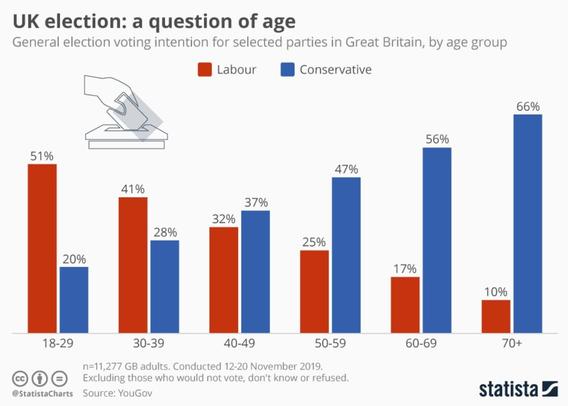
But yeah, if you look at this YouGov voting intention survey from 2019, you can really see that it's the middle of Gen X where the pivot away from the Conservative party comes. Not the Boomer/Gen X split, or the Gen X/Millennial split.

I really, really, wish they'd done that survey in five year, not ten year, increments.

Because I'd love to see how that 40-49 block split between 40-44 and 45-49.

That's the "beat the UK housing apocalypse" point.

Essentially if you're born in the UK after 1975, your first opportunity to buy a house hit right at the point where you needed a massive deposit and a many-times-value mortgage. If you've managed it all.

And born after 1978ish you had to pay for university in some way.

So the Xennial (i.e. late Gen X) experience is far more similar to the Millennial one than a lot of people realise. If you got on the housing ladder, it was a horrific and costly experience. And you likely either still have, or had to pay off, student loans.

So it's wrong to map age (and, indirectly, generation) to a shift to conservatism, especially in the UK.

It's all about "screw you, got mine."

And few people under 45 feel like they got theirs.

Indeed you could argue it's only people born 1937ish - 1975ish that ever 'got theirs' in the UK.

That's the only group that ever legit got the full benefits of the welfare state and a wave of national, future-focused infra/housing development.

Ironically all the Conservative Party needed to do in order to remain eternally relevant/powerful was maintain the welfare state and housing.

That had created a MASSIVE, natural pipeline of fresh blood into the status quo.

And they screwed up. Hard.

Finally, it's worth remembering that the "Boomers are deliberately selfish" thing isn't really true either.

But admitting you pulled up all the ladders is hard. And there is an ENTIRE RIGHT WING MEDIA INDUSTRY (Daily Mail etc) dedicated to convincing them they didn't.

This is why it's always about Millennials 'choosing' Netfix, or avocadoes over housing. Or about how it's immigrants that are the problem. Or 'wokeness'. Or 'waste' within vital services.

Or the EU stealing money from the NHS.

All of that has one main purpose:

To convince those who are part of the status quo that the ONLY reason those outside it don't have access to it is because they are too lazy, or because of foreigners.

It's absolutely NOT because of their own actions or voting pattern. Honest.

And that's another reason why that shift to conservatism breaks down so hard the further you push through Gen X.

Because the personal experience of being part of it weakens, and there's less of a desire to be convinced it wasn't their fault. Because it wasn't.

And by the time you hit Xennial, you're (mostly) looking at voters who feel that whatever part of the status quo they've managed to obtain was at great cost and/or luck, and can see the inequalities get worse for everyone after them.

Because ultimately this is all about participation and opportunity.

What matters isn't just being PART of the status quo. It's feeling like the OPPORTUNITY to be part of it, for oneself or for others, isn't closed off.

That's what's different for everyone born after 1975.

And not just for them. For some people older than that the issue has always been obvious. For others, as they've grown older and seen children struggle, it's BECOME obvious.

You can remove access to parts of the status quo and get away with it. But the more parts you remove, the more obvious the lack of opportunity becomes until you can't persuade people they have that opportunity, or make people feel like they obtained it fairly if they got it. /END

@garius interesting analysis, but it begs the question, if the welfare state is part of how boomers "pulled up the ladder" for millenials, how is them voting more left (= more welfare state) going to help them?

Sounds like an alcoholic voting for more booze if you ask me.

@garius @ligma

I think you may have misread. The failure to replace sold-off public housing was a withdrawal of the welfare state, as has been the move to make people use their lifetime-acquired wealth to pay for end-of-life care rather than to pass it on to the next generation.

@valoisdubins @garius that seems like an oddly specific thing to nail what appears to be a systemic failure on.

@garius @ligma

A sharp curtailment in the ability to accumulate wealth over a lifetime and invest it in one’s children seems pretty significant in terms of how much one wants to preserve the system.

Look, for example, at the horrible impact of redlining in the US on the intergenerational wealth of African Americans.

@valoisdubins @garius that’s presuming boomers *wanted* to invest in their kids all along, when the evidence mostly shows otherwise.

Remember, THEY voted for the people who instituted such practices. And the fact that they never protested against or recalled their elected representatives for doing so shows at least tacit agreement with all of it.

@garius @ligma

Boomers benefitted from welfare state support for housing. The argument is that they like previous generations, became conservative as they aged because they were able to get on the property ladder. That conveyor belt broke down halfway through Gen x. So half of gen x and millennials are not moving right like older generations did because they have a lot less invested in the status quo.

I really think it would be worth reading the thread again.

@valoisdubins @garius it’s not the boomer’s fault that the welfare state is failing, it’s their fault for not getting rid of it sooner because they wanted to keep enjoying the benefits while they could.

The welfare state was doomed to begin with, it’s a Ponzi scheme that pays people today with money borrowed from the future. It’s nothing but a vote buying program for unscrupulous politicians.

@valoisdubins @garius the reason that millenials have a harder time building wealth is because the welfare state drives up the cost of labor while simultaneously reducing the incentive to work at all.

The welfare cliff effect is real, and it’s what’s causing the increasing amount of inequality we see. https://www.learnliberty.org/blog/the-welfare-cliff-and-why-many-low-income-workers-will-never-overcome-poverty/

The Welfare Cliff and Why Many Low-Income Workers Will Never Overcome Poverty | Learn Liberty

Policies backed with even the best of intentions can still have detrimental effects on those they aim to help. The "Welfare Cliff" is one such example.

@ligma @garius

You don’t appear to have the slightest clue about British housing policy over the past fifty years.

You also don’t appear able to take in new information. You just want to peddle someone’s daft theories - while quoting the racist Charles Murray for good measure.

So, there’s no point having any further discussion. Bye now.

@valoisdubins @ligma @garius He did have one good point though, which is that the welfare state is doomed to fail. It's a stopgap solution at best. What we need, have needed for centuries, is to democratize control over the means of production.

@SocialistStan @garius @[email protected]

The overall welfare state is one thing, but this is in the context of how property impacts personal and intergenerational wealth. A set of *specific* *political* decisions were taken in the UK in the 1980s and after, that combined to undermine the ability of young people to get on the property ladder. It wasn’t inevitable.

@valoisdubins just to say i appreciate your attempts here.
@miss_s_b
Thanks! tbh I had a gut feeling from the beginning that this was someone almost deliberately refusing to understand, but I perhaps naively gave them the benefit of the doubt.
@valoisdubins a always, you're not just talking to the person, but to the lurkers too ;)

@ligma @garius I think you may have misread the thread? The Boomers pulled the ladder up by dismantling¹ the welfare state; repairing the welfare state would be lowering the ladder again.

¹: incidentally, it's kinda weird how, for my entire lifetime, “Conservatives” have consistently persued a utopian project to radically reshape the economy.

@RAOF @garius but the welfare state hasn’t been dismantled. In fact, welfare spending has been on a consistent uptrend ever since it was instituted, yet the results in terms of poverty and inequality appear to be getting worse every year.

It’s high time that millenials realize that the welfare state is the PROBLEM. It was never the solution.

@ligma @garius so, there's a lot implicit in your toot, but I'll start with: you're making a subtly, but significantly, different argument. That graph is a graph of social spending, not social programs. That graph is just as compatible with the hypothesis “shifting social spending to individual grants rather than community infrastructure is inefficient”. You're spending more, and not even getting free college out of it 😉

Unless society is willing to let people starve/freeze/die of easily treated diseases/be illiterate/etc you have to have a bunch of social spending.

I wonder the extent to which this is a broader version of the US' health care debacle, where (for example) the federal government spends about the same per capita as the UK spends on the NHS, and then twice as much again in private spending.

(The US has also never had a welfare state in the UK sense - the context the OP is working in.)