
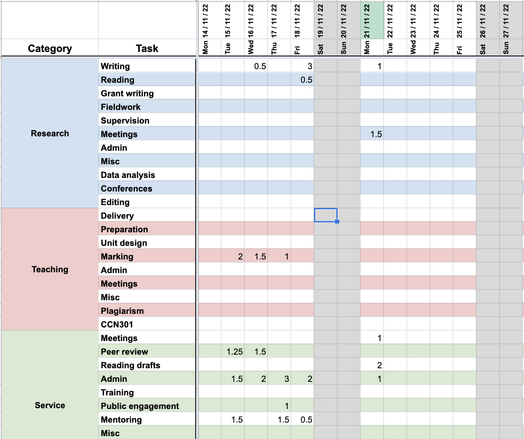
For a few years I've been maintaining and slowly improving a Google Sheet template to help #academics (particularly salaried academics) track how much they are working, and how this work is distributed. I've just updated the template for 2023.

The reason for this is academic #workloads are often left very abstract and vague, usually measured in 'percentages' with only the loosest connection to time and the actual number of hours you are paid to work. I find that tracking my hours helps to reassure me I am doing enough work in some aspects of my job (in #research, for instance), and also help prevent me from overworking.

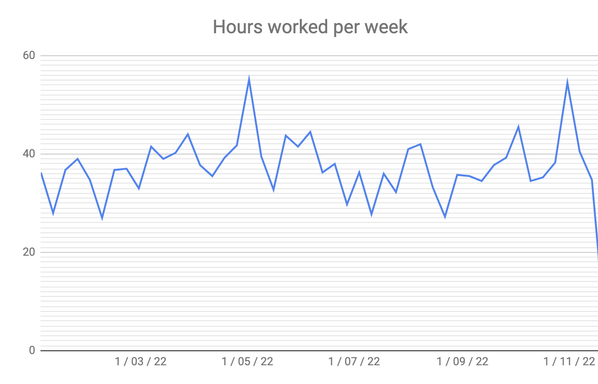
For example, this year, I know I have worked 61 hours more than I have been paid for thus far. This means in December, once marking and everything is wrapped up, I'm just going to tap out and do pretty much no work for a couple of weeks (just keep an eye out for urgent emails), but also not take leave. Because those are hours I'm owed. So by the end of the year, I should be back close to zero hours overworked.

Some academics hate counting hours as bean counting or volunteering into surveillance. I get that. But considering how the ever-intensifying exploitation of academic staff relies on #university management obscuring and intensifying our work, I find tracking how much I've actually worked incredibly empowering.

With the new year, maybe consider tracking your own #academic work!

The template: https://docs.google.com/spreadsheets/d/1W-w_pbJgsemr5vznErqqNG5UJsfxeiPUNgG8f6pXyfg/edit#gid=1226213337 #commodon
Academic Work Tracker Template v2.1 (2023)

Instructions INTENT OF THIS SPREADSHEET Universities allocate workload and evaluate performance based on metrics that are often arbitrary and obscure. Within these metrics, the extensive time spent on tasks such as emails, meetings, reading, and thinking is inadequately accounted for. Consequen...

Google Docs

Bumping my academic workloads tracker again to fellow #academics as the new year starts (see toot this one is replying to for details). New year is a great time to start and to see just where you are spending your time, and how much you are really overworking. #academia #commodon

https://docs.google.com/spreadsheets/d/1W-w_pbJgsemr5vznErqqNG5UJsfxeiPUNgG8f6pXyfg/edit#gid=1226213337

Academic Work Tracker Template v2.1 (2023)

Instructions INTENT OF THIS SPREADSHEET Universities allocate workload and evaluate performance based on metrics that are often arbitrary and obscure. Within these metrics, the extensive time spent on tasks such as emails, meetings, reading, and thinking is inadequately accounted for. Consequen...

Google Docs
@brkeogh I’m not sure I want the reminder.
@schwbby That's very understandable but I've found that actually tracking how much time I'm spending working has really helped prevent me from overworking as much as I otherwise would.
@brkeogh thanks for the share! 2023 will require self-discipline...
@brkeogh I have been tracking my hours worked for the same reasons, and have found additional benefits: Seeing how long tasks actually do (or don’t) take, and noting the discrepancies between how many hours I “actually work” in a day vs. how much I feel like worked drained my energy (this relationship is not always in the same direction).
@brkeogh I have a very similar spreadsheet that I started to basically track my work time during pandemic lockdowns. Find it’s useful to basically track when I work and when I work too much.
@brkeogh Thanks for sharing this, Brendan. @thesiswhisperer and @jasondowns may be interested for #OnTheReg purposes?
@brkeogh @jasondowns @tseenster great tool - thanks for sharing. Definitely up for discussion. I'm actually writing a column for nature at the moment about this topic. Would you be ok if I share there @brkeogh ?

@brkeogh this is great! ... I've kind of tried various attempts at this - usually falls down at the actual tracking step at some point..

Don't suppose you have any tips (or software even?) for helping with that part?

@dylanjmcconnell well with my spreadsheet i have it in my bookmark bar so it’s real easy to always access. I’ve also sorta internalised completing it during the day as a procrastination exercise. And as something j do at the end of the day before logging off. It’s sorta like going to the gym. Hard to keep with it but eventually internalise it hopefully.

There’s also Clockify, which some people use, which has real useful browser extensions. It’s not academic-specific so setting it up can take a bit of work, but it’s pretty good.

@brkeogh thanks!

This makes sense, and is also consistent with my track record of going to then gym 🥲

@brkeogh I used to work as a research administrator in a very well known university. I really struggled to get most academics to complete time sheets for research projects, but every now and again I would come across one who genuinely welcomed the opportunity to track their time and usually prove that they were giving far more time than their university was or could claim for their work. Academia is not a cushy life, every single academic I’ve met has been exploited.
@brkeogh 60 hours across 11 months sounds like utopia. It shouldn’t but it does.

@komesanyamada I would say 60 hours across 11 months sounds like pretty bad wage theft and if it sounds like utopia then that sounds like even worse wage theft.

Other point I'd make is it would be a lot higher if I wasn't tracking my hours!

@brkeogh I love how this is tagged as "Sensitive content." Like, I was expecting to click that and see a photo of an academic bleeding out at their desk as they finish a grant proposal or something, though admittedly a spreadsheet of how many hours you actually work is probably scarier.
@IanSchreiber They really like their content warnings here! Most people (self included) more just use the built-in CW feature as a subject line / expand thing.
@brkeogh this is phenomenal. Do you by chance have a version that still has the 2022 dates in it? I'd like to give it a try and spend the rest of fall semester getting into the habit, so come January it's second nature. 😊
@ryanstraight thanks! make a copy of the template and invite me to it (brendankeogh86 at gmail) and i’ll jump in and get the extra columns working.
@brkeogh Done! Very much appreciated!
@brkeogh Nice to see somebody else do this. I have been tracking my time daily with a plain old spreadsheet since 2007 and especially the long term trends are interesting to me, for example, how much time I spent on various activities -- see the figure. I really need to update this with the recent data ...
@wviechtb that's so interesting! I should setup something longitudinal. I've been doing this for 3-4 years now...
@brkeogh I find that part super interesting -- to see how responsibilities, interests, and priorities are shifting.
@brkeogh I track my time, but at a high level (research/teaching/service/leave). I'm impressed you're only 61 hours over. I've made some poor choices this year and now I'm feeling the effects!
@elsand I would be a lot more over if I wasn't tracking it! I'm very stubborn about not overworking and frankly would rather do less good quality work. But also I'm in a pretty stable ongoing position where it's less risky for me to think like that. I'm not hustling for the next gig.
@brkeogh Although I track I don’t act quickly enough to take time back. Changing that needs to be my goal for 2023. I don’t have concerns about job security either, just need to be more stubborn! Thanks for sharing the tracking doc.
@elsand do you need to act quickly though? I sorta treat it like a bank. Worked way too much a while ago, deposited those hours, will work less now when that’s more feasible.
@brkeogh I think my issue is recognising when it’s more feasible. I have occasionally managed, but there’s been so much I could be doing all the time. Working on better project management, better understanding of my personal priorities and better task list management (including saying no to things) will help.