 Brendan Keogh
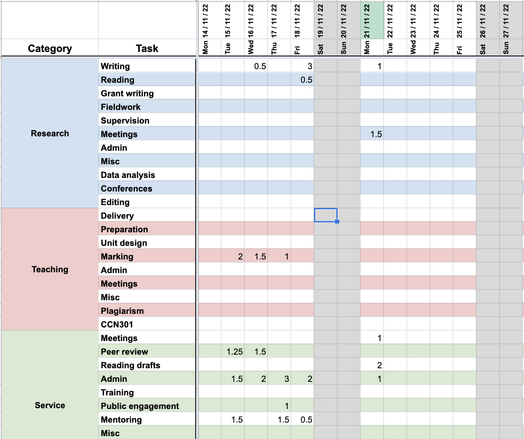
For a few years I've been maintaining and slowly improving a Google Sheet template to help #academics (particularly salaried academics) track how much they are working, and how this work is distributed. I've just updated the template for 2023.
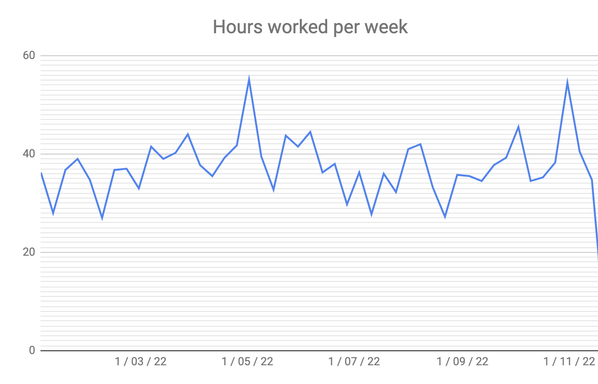
The reason for this is academic #workloads are often left very abstract and vague, usually measured in 'percentages' with only the loosest connection to time and the actual number of hours you are paid to work. I find that tracking my hours helps to reassure me I am doing enough work in some aspects of my job (in #research, for instance), and also help prevent me from overworking.
For example, this year, I know I have worked 61 hours more than I have been paid for thus far. This means in December, once marking and everything is wrapped up, I'm just going to tap out and do pretty much no work for a couple of weeks (just keep an eye out for urgent emails), but also not take leave. Because those are hours I'm owed. So by the end of the year, I should be back close to zero hours overworked.
Some academics hate counting hours as bean counting or volunteering into surveillance. I get that. But considering how the ever-intensifying exploitation of academic staff relies on #university management obscuring and intensifying our work, I find tracking how much I've actually worked incredibly empowering.
With the new year, maybe consider tracking your own #academic work!
The template: https://docs.google.com/spreadsheets/d/1W-w_pbJgsemr5vznErqqNG5UJsfxeiPUNgG8f6pXyfg/edit#gid=1226213337 #commodon

Academic Work Tracker Template v2.1 (2023)
Instructions INTENT OF THIS SPREADSHEET Universities allocate workload and evaluate performance based on metrics that are often arbitrary and obscure. Within these metrics, the extensive time spent on tasks such as emails, meetings, reading, and thinking is inadequately accounted for. Consequen...
 Anne Oeldorf-Hirsch