In Super Mario 64 to achieve the infinite stairs effect, Mario gets teleported back. Also the reason why Speedrunners can glitch and skip it using the backwards jump trick. #gamedev
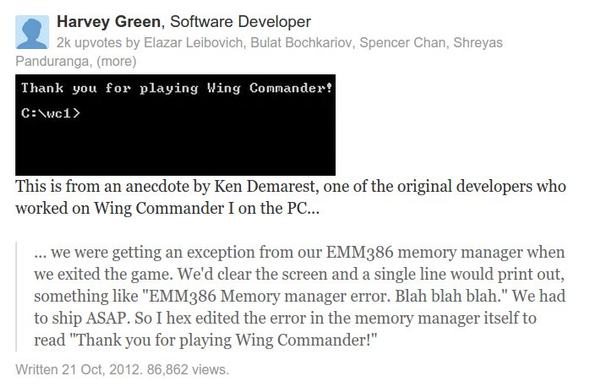
There was a memory exception in Wing Commander on exit, because of the deadline they left it but change the error message to "Thank you for playing Wing Commander!" #gamedev
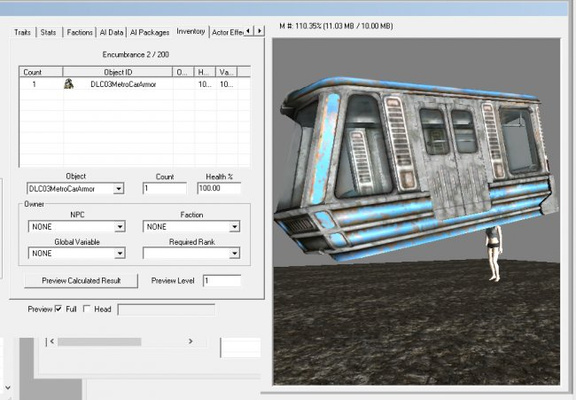
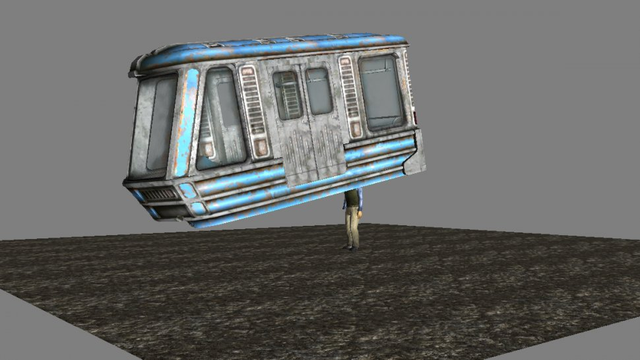
In Fallout 3 the Trains are actually a character wearing a train model as a hat. Engine didn't allow for vehicles, so this way they could reuse NPC movement code. #gamedev
Here's one of my fav, in Zelda: A Link Between Worlds because a true top-down view in 3D would have perspective issues, they purposely tilt the objects, so the perspective looks good to the player from top. #GameDev
Duke Nukem 3D mirrors reflection were achieved by duplicating the room on the other side. If you deactivate clipping you can go to the other side. True reflections are computational intensive even today #GameDev
In NBA Jam: T.E. for Genesis/Mega Drive developers only found out after making the 250k cartridges, that there was a save bug. But playing the game in a certain order fixed it, so it got a day one "patch" in the manual saying how to initialize memory. #GameDev
In Super Mario Galaxy when Mario drowns in a swap his hand reaches out, but because of the size of the head devs had to shrink it so only the hand is visible to the player #GameDev
World of Warcraft rest bonus was made to encourage breaks, half XP gained after a few hours. Players hated, so they made everything take 2x as much XP to achieve but you start at 200% XP and gradually back to 100%. Same thing & players are happy. #GameDev
In Duck Hunt the NES Zapper worked by blacking out screen & drawing white blocks around targets when you fire, for a couple frames. The diode in the Zapper detects the change in light intensity and tells the computer if it’s pointed at a lit target. #gamedev#retrogaming
In Metal Gear Solid 1, another reflection trick. Water puddles are just a transparent texture with the geometry of ceiling and walls duplicated and inverted below the ground. That's why we can't see Snake reflection in puddles. #gamedev
In Prince of Persia (1989) animations looked fluid & realistic because @jmechner used Rotoscope. He filmed his brother doing the stunts, took pictures with a camera, had them developed at Fotomat and then traced them, frame by frame. #gamedev
Sega Saturn used Quads instead of triangles (the industry norm) for rendering, which is good for 2D but not as practical for 3D, devs had to work around that, so games like Tomb Raider had to be built to support quads on Saturn and triangles on PlayStation #gamedev
In Dead Space menus and UI is all made with particle systems so it can sort during render, glow so that they could place it in-game and be more immersive. #gamedev
This is easily one of the best, on OG Xbox, Elder Scrolls III would occasionally reboot the Xbox if they ran out of memory. The user would just see a longer then usual loading screen. #gamedev
Lord of the Rings game needed large areas with a sort of goal at the end, so developers grabbed the Tiger Woods golf game and turned it into LOTR game. #gamedev
@vactro it’s a bunch of particles forming the user interface we see in game. He mentions that they had to make a font renderer in the particle system for example.
@djlink I love seeing all the tricks that come out of gamedevs getting the most out of less powerful hardware! I feel like many games these days just take advantage of the more powerful hardware and don't optimize much at all.
@ima I think as games get incredibly more complex there is less time for issues that hardware can power through sometimes. A cool thing from before is that sometimes limitations led to very creative solutions in also gameplay things.
@djlink That's so interesting! Wasn't Virtua Racing and Virtua Fighter 3D engine also based on quad? That may be a SEGA thing, I wonder what other game or system also worked the same way
@djlink right this refers more to the texture mapping technique which really did distort an alighned quad in texture space into a quad in screenspace. more pleasing perspective aproximation in some cases but awful for clipping. both "1st 32bit 3D gen" machines had problems with perspective texture really. grouping 2 tris as a quad can be nice generally. artists try to make clean quad meshes for anim/tetxure control
I came across the presentatino here
http://www.extra.research.philips.com/graphics/
and the images produced aren't too bad and was interested on exactly how the forward texture mapping actually works.
@djlink found the saturn interesting in many ways.. kind of regret not actually getting around to doing anything on it (and it would be a great retro dev target - lowpoly 3d+pixel art) - but "triangle machines" were clearly going further .. wasn't worth the effort
@pjperez that's incorrect, Sega Saturn has 3D capabilities, it actually has 2 Hitachi SH-2 CPUs because during dev they realized 1 would not cut it to calculate 3D math etc.
@4ScarrsGaming I didn't know that either. I knew they wanted the 2d, but if memory is correct the 3d was slapped on in response to playstation doing 3d.
@djlink this one is also used in Tony Hawk games! I seem to recall they even went as far as cloning the player so they got reflected too, but my brain might be lying to me as there's a lack of coffee. :)
@djlink If you want to see a demo of it in THPS, there's a video of it at 7:46 of this video (sorry, YouTube Vanced isn't letting me link with timestamps) :) Fun video in general, lots of illusions are done behind walls etc. :) https://youtu.be/-1BoG3yPnu0
@djlink IIRC Spyro Year of the Dragon did the same thing for ice, except they also had a duplicate character rig moving around on the other side to give fake character reflections. That's also how the mirror room in Super Mario 64 was achieved.
@djlink I'd say this trick is valuable even today, if you don't want to mess with real-time reflections, for mobile games for example. Making people "reflect" in them would be trickier though.
@djlink ah of course. I remember being a kid and seeing the flash of the squares, knowing I was getting a small glimpse behind the curtain, but having no idea what to make of it. Early console devs were so clever.
@djlink@thegrugq there seems to be some magic in knowing which bird was shot. Initially I’d say it was time based from the alternating white blocks but that seems problematic without some kind of timing circuit in the gun
@djlink@corsac No, you couldn't. Because the description is missing a crucial step: first the game blanks the screen, and checks the gun for seeing *no light". And THEN it draws a square, and checks for it. Which is why shooting a lightbulb wouldn't work.
 David Amador



 pinecones
 Sofia "Soficious" 🎮🏳️🌈
 David Gavilan
 vactro
 Chuck Jordan
 Fox Chaotica
 ima
ima 🚩 Green Hill Autonomous Zone
 NIGHTEͶ ∆
 Sebas van den Brink
 walter4096
 PJ Perez
 4ScarrsGaming(Jon Scarr)🇨🇦🎮
 xNASAdev
 Retrostage
 Adam - The Funny Brain
 Connor Cadellin
 Darth Biomech
 Morgan Loomis
 Brian Louden
 Clive Blackledge⁷
 Corsac
 Anatoly Shashkin💾
 AMS
AMS Michiel Toneman
 Gavroche
 Ted Martens
 Jordan
  helix2301
 TacticalTechyTaky
 Eric Corps Conscient