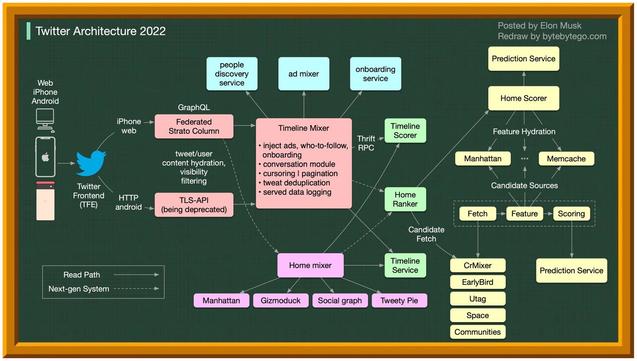

Elon Musk tweeted an image on a whiteboard from a "Twitter HQ code review" that wrapped up early Saturday. The image has attracted nearly 12k upvotes and over 1,000 comments over at the subreddit r/ProgrammerHumor, under the title "Twitter for Dummies". The image itself is an architecture schematic, not code. I put it on a Miro Board and Luke Dubois and Mark Hansen helped annotate it. If you're curious how Twitter's bits work, check it out here: https://miro.com/app/board/uXjVPBnTJmM=/?share_link_id=748653261357
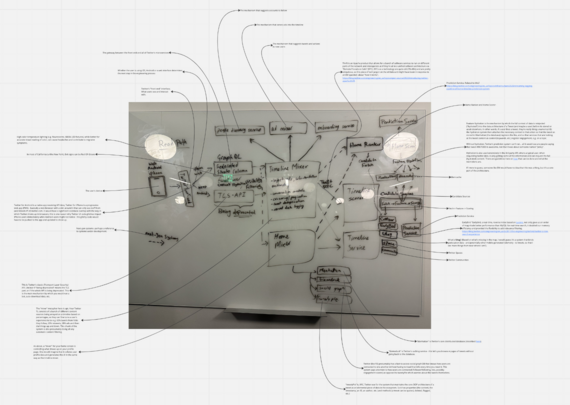
Twitter Architecture

miro.com
@justinhendrix so three weeks in, and after firing a vast majority of the company, he finally decides to see how Twitter works. A+
@mrkampmann @justinhendrix and after shutting down 80% of the services!! did they just throw darts blindfolded to figure out what to turn off?
@justinhendrix @mrkampmann my observation exactly. Isn’t this the first thing you do? Then win the hearts and souls of the devs. Then cull ruthlessly?
@justinhendrix this…looks like a pretty normal distributed system. Guess I’m not sure what I’d expect. It’s a thing like the others things we’ve worked on.
@shanselman @justinhendrix it's kind of reassuring to me. I feel like this is an architecture I might have been involved in.
@justinhendrix this feels pretty standard - possibly better architected than most distributed systems out there 😂

The fact the Musk called this a"code review" itself is bit odd, if not downright ludicrous. This is more like the outcome of an architecture review, and a very high level one at that. That Musk would call this a "code review" leads me to wonder how much he actually knows about building secure, reliable, and maintainable software.

In short, I don't think Musk has a clue about what a code review is, let alone how is supposed to work.

@musicologyman complete lack of code in the code review for a start
@justinhendrix This picture is only a small part of the overall system, ofc. Unless I'm missing something, It doesn't look at admin, moderation, history generation, support, &c. Your annotations are great!
@allenholub @justinhendrix for whatever reason, it seems like it’s the front end that he has a bee in his bonnet over.

@justinhendrix Anytime I see an architecture diagram, I can't help but think of the classic microservices video.

https://www.youtube.com/watch?v=y8OnoxKotPQ

Microservices

it's because of the way our backend works // merch: https://merch.krazam.tv// https://www.instagram.com/krazam.tv // https://twitter.com/krazamtv

YouTube
@justinhendrix This is a clear redesign of the architecture by bytebytego
@justinhendrix Thank you, what I understood from you notes was very interesting.
@justinhendrix Cool, thanks for doing that. The whole thing looks like a polite “you don’t know what you are talking about” Mr. Musk/boss.
@justinhendrix "why read the docs when the remains of the team can come in Saturday and show me"
@justinhendrix thanks for sharing. Seems fairly standard with the exception of the TLS API being deprecated - presumably they’re going to flip people across to the GraphQL implementation albeit that feels quite aggressive.
The Infrastructure Behind Twitter: Scale

The Infrastructure Behind Twitter: Scale

@justinhendrix I laugh at “hydration” every time. Been in tech for 23 years and I’ve heard all thesaurus euphemisms for “load the data” at this point.
@justinhendrix A popular interview question for system architects is, “design Twitter.” As ASP apps go, the architecture of the thing is relatively simple (assuming you blackbox things like timeline algorithms and advertising), but the question goes more toward handling chokepoints and managing performance over millions of hits per second.
@justinhendrix This is great and all, but don't you think this is something that should have been done first before anyone was fired?
@longobord @justinhendrix There should already have been documentation of all of this. But of course all the technical writers/architects are probably gone.
@ksoltys @justinhendrix I don't doubt that there was never a "big picture" view like this back when they had people to do documentation. It is rare that anyone not intimately familiar with one or more systems would need to know it.
@longobord @justinhendrix I worked on architectural docs in my last job at the Toronto Stock Exchange. They were mainly for knowledge transfer and to satisfy regulatory oversight requirments. They were also helpful for QA and troubleshooting.
@justinhendrix 🌟 for the comments about the lighting
@justinhendrix Loved the miro board addition
@justinhendrix Twitter Front End is their network connection multiplexer, not something that users interact with directly
@justinhendrix this was an interesting read, thanks!
@justinhendrix I found the commentary on signage building codes and lighting environmental effects to be most illuminating.
@justinhendrix it’s kinda funny how this undermines his “android makes thousands of requests” spat that he fired a dude over.
@justinhendrix @PadreSJ might be interested in this
@justinhendrix @rafelbev why keep bringing that storyline over here? 🐘😆
@justinhendrix this is quite enlightening. Thanks for sharing "Twitter for Dummies" with me (I admit being a Dummie).
@justinhendrix this is a great tool for reviewing other peoples work. Every government or major corporation that puts out a press release should be reviewed in this way. Adds a lot of context.

@justinhendrix @canadiancharity
Reading through this thread, this post exemplifies what I used to use the Quote feature for. It was perfect to say an "aside"; that is, a comment relevant to the main thread but not precisely about the heart of the thread.

When I found people who used the tool to disparage, I'd usually just scroll on by, or block.

And, I agree about the micro board! It reminds me of mind-mapping to take notes.

@justinhendrix This looks like it encompasses only the top-level components in the main request path. As usual, only a few bits of deeper infra (network, storage, OS, provisioning, name service, auth*n) even get passing mention. Monitoring, alerting, tracing, performance analysis tools, dev tools are omitted entirely. Ditto for "offline" processing, which AIUI is substantial. What percentage of Twitter code does this represent?
@justinhendrix Very interesting to a tech hanger-on like me. Thanks!
@justinhendrix Think they are on a path to open-sourcing Twitter?

@justinhendrix What's missing from this high-level overview are the infrastructure components. What's doing the orchestration and launching/restarting/deploying all of the dozens/hundreds of application instances? Simple stuff like DHCP servers, DNS servers, load balancers. How does the horizontal scalability work for each of these components? It's the interdependencies that are often the most interesting and brittle.

"Doors and corners kid. That's where they get you." #TheExpanse