Both Husker Women and Men have the Aggies first round. It was like it the selection committee was like, "what could break records for viewing in the first round?"
David Kampmann
- 43 Followers
- 61 Following
- 79 Posts
L&D | Family | #SouthDakota. I love to talk about #history, #politics, and all kinds of random stuff. #TeamPete
Just another reminder, that so much of our infrastructure is fragile. Mostly because large corporations decided to pocket their wealth instead of reinvesting in the people, and in the systems.
https://apple.news/A_JWnOs03TvqMF5lhFMGwDw
https://apple.news/A_JWnOs03TvqMF5lhFMGwDw

What kind of raw deal is this weather? It is August. My favorite month and a warm one for South Dakota usually. I have 4 days of 70 something degree weather to look forward to. Not a fan.
 Approaching Forgiveness
An alley door downtown #Ypsilanti, #Michigan
Vertical photo
🖤 🤍
#SilentSunday
#MastoArt #Monochrome #Photography
#Urban #Americana
Well. I don’t know if this X thing is a stunt. But Twitter has passed on as far as I am concerned.
This sucks. Twitter was the one social media app I used and built a network. I do not celebrate its fall.
I hope Gen 2 of social media becomes an improvement on Gen 1.
 Steve Herman
Comedian Sarah Silverman and two authors file copyright infringement lawsuits against Meta Platforms and #OpenAI for allegedly using their content without permission to train #AI language models. https://www.reuters.com/legal/sarah-silverman-sues-meta-openai-copyright-infringement-2023-07-09/

Sarah Silverman sues Meta, OpenAI for copyright infringement
Comedian Sarah Silverman and two authors have filed copyright infringement lawsuits against Meta Platforms <a href="https://www.reuters.com/markets/companies/META.O" target="_blank">(META.O)</a> and OpenAI for allegedly using their content without permission to train artificial intelligence language models.
 Jerome G
 Sheril Kirshenbaum
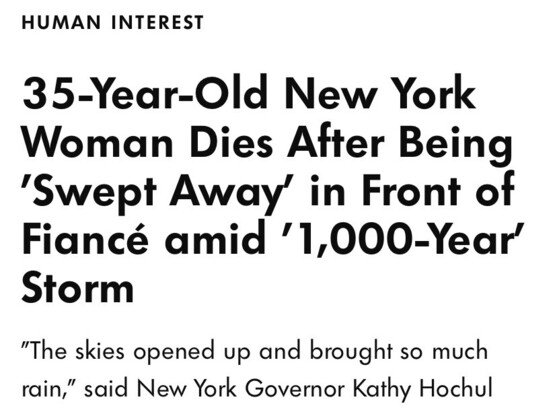
When “1000-Year” storms happen frequently, they are no longer anomalies. This is #ClimateChange.
 bonstewart
proud to share the BIG PAPER (ie core findings) from my data literacies study. it's open!
tl;dr - educators *do* understand the paradigm shift that faces us in higher ed right now, with datafied systems we KNOW we're not knowledgeable about. but none of this is designed to make us knowledgeable. we need to advocate for literacy & ethics-focused approaches to digital & datafied (& AI! oh my!) infrastructure or we hand over the sector to vendor control.
https://educationaltechnologyjournal.springeropen.com/articles/10.1186/s41239-023-00402-9

Barriers and beliefs: a comparative case study of how university educators understand the datafication of higher education systems - International Journal of Educational Technology in Higher Education
In recent decades, higher education institutions around the world have come to depend on complex digital infrastructures. In addition to registration, financial, and other operations platforms, digital classroom tools with built-in learning analytics capacities underpin many course delivery options. Taken together, these intersecting digital systems collect vast amounts of data from students, staff, and faculty. Educators’ work environments—and knowledge about their work environments—have been shifted by this rise in pervasive datafication. In this paper, we overview the ways faculty in a variety of institutional status positions and geographic locales understand this shift and make sense of the datafied infrastructures of their institutions. We present findings from a comparative case study (CCS) of university educators in six countries, examining participants’ knowledge, practices, experiences, and perspectives in relation to datafication, while tracing patterns across contexts. We draw on individual, systemic, and historical axes of comparison to demonstrate that in spite of structural barriers to educator data literacy, professionals teaching in higher education do have strong and informed ethical and pedagogical perspectives on datafication that warrant greater attention. Our study suggests a distinction between the understandings educators have of data processes, or technical specifics of datafication on campuses, and their understanding of big picture data paradigms and ethical implications. Educators were found to be far more knowledgeable and comfortable in paradigm discussions than they were in process ones, partly due to structural barriers that limit their involvement at the process level. Graphical Abstract
For all my higher ed friends. I applied for a Coursea position. If you have any colleagues there, I would appreciate a shout out.